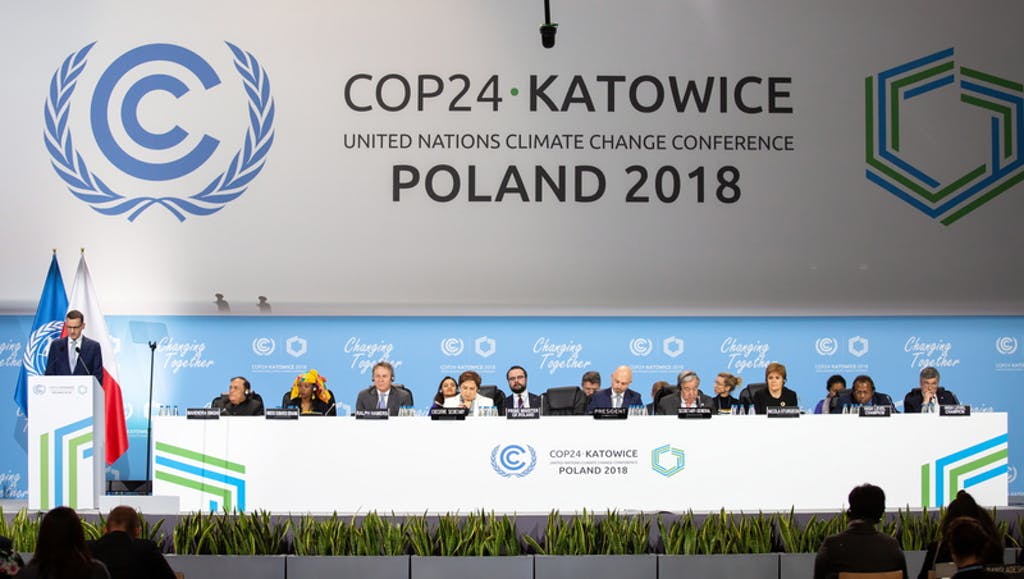
The 24th UN Climate Change Conference is taking place in Katowice from 2 to 11 December 2018. At the meeting in the Polish city it will be decided what rights and obligations individual countries will have in order to achieve the goals set in the Paris Agreement of 2015.
For 11 days, politicians and experts from all over the world will discuss the pressing climate issues in Katowice, a small industrial city located in the heart of Poland’s coal-mining industry.
The World Bank doubles funding for combating climate change
A week ago, the World Bank announced that it would provide 200 billion US dollars (176 billion euros) to countries that need assistance to adapt to the effects of global warming and to reduce their greenhouse gas emissions. The funds will be available in the period 2021–2025. The financial support is twice the amount granted by the World Bank for the first 5-year period after the signing of the Paris Climate Agreement.
In addition, developed countries have pledged that from 2020 onwards, 100 billion US dollars per year from private and public funds will be made available. It is still unclear exactly to whom these additional funds will be directed and what commitments will be undertaken in the framework of the common climate policy.
The UN calls for much more decisive action to combat climate change
At the 24th annual UN Climate Change Conference, which is being held in Poland, the main topic is once again the goal set at the Paris conference in 2015 – to limit global warming to 2°C compared to the pre-industrial era. But the world is far from these imperative changes. The United Nations warns that in recent years global warming of 3° to 5° degrees has been observed, and the reported greenhouse gas emissions give no indication of any change in the existing trends. Experts are calling for the introduction of a kind of “climate revolution”, otherwise they fear catastrophic consequences for the climate, the environment and humankind.
One of the main criticisms made by the UN towards the countries participating in the current global meeting is that governmental climate targets differ greatly from one country to another and that climate is not among the priority political objectives of the respective governments.
It is necessary to determine specific steps to limit global warming for each individual country, because so far the conclusions from the reports have functioned more as recommendations than as clearly defined obligations.
New rules
At the annual session of the UN Climate Conference, the Secretary-General of the world organization, António Guterres, called for even more ambitious measures against climate change. A number of countries, however, are opposed, including Bulgaria. According to Guterres, there will be no possibility to achieve what was promised in Paris for 2020. At the same time, climate change is a dynamic process that requires the imposition of new, much more drastic measures to limit the lasting consequences in the complex climatic situation.
Within the framework of the meeting in Katowice, a “rulebook” will be presented, the purpose of which is to define the technical implementation of the Paris Agreement. The difficulties stem from the fact that more than 180 countries that have signed the Paris Agreement must agree on a unified system that will present in an unambiguous way the results of the measures applied in the field of climate change. The conference will determine which countries can strengthen their climate protection targets in the future. As climate expert Adam Pawloff from “Greenpeace” warned, it is “extremely important” not only to define new climate protection targets, but also to monitor and comply with them.
The focus of the event will fall on the topic of coal. It is no coincidence that Poland was chosen as the venue for the world-level conference, where 80% of the electricity produced comes from coal-fired power plants. This places the country among the leading polluters in Europe. Under Poland’s overall climate change policy, coal consumption is expected to decrease by 60% by 2030, but in practice these recommendations are almost unachievable, judging by the structure of the Polish economy. Nevertheless, Poland stands behind the idea of a “just transition” from fossil to clean fuels. The host country has proposed a declaration emphasizing the need to ensure a future for workers affected by the transition.
Germany is also under some pressure from the common European climate policy. The intention of the German participants in the conference was to present a plan as an alternative to coal consumption, but the vote on it was postponed until February, when the German government expects to reach agreement on the issue with all federal states. At present, the eastern German states are still opposed to eliminating coal as a main source of energy in developed economies.
The political situation is complex
The summit in Poland is taking place in a complex political environment, because after the great successes in Paris, the world has returned to the starting position regarding the agreed arrangements in the field of climate.
US President Donald Trump has completely blocked the implementation of the commitments undertaken, after withdrawing from the agreement and rejecting the reports signed in Paris. The problem is that the USA is the second-largest global polluter after China and its decisions will always be leading. The future president of Brazil, Jair Bolsonaro, is also considered a risky player who firmly supports the American position. After taking office, the new president intends to ease the current restrictions introduced for the protection of Brazil’s tropical rainforests. During his election campaign, Bolsonaro promised to withdraw his country from the Paris Climate Agreement and called for active support for companies engaged in the mining sector and agribusiness, whose activities extend into protected areas of endangered forests.
In addition, days before the start of the 24th international climate conference, global news agencies reported that the Latin Americans had withdrawn their proposal to host the next climate summit.
Another interesting fact is that during the past week an unusual coalition blocked the joint decision of all governments on the report of the Intergovernmental Panel on Climate Change (IPCC) from October, initially presented in South Korea. The USA, Russia, Saudi Arabia and Kuwait did not vote on the decisions in the report, which warns of the increase in the Earth’s temperature. The document also states that in order to keep the temperature increase below 1.5 degrees, measures are needed that will lead to a reduction of carbon emissions by 45% by 2030.
The position of Austria, which holds the EU Presidency until the end of 2018
From the point of view of the Minister of the Environment Elisabeth Köstinger (Austria), this year’s climate conference in Poland is the most important one. “This conference will show whether the Paris Agreement makes sense at all,” says Köstinger. Europe wants to play a leading role in taking important decisions such as those on climate change, but for this it needs the support of other countries. The President of Austria, Van der Bellen, who has been in Poland since before the start of the conference, invited European heads of state to sign a joint call to phase out the use of coal during the meeting. A total of 18 countries signed this appeal, among them large European countries such as Germany, France, Italy and Spain.
“There is no longer any serious politician who denies climate change,” Van der Bellen pointed out. That is why it is important that countries, even those the size of Austria, do not withdraw from the individual agreements concluded in Paris.
It is evident that in the Alpine republic there is a certain inconsistency in the political position not only on domestic policy issues, but also on matters affecting international well-being such as the environment and climate change. A few days after the start of the conference, in an interview for one of the major Austrian daily newspapers, Austria’s Vice-Chancellor Heinz-Christian Strache stated that the extent to which people can influence the climate is a question with an unclear answer. “Climate changes have existed for millennia. The Sahara was once the granary of Rome and then became a desert. This is linked to many factors, but certainly not to the existence of factories, which did not exist then. There are processes that cause cooling and warming, but sometimes even science does not know what the causes are.”
The Bulgarian position
The President of Bulgaria, Rumen Radev, refused to support the declaration sent to him by Austria for the cessation of coal mining, because it does not correspond to the interests of the country.
At the same time, Bulgaria’s position regarding the Paris Agreement is unequivocal. Radev emphasized that measures to combat climate change are necessary and urgent, but they must be preserved in their original form, agreed and signed three years ago in the French capital, without additional tightening of the requirements, as some countries are insisting. The Minister of the Environment, Neno Dimov, who is part of the Bulgarian delegation in Katowice, defended the position in favour of cheaper electricity and preserving miners’ jobs.
One conference, many countries, no decisions
At present, the methods for measuring greenhouse gases play a substantial role in reducing and limiting their harmful impact on the climate. Unfortunately, they are defined only for “industrialised countries”; “developing countries” still have to build systems for reporting and complying with rules in this context. Therefore, the adoption of uniform or at least comparable methods for measuring greenhouse gases would be a significant step towards a common climate policy. But with each passing day of the conference in Poland, it becomes clear that it will be difficult to reach consensus in the field of climate, because each country is pursuing its own industrial interests, and climate change remains more virtual than real.