Ветрушка - Apera spica venti (L.) P.
Author(s): Растителна защита
Date: 13.11.2018
4996
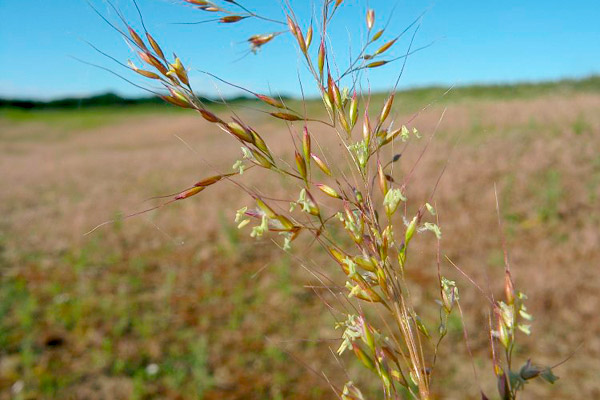
The stems are thin and smooth, erect and less frequently geniculate-ascending, with a height of 50–120 cm. From one tuft 4–10 stems emerge. The leaves are 2–5 cm wide, furrowed, and rough along the margins. The sheath is deeply cleft, smooth, with a ligule and without auricles. The inflorescence is a panicle. The spikelets are one-flowered, small, green or coloured to varying degrees in violet. The glumes are lanceolate, with the lower being shorter than the upper. The lower lemma is slightly shorter than the glumes. Towards its upper part it is ciliate-pubescent, with an awn. The fruit is a caryopsis, tightly enclosed in the lemmas, which are straw-yellow with a violet tinge. The grain is oval, elongated and pointed.
It reproduces by seeds, which germinate in the soil at a temperature of 10–120C at a depth of 2–5 cm. It flowers and fruits from June to September. A single plant forms on average 9,600 (up to 84,000) seeds. It develops on moist soils and withstands only mild drought.
Windgrass infests winter and spring crops with a solid stand, row crops, flax, alfalfa, clover and grass mixtures. It develops on grey, brown and cinnamon forest soils.
In our country this weed is distributed in the foothill and mountainous areas up to 1,600 m above sea level. With increasing altitude, the density of the species also increases and the habitus of the plants changes, i.e. they become taller, with a larger number of tillers and much larger panicles.
It is used as a forage plant.