Black-grass - Alopecurus myosuroides Huds.
Author(s): Растителна защита
Date: 13.11.2018
5606
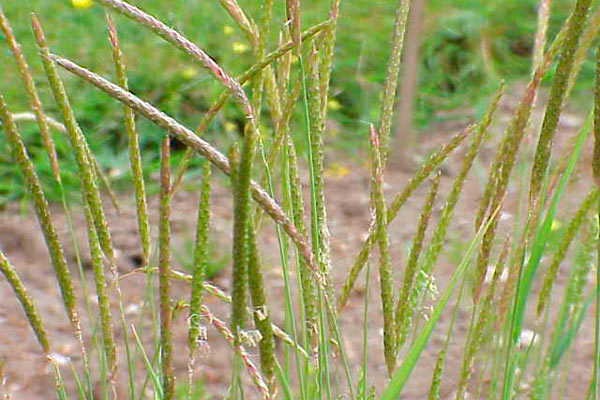
The stems are erect and less frequently prostrate, single or with 3–10 tillers, with a height of 50–90 cm. The leaves are flat, lanceolate, with a striated and glabrous blade. The sheath is slightly rough from the base upwards, and in the upper leaves it is slightly swollen. The ligule is thin and serrated, without auricles. The inflorescence is a narrow and cylindrical light-green false spike, pointed at the top, with 1–2 spikelets. The spikelets are one-flowered, elongated-elliptical, light green to purple. The glumes are one or two, fused at least to their middle, with very short silvery-white cilia only along their central dorsal edge, and the lower lemma has a long awn attached at its base. The grain is flattened, elongated-ovoid, lemon-yellow. Seedlings: the first leaf varies in length and is pointed at the tip, and the second is shorter. The coleoptile is light pink at the base and white towards the top.
It reproduces by seeds, which germinate in March–April at a temperature of 10–120C. The formed plants head simultaneously with the cultivated crop. It tillers weakly. In sparse stands it exhibits stronger tillering – up to 10–12 tillers per clump. It flowers and fruits from May to July. One plant produces on average 620 (up to 9300) seeds. They are dispersed in the soil, and part of them remain in the seed material. The species is thermophilic. It forms neotenic plants. It withstands spring droughts or soil crust formation after heavy spring rainfall.
Field foxtail infests winter cereal crops in solid stands, row crops, very strongly old lucerne stands, clovers, sainfoin, grass mixtures, vineyards and orchards. It develops on all soil types. In our country it is distributed in the lowland areas and up to 600 m above sea level.
It is used as a forage plant, especially in the southern regions of the country, where it is a component of natural clover grasslands.