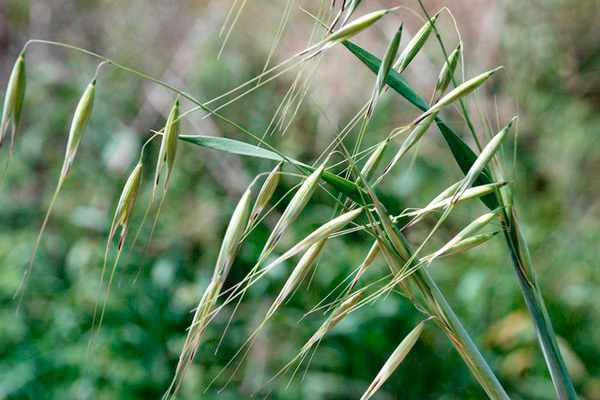
The stems are erect, slightly pubescent at the nodes, with a height of 80–120 cm. From a single plant, 2–7 tillers develop. The leaves are lanceolate, pointed, with cilia along their peripheral margin. The sheath of the lower leaves is usually pubescent and less frequently glabrous, with a ligule. The inflorescence is a loose panicle. The spikelets are large, drooping, with 3 florets and awns, and the glumes are identical. The fruit is a grain enclosed in the floral glumes, straw-yellow to dark brown in colour, with a thin longitudinal groove. Seedlings: the first leaf is light green, with hairs along its peripheral margin and clearly outlined veins on the blade, the ligule is short and membranous, and the coleoptile is grey-green. The subsequent leaves are almost glabrous.
An early spring weed that successfully overwinters in milder winters. It reproduces by seeds, some of which germinate in autumn (September–October) at a temperature of 15–18 0C, and others after overwintering (March–April) at a temperature of 6–10 0C. The seeds have a dormancy period of 3–4 months, with mass infestation occurring from the spring germination of the seeds. It flowers and fruits from June to July. The largest seeds are in the lower part of the panicle. Their dormancy period is 2–2.5 months, germination is uniform, and the plants developed from them are early maturing. In the soil, the seeds retain their germination capacity for over 3 years. A single plant produces 200–300 (up to over 3000) seeds.
Wild oat infests winter and spring cereal crops with a solid stand, as well as poorly cultivated row crops, vetch, flax, young alfalfa, clover, grass mixtures, vineyards, vegetable gardens and field margins. It develops on all soil types, but predominates on their lighter variants.
In our country it occurs up to 850 m above sea level.
Up to the heading stage it is a good forage plant.