Issue 8-9/2018 of the journal "Plant Protection"
Author(s): Растителна защита
Date: 26.09.2018
29264
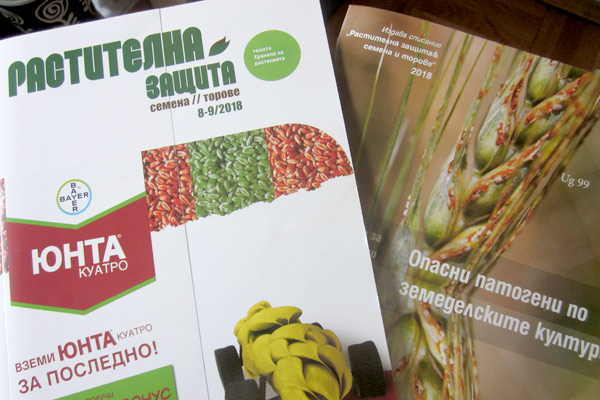
See which topics are current in this issue.
For the topic of the new autumn issue of the magazine “Plant Protection” our team has chosen the management of plant nutrition, which is attracting increasing interest from modern agriculture, faced with numerous challenges. Along with the question of how the growing population will be fed, climate change and the loss of agricultural land, agricultural science is beginning to engage actively with the ecological intensification of agricultural production. This is a process in which there is a simultaneous increase not only in yields, but also in the environmental compatibility of the produce, with a focus on soil fertility and the production of foods that provide important minerals and organic substances for maintaining the body and the proper functioning of the organs of the world population participating in the food chain. To address the problems of mineral deficiencies in humans, scientists use cultivation agronomic practices and plant nutrition management methods that increase the concentration or bioavailability of mineral elements in agricultural produce.
Therefore, in this issue we focus on the importance of balanced fertilization and soil fertility as a guarantee for high yields. A decisive role in the proper nutrition of plants is also played by the concept of chemigation, which is a promising alternative for the application of agrochemicals through irrigation water.
The issue also addresses the topic of precision agriculture not only as the future of modern agricultural production, but also as an alternative solution to the problem of inaccurate soil sampling from agricultural land and, accordingly, the inadequate understanding of the needs of plants at a specific location.
Under the current fertilization system, plants receive an average dose of nutrients, which for some of them is optimal, while for others – excessively high. In this way, the efficiency of fertilization decreases and funds are lost due to the ineffective use of fertilizers by plants. In plants that have received a lower than necessary fertilizer dose, reduced quality and lower yield are observed, while fertilization with doses higher than necessary may lead to yield reduction under the influence of diseases, pests and adverse weather conditions as a result of excessive crop development.
Topic
M. Nikolova – Management of plant nutrition – modern approaches
S. Kostadinova, M. Nikolova – Balanced fertilization of the main field crops is a guarantee for high and stable yields
I. Manolov – The experience of the fruit grower is of great importance
I. Mitova – The choice of fertilization is an important element of the cultivation technology of medium-early tomatoes
K. Kumanov – Chemigation – a promising alternative for applying agrochemicals with irrigation water
I. Manolov – Increasing soil fertility in organic farms is a long-term process
V. Kutev, M. Stoyanova – Precision agriculture is the future of modern agricultural production
Pests
A. Harizanov, A. Harizanova – Cereal mealybugs
Quarantine
E. Dimitrova, M. Dimova – Newly detected pest of phytosanitary significance for the entire European Union
Attention
L. Dimitrova – 2018 is the year with perfect conditions for the manifestation of potato wart disease
Magazine within the magazine
A. Harizanov, A. Harizanova – Exocrine and endocrine system in insects – glands, types, functions.
Traffic light
M. Borovinova, I. Lecheva – In the orchard in September: Chemical treatments are reduced
V. Yankova et al. – It is time for disinfection of greenhouses
Events
*** Arysta LifeScience offers: Top-class protection of vineyards
*** BASF: Agricultural solutions that create new opportunities for investment and growth with
- BASF oilseed rape hybrids
- Systiva – 360° protection from sowing to spring at 3.6 BGN per decare
School for specialists
Prof. Maria Borovinova – Dangerous fungal pathogens on cherry and plum
The magazine „Plant“ Protection Seeds and Fertilizers is not responsible for the information presented in the published advertisements and PR materials. Responsibility for their content lies entirely with the advertisers. The authors of the articles are responsible for the information in the authored materials.