Categorisation of the pest Grapholita packardi for the territory of the European Union (EU)
Author(s): гл.експерт Татяна Величкова, Дирекция "Оценка на риска по хранителната верига", ЦОРХВ
Date: 27.08.2018
8517
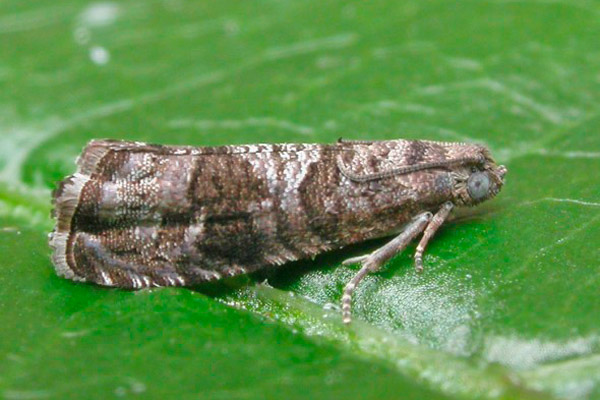
The Panel on Plant Health of the European Food Safety Authority (EFSA) has carried out a categorisation of the pest cherry fruitworm (Grapholita packardi).
Grapholita packardi is listed in Annex IIАI to Council Directive 2000/29/EC[1] under the synonym Enarmonia packardi and is not known to occur in the EU as a pest that poses a risk.
Grapholita packardi is a well-identified multivoltine[2] pest, a polyphagous[3] species, of the order Lepidoptera (Lepidoptera), family Tortricidae (Tortricidae). It causes damage mainly to cherries (Cerasus avium) and blueberries (Vaccinium corymbosum), but damage has also been reported to apples (Malus domestica), pears (Pyrus communis), plums (Prunus domestica), quinces (Cydonia oblonga), sour cherries (Prunus cerasus), peaches (Prunus persica) and wild plants such as hawthorn (Crataegus). Damage is caused by the larvae, which feed on the interior of the fruits of blueberries, cherries, peaches, plums and hawthorn. On apples, damage is mainly to actively growing shoots, and there are few data on damage to the fruits. The damage caused by the larvae impairs the quality of the fruits, reduces yield and their market value.
Grapholita packardi is widely distributed in the USA and has a limited distribution in Canada and Mexico.
In the 2018 global database of the European and Mediterranean Plant Protection Organization (EPPO) it is reported that Grapholita packardi is absent from the EU. The pest is listed in Annex II, Part A, Section I to Directive 2000/29/EC as a pest that is not known to occur in the Community, and its introduction and spread is prohibited in all Member States when present on plants of the genera Cydonia, Malus, Prunus and Pyrus, with the exception of seeds originating from non-European countries.
The pest could potentially enter the territory of the EU through host plants as plants for planting or through fruits originating from countries where infestation is established.
The host plants of Grapholita packardi (cultivated and wild-growing) are widely distributed in the EU and, taking into account the climatic similarities between North America and Europe, it is assumed that if the pest enters the EU it has the potential to establish and spread in its territory and to affect the yields of the host plants.
Measures and control methods.
The existing phytosanitary measures regulating Grapholita packardi for plants of the genera Cydonia, Malus, Prunus, Pyrus and Crateagus can also be applied to the other (cultivated and wild-growing) host plants of the pest.
The methods for controlling Grapholita packardi are:
• Agrotechnical control:
By carrying out pruning and soil cultivation between the rows in the orchards, the habitats where the larvae of the pest overwinter are minimised (after pruning, the branches are removed and destroyed, and with inter-row soil cultivation the weeds and plant residues around the plants are destroyed); already during harvesting, infested fruits are picked separately and destroyed; to preserve the natural enemies of the pest, plant protection products (PPPs) that are selective with respect to them are used.
• Biological control:
There are several parasitic wasps and flies of the families Trichogrammatidae, Ichneumonidae and Braconidae, which attack the eggs or larvae of Grapholita packardi. By selecting insecticides with lower toxicity to these parasitoids (such as Bacillus thuringiensis), the effectiveness of biological control will be increased.
• Chemical control:
Through chemical treatment of the codling moth (Cydia pomolella), the apple maggot (Rhagoletis pomonella) and other North American Rhagoletis spp. control is also exerted over Grapholita packardi. The pest can be managed through careful monitoring and the use of appropriate insecticides. The use of pheromone traps for monitoring adults and the history of damage in the area are tools that determine whether and when PPP treatments should be carried out. The most accurate way to determine the timing of spraying is to establish the beginning of egg-laying during fruit development.
Uncertainty
Although there is uncertainty regarding which wild hosts from the families Rosaceae and Ericaceae are involved and the economic impact that could result if Grapholita packardi becomes established within the EU, this uncertainty is not sufficient to call into question whether Grapholita packardi meets the criteria required to be considered a Union quarantine pest.
Conclusion
Grapholita packardi meets all the criteria assessed by EFSA to be considered as a potential quarantine pest for the EU. Since the pest is not known to occur in the territory of the EU, it does not meet the criteria assessed by EFSA for a regulated non-quarantine pest of the Union.
Relevance for Bulgaria
At present, the pest is not present in the territory of the EU and is therefore included in Annex IIАI to Directive 2000/29/EC as a pest that poses a risk. In view of the economic significance of the damage caused by Grapholita packardi, phytosanitary control measures are strictly observed in Bulgaria.
Source:
Pest categorisation of Grapholita packardi - https://efsa.onlinelibrary.wiley.com/doi/epdf/10.2903/j.efsa.2018.5304
Other scientific opinions and up-to-date information in the field of plant health, as well as risk assessment along the entire food chain, can be found on the website of the Centre for Risk Assessment in the Food Chain - http://corhv.government.bg/
[1] Council Directive 2000/29/EC of 8 May 2000 on protective measures against the introduction into the Community of organisms harmful to plants or plant products and against their spread within the Community.
[2] Multivoltine species – a species that develops several generations per year
[3] Polyphagous – a pest feeding on a large number of plant species