Multicolored grape moth (Lobesia botrana)
Author(s): Растителна защита
Date: 16.05.2018
10180
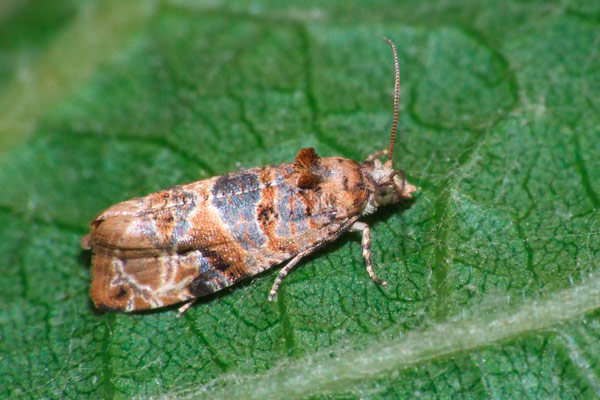
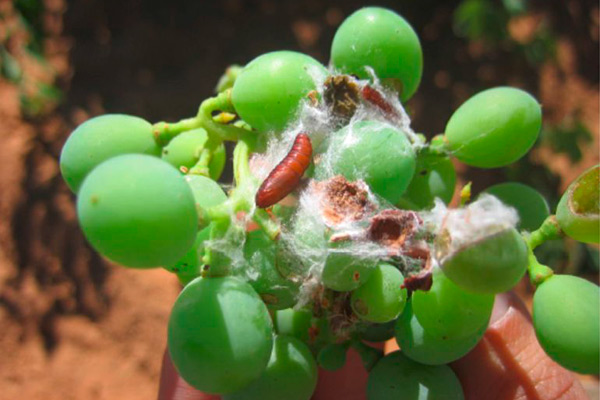
At the end of April and the beginning of May, inflorescence emergence in the vine is observed. During this phase, the harmful activity of one of the most dangerous pests – the European grapevine moth – takes place. The larvae of the first generation of the moth damage the inflorescences of the vine, which, at increased population density (ETL > 6-8 larvae per 100 inflorescences), requires timely treatment.
In June, the butterflies of the second generation of the pest are in flight. They lay their eggs on berries at the pea-size stage. The larvae damage the pea-sized berries by gnawing and consuming the interior of the berries together with the seeds. The damaged berries are loosely webbed with silk threads. A single larva damages from 7 to 24 berries.
From August to the second half of September, the flight of the butterflies of the third generation of the pest continues. The larvae damage the ripening and already ripe grape berries, webbing them with silk threads. As a result of the damage, conditions are created for the penetration of the causal agent of grey mould.
Strategy for pest control:
Treatment should be carried out at ETL: for table grape varieties 6-7 larvae per 100 pea-sized berries, and for wine grape varieties 11-12 larvae per 100 pea-sized berries.
Authorised plant protection products:
Afikar 100 EC – 40 ml/da; Decis 100 EC - 12.5-17.5 ml/da; Dipel 2X - 0.1%; Efcy-metrin 10 EC / Cyper 10 EC - 40 ml/da; Karate Zeon 5 CS – 0.02%; Coragen 20 SC - 18 ml/da; Mageos - 10 g/da; Rapax - 75-100 ml/da; Sumi Alpha 5 EC / Sumicidin 5 EC / Oasis 5 EC - 0.025%; Forey 48 B - 0.15%; Cyclon 10 EC - 40 ml/da; Cyperfor 100 EC - 40 ml/da; Citrin Max / Cyperkill 500 EC / Cypert 500 EC / Poli 500 EC - 6 ml/da; Sherpa 100 EW / Afikar 100 / Cyperfor 100 EW - 40 ml/da; Sherpa 100 EC - 40 ml/da; Delmur - 50 ml/da; Kedu - 40 ml/da;