Who damages the bulb crops?
Author(s): проф. д-р Стойка Машева, ИЗК "Марица" Пловдив; гл.ас. д-р Дима Маркова; проф. д-р Винелина Янкова, ИЗК “Марица” в Пловдив
Date: 12.04.2018
13780
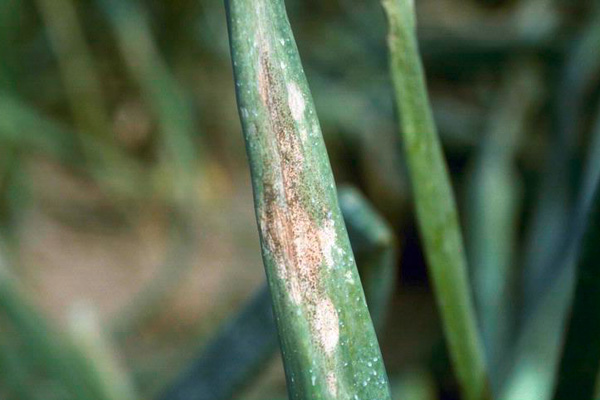
Downy mildew on onion, garlic and leek (Peronospora destructor (Berk.) Casp.)
This is the disease of greatest economic importance for onion. It attacks set onions, bulb onions and green onions, as well as seed production stands. From infected planting material, weak, chlorotic plants with curved leaves develop. At high air humidity, the leaves are covered with a loose violet coating formed by the sporulation of the fungus. Carried by air currents, the spores reach the leaf axils of healthy plants and cause new infections. Later, yellowish, sunken spots of scorched tissue appear on the leaves. Stemphylium allii secondarily colonizes them and they turn black. In wet years, the disease affects the entire leaf mass, and on the false stem it descends into the bulbs and infects them. It overwinters as mycelium in infected bulbs and as oospores in the soil. The spores of the fungus germinate in a water droplet at a temperature of 7-160C. It attacks leek and garlic to a lesser extent. Preventive treatments are applied when conditions are favourable for the development of the pathogen. Treatment is carried out after the appearance of the first spots: Acrobat Plus WG 200 g/da; Bordeaux Mix 20 WP 375-500 g/da; Zoxis 250 SC 80-100 ml/da; Corsate 60 WG 30-40 g/da; Melody Compact 49 WG 185 g/da; Orvego 70 ml/da; Pencozeb 80 WP 200-250 g/da; Pencozeb 75 WG 210-260 g/da; Polyram DF 180-220 g/da; Presidium One 83-100 ml/da; Ridomil Gold MZ 68 WG 250 g/da; Ridomil Gold R WG (valid until 31.06.2020) 500 g/da; Signum WG 150 g/da;
Purple blotch on Allium crops (Alternaria solani f. sp. porri Sor.).
Small watery spots with white centres appear on the leaves. They enlarge, turning brown to purple, with a red or purple margin and a yellow halo. Large spots may coalesce and cover the entire leaf. The tissue above the spots dies. The disease develops under conditions of high humidity. Sporulation takes place at night on the moist leaf surface. Control is carried out throughout the entire vegetation period: Bordeaux Mix 375-500 g/da; Zoxis 250 SC 80-100 ml/da; Ortiva Top SC 100 ml/da; Ridomil Gold R WG (valid until 31.06.2020) 500 g/da;
Onion fly (Delia antiqua Meig.)
In our country it is a specialized pest of onion, but it also slightly attacks garlic. The onion fly develops two full and a partially third generation. It overwinters as a pupa in the soil at a depth of 10-20 cm. The flight of the first-generation flies begins at the end of April. They lay their eggs on the leaves, on the bulbs and on the soil surface near the plants. Damage is caused by the larvae of the first generation. They bore into the plants at the base of the leaves. They make longitudinal galleries in the stems and move towards the bulb. Damaged plants lag in development, fade, lodge and finally dry out. As a result of the damage, the tissues ferment and emit an unpleasant smell of rotten onion. Several larvae can develop in a single plant, and if they cannot feed sufficiently, they attack the stems of neighbouring plants. Chemical control is aimed at the adults before egg laying, at a threshold of 5 flies/10 sweeps with an entomological net. The flies appear in spring during the flowering of sour cherry and dandelion. Spraying is carried out with broad-spectrum insecticides – Vaztak New 100 EC 0.03% and Meteor 0.08%.
Onion moth (Acrolepia assectella Zell.)
It damages onion, garlic and leek grown for fresh consumption and for seed production. It develops two generations per year. It overwinters as an adult insect and as a pupa in plant residues and other suitable sheltered places. Eggs are laid singly on the leaves and inflorescences of onion. Initially, the larvae scrape narrow strips, after which they penetrate into the leaves or flowering stems, feeding on the leaf parenchyma in the form of elongated strips without affecting the upper epidermis. As the leaves grow, the epidermis cracks. The caterpillars enter the inflorescences, bore into the flowers and part of the seeds dry up. Due to the damage to the flowering stems of onion and leek, the seed yield decreases and its quality deteriorates. Onion stands should be sprayed before the caterpillars bore into the tissues: 1st generation – end of May – beginning of June; 2nd generation – end of July – beginning of August. Effective insecticides are Vaztak New 100 EC 0.03%; Meteor 0.08% and Deka EC/Desha EC/Dena EC/Poleci/Decis 50 ml/da.
Leaf miner fly on Allium crops (Napomyza gymnostoma Loew)
It damages Allium crops, but the greatest and most noticeable damage occurs on leek. The leaf miner fly develops 3-4 generations per year. It overwinters as a pupa in leek stems, located at the end of the mine, and very rarely in the soil beneath the plant. Damage is in most cases detected after the harvest of the crop. In the area of the false stem, on the outer 3-4 leaves, almost straight mines directed towards the base are observed. As they grow, the stems of damaged plants crack lengthwise and through the cracks pathogens enter, causing rot. Sometimes the false stem of leek, damaged by the fly, turns pink and rots during storage. In the stems of heavily infested plants, between 5 and 15 larvae and pupae can be found. Chemical control must be directed against the adult flies, before egg laying. The larvae lead a concealed way of life and remain almost invulnerable to the products used. The most suitable moment is the period of mass flight of the flies – the end of March-beginning of April, before they have laid the main quantity of eggs. Suitable plant protection products are: Vaztak New 100 EC 0.03% and Meteor 0.08%.