

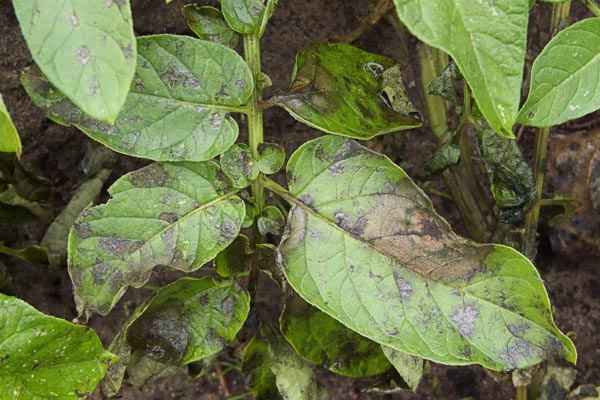
Potatoes are among the most widespread agricultural crops. Their high biological value and their broad use as food, feed and raw material for industry determine their important place in crop production. In Bulgaria, they are of great importance for the sub-mountainous and mountainous regions of the country, where potato production is the main livelihood for a significant part of the population. Yields, however, are among the lowest in Europe. The reasons for this are several – discrepancy between the biological requirements of the crop and the soil and climatic conditions in the predominant part of the areas; non-observance of key elements of the cultivation technology; use of low-quality seed potatoes and, not least, the high level of infection pressure in the country. Potatoes are attacked by a considerable number of diseases and pests.
Pests
Potatoes are attacked by several major pests of significant economic importance. They cause direct damage to the plants and tubers and indirect damage as vectors of viral diseases. The more important are: Colorado potato beetle (Leptinotarsa decemlineata) – causes direct damage by feeding on the leaves; aphids – many aphid species attack potatoes, but the most widespread and economically important are the green peach aphid (Myzus persicae), the buckthorn-potato aphid (Aphis nasturtii) and the potato aphid (Macrosiphum euphorbiae). In addition to direct damage, aphids also cause indirect damage. They are vectors of viral diseases of potatoes. Another pest of increasing economic importance is the potato tuber moth (Phthorimеa operculella). Control of this pest is difficult due to the concealed way of life of the larvae and its high reproductive potential. The following pests damage potato tubers: wireworms (fam. Elateridae); mole cricket (Gryllotalpa gryllotalpa); potato cyst nematodes (Globodera rostochiensis and G. pallida); root-knot nematodes (Meloidogyne hapla, M. arenaria, M. incognita and M. javanica).
Diseases
Viral and fungal diseases are of major economic importance. Some of them can be controlled chemically, while prevention of others requires observance of specific phytosanitary and agronomic requirements that contribute to the protection of the crop and the achievement of high yields. Viral diseases are of great economic importance in potato cultivation, especially in seed production. They cause serious damage to potato crops and are the reason for degeneration of seed material. Many of them are transmitted by aphids, therefore the presence of even a single infected tuber in a seed crop is sufficient for the crop to become virus-infected. The main viruses that damage potatoes are: Potato virus X – PVX (common potato mosaic); Potato virus Y – РVY (y-virus disease); Potato leaf roll virus – PLRV (leaf roll); Potato virus A – PVA (potato virus A); Potato virus M – PVM (potato M virus); Potato virus S – PVS (potato S virus). In addition to those listed, there are dozens of other viruses that damage potatoes. Under the conditions of our country, not all of them are of economic importance. Fungal diseases rank second in economic importance. In terms of harmfulness, some of them exceed the viral diseases. The main diseases caused by fungal pathogens that damage potatoes are: late blight of potato (Phytophthora infestans); early blight (Alternaria porri f.sp.solani); common scab (Streptomyces scabies); powdery scab (Spongospora subterranea); gangrene (phoma) (Phoma exiqua var. foveata). The listed diseases cause damage during the vegetation period. The fungal diseases that develop on potatoes during storage are dry Fusarium rot (Fusarium coeruleum) and gangrene (phoma) (Phoma exiqua var. foveata.) Bacterial diseases. The only bacterial disease registered on potatoes in our country is soft rot of tubers caused by Erwinia carotovora. It causes damage only during tuber storage.
Quarantine diseases and pests
The diseases of potatoes subject to monitoring and control in our country are Clavibacter michiganensis ssp. sepedonicus – causal agent of ring rot; Ralstonia solanacearum – causal agent of bacterial brown rot; Synchitrium endobioticum – causal agent of potato wart disease; Potato Stolbur MLO – stolbur; Tomato spotted wilt virus (TSWV) – tomato spotted wilt; Potato spindle tuber viroid – spindle tuber. The quarantine pests under observation are the Guatemalan potato moth Scrobipalpopsis solanivora Povolny, potato flea beetles – Epitrix tuberis, Epitrix cucumeris, Epitrix similaris, Epitrix subcrinita, and the nematodes: Columbia root-knot nematode – Meloidogyne chitwoodi and Meloidogyne fallax; the potato cyst nematodes – Globodera rostochiensis – golden potato cyst nematode; Globodera pallida – pale potato cyst nematode and Ditylenchus destructor – potato tuber nematode.