Pests in seedling production
Author(s): проф. д-р Стойка Машева, ИЗК "Марица" Пловдив; проф. д-р Винелина Янкова, ИЗК “Марица” в Пловдив
Date: 19.02.2018
5370
Greenhouse whitefly (Trialeurodes vaporariorum)
Damage is caused by the larvae, nymphs and adults. They suck sap mainly on the lower side of the plant leaves. During feeding, the larvae excrete large amounts of sugars in the form of “honeydew”, as a result of which the leaves become sticky. Sooty mould fungi develop and the physiological processes of the infested plants are disrupted.
Authorized plant protection products: Admiral 10 EC – 0.05%; Actara 25 WG – 0.03%; BI-58 – 0.1%; Vaztak New 100 EC – 0.03%; Deca EC/Desha EC/Dena EC – 50 ml/da; Decis 2.5 EC – 0.05%; Eforia 045 ZC – 125 ml/da; Confidor Energy OD – 0.08%; Mospilan 20 SP – 0.02%; Fury 10 EC – 0.02%; Naturalis – 75-100 ml/da.
Aphids (Aphididae)
Damage is caused by the adults and larvae, which suck sap from the lower leaf surface, the vegetative apex and the stems of the plants. In case of heavy infestation, the leaves curl severely and become deformed. The plants lag in their development. On the “honey dew” secreted by the aphids, saprophytic sooty fungi develop. Aphids are vectors (carriers) of viral diseases.
Authorized plant protection products: Mospilan 20 SP – 0.0125%; Actara 25 WG – 0.007%; Picador 20 SL – 0.05%; Confidor Energy OD – 0.06%; Biscaya 240 OD – 0.06%; Calypso 480 SC – 0.02%; Nexide 015 CS – 0.02%.
Thrips
In seedling production, tobacco thrips (Thrips tabaci) and western flower thrips (Frankliniella occidentalis) are mainly encountered. Damage is caused by the adults and larvae, which suck sap from the leaves and the vegetative apex. At the feeding sites, small silvery white spots with black dots appear. At high population density, the spots enlarge and merge with each other. The leaves dry out. The plants lag in their development. The nymphal stage of the pest occurs in the soil, and the eggs are laid in the leaf tissue. Thrips transmit the viral disease tomato spotted wilt (bronzing).
Authorized plant protection products: Fury 10 EC – 0.015%; BI-58 – 0.1%; Mospilan 20 SP – 0.02%; Sineis 480 SC – 10-25 ml/da; Naturalis – 75-100 ml/da.
Tomato leafminer moth (Tuta absoluta)
Damage is caused by the larvae. They prefer the leaves most of all. Symptoms of the presence of the moth are short and wide mines on the leaves, in which larvae and excrements located at one end can be seen. In case of severe infestation, the mines merge and the leaves dry out.
Authorized plant protection products: Avant 150 EC – 25 ml/da; Alverde 240 SC – 0.1%; Altacor WG – 8-12 g/da; Ampligo 150 ZC – 40 ml/da; Affirm 095 SG – 150 g/da; Voliam Targo 063 SC – 0.08%; Decis 2.5 EC – 0.05%; Confidor Energy OD – 0.08%; Coragen 20 SC – 14-20 ml/da; Mospilan 20 SP – 0.02%; Warrant 20 SL – 50 ml/da; Neem Azal T/S – 0.3%; Picador 20 SL – 0.05%; Rapax – 100-200 ml/da; Sineis 480 SC – 10-25 ml/da (20-25 ml/100 l water).
Leaf-miner flies
Among the leaf-miner flies, tomato leaf-miner fly (Liriomyza bryoniae Kalt.) and South American leaf-miner fly (Liriomyza huidobrensis Blanchard) are often encountered. During oviposition, the adults make numerous punctures with their ovipositor, mainly on the upper side of the leaf, and feed on the exuding plant sap. This damage is easily noticeable, as the tissue turns yellow, dries up and small pinpoint spots are formed. The hatched larvae bore into the leaf and feed, forming long, serpentine mines without affecting the upper and lower epidermis. The mines widen, intersect or merge. Only one larva is found in a single mine. The leaves turn yellow and dry out.
Authorized plant protection products: Trigard 75 WP – 0.02%; Picador 20 SL – 0.05% (at the beginning of the flight of the flies); Vaztak New 100 EC – 0.03% (against the adults); Sineis 480 SC – 25-30 ml/da.
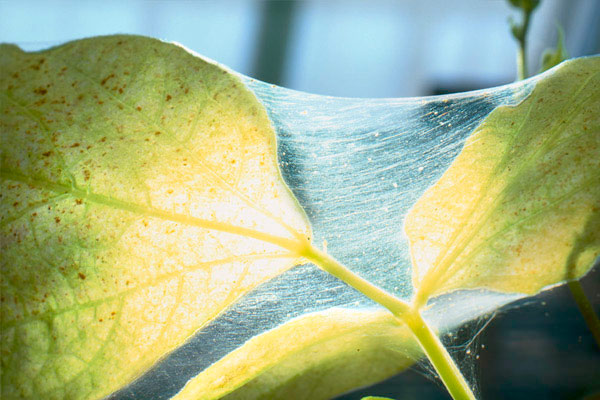
Two-spotted spider mite (Tetranychus urticae) Spider mites live and feed on the lower leaf surface. In case of severe infestation, the leaves are covered with webbing. The pest sucks sap and at the puncture site a pale green, pinpoint spot is formed. Later, the spots merge and the leaf becomes mottled, with a marbled appearance. Spider mites prefer older leaves with reduced water content, as well as senescent, drought-stressed plants. In case of severe infestation, the plants dry out.
Authorized plant protection products: Ortus 5 SC – 0.1%; Nissorun 5 EC – 0.06%; Floramite 240 SC – 40 ml/da; Sanmite 20 WP – 0.075%; Vertimec 018 EC – 60 ml/da; Neem Azal T/S – 0.3%.