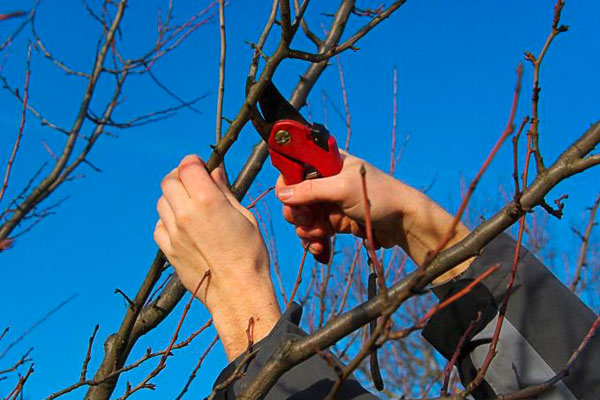
For pome fruit species, pruning is carried out during the winter dormancy of the trees, but for stone fruit species this is contraindicated, because they are more sensitive to injuries – cankers and necroses are formed, accompanied by gummosis. Wounds are an open gateway for various disease agents. Pruning starts with the pome species, while the stone fruits are left for the end of the period – in March, and peaches – at the bud formation stage, shortly before flowering.
For stone fruit species it is also very important to create a loose canopy by removing crossing branches. Good air circulation and the absence of moisture retention prevent the creation of favourable conditions for infections by shot-hole disease, blossom blight and fruit brown rot, and others.
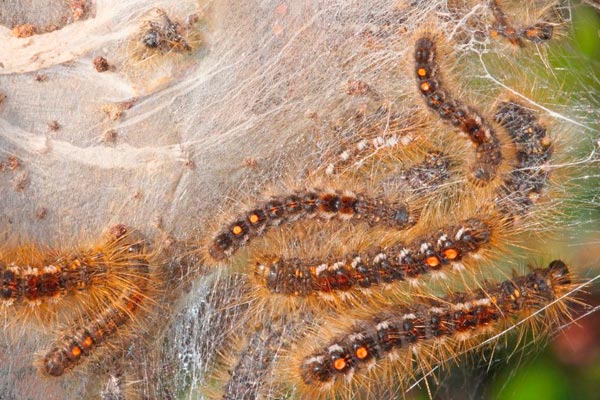
caterpillars of the brown-tail moth (Euproctis chrysorrhoea L.)
Sanitary pruning continues for the removal of shoots and branches with damage, cankers, any unnatural swellings, witches’ brooms (dense but thin twigs resembling a broom), which are observed most often on plum. Nests of the caterpillars of the brown-tail moth (Euproctis chrysorrhoea L.) and of the hawthorn moth (Aporia crataegi) are cut out. They are usually located at the tips of the branches and on the periphery of the canopies, formed by leaves woven together with webbing. During these prunings, the eggs of the lackey moth (Malacosoma neustria L.) are clearly visible; they are laid by the moth in a spiral around the thin twigs and resemble a little ring made up of a large number of greyish eggs, stuck one next to another. The egg masses of the gypsy moth (Lymantria dispar) on the tree trunks are also scraped off. The wound sites formed after scraping are best covered with a special orchard tree wound dressing.
During pruning, buds and shoots of apple infected with powdery mildew are removed by cutting them back to the base. Diseased buds are easily distinguished from healthy ones – they are more pointed and more open, and the one-year-old shoots are covered with a whitish mouldy coating. They have shortened internodes and a dead tip. Branches are inspected once again and any remaining mummified fruits, which are carriers of many infections, are removed. In apple and plum, suckers should be pruned out in particular, because some pests overwinter on them.
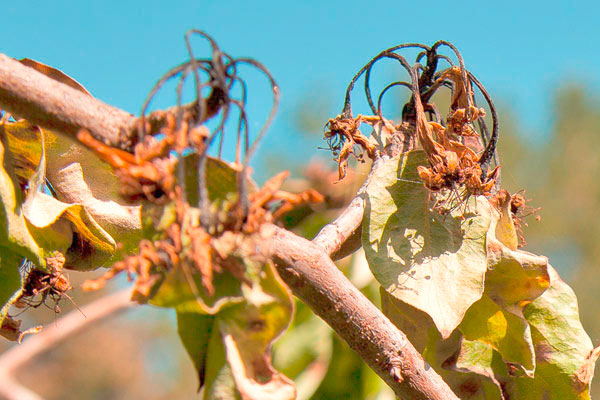
fire blight infection in pome fruit species
In case of established fire blight infection in pome fruit species pruning is carried out during the dormant period (the months of December, January and February) in dry weather. Diseased branches are cut about 70 cm below the site of infection and are burned after being removed from the orchard. Pruning tools should be disinfected in 10% bleach, formalin or denatured alcohol.
Immediately after pruning, wounds with a diameter greater than 2.5 cm are covered with oil-based paint, orchard tree wound dressing or a ready-to-use wound sealant (paste). This measure is mandatory, as it limits the entry of secondary infection and supports the process of callus formation.
The pruned branches are removed from the orchard and burned or shredded using a wood chipper and used as organic fertilizer.
In strawberries, the plants are cleaned, and the dried leaves are collected and burned.
In raspberry, hoeing is carried out around the bushes in order to bury the fallen leaves. All canes and shoots with various spots or growths are cut out. Spraying is carried out with 2% Bordeaux mixture.
In blackcurrant and redcurrant, hoeing is also carried out to bury the fallen leaves, and the shoots infested with powdery mildew are cut out. Their tips are darkened and distorted.
The orchard sanitation plan also includes: uprooting all dead and diseased trees, cutting off broken branches and cleaning up plant residues, loosening the soil in the tree circles. When planning the distribution of crops in the orchard, sowing or planting nectar-bearing plants should be envisaged; these provide shelter and food for a number of beneficial species that destroy large numbers of harmful insects and larvae. Nectar-bearing plants include alfalfa, clover, dill, lemon balm. It is also advisable to have shrubby plants in the orchard, in which insectivorous birds can nest.
The National Agricultural Advisory Service (Territorial District Office – Kyustendil), the Institute of Agriculture – Kyustendil at the Agricultural Academy prepared several online practical seminars in the experimental orchards of the Institute of Agriculture – Kyustendil in 2022 on the basic principles of pruning for fruiting and rejuvenation in cherry and plum in the experimental orchards of the Institute of Agriculture – Kyustendil. The “slender spindle” training system in apple will be demonstrated. Assoc. Prof. Sotirov, PhD, also demonstrates the “slender spindle” training system in apple.