Plant Protection Act
promulgated on July 31, 2014
Author(s): Растителна защита
Date: 24.11.2014
3359
A new Plant Protection Law has been promulgated. The law's objectives, the public relations it regulates, and the measures introduced at the national level for the implementation and application of the International Plant Protection Convention and EU acts in the field of plant protection are defined specifically and clearly. The activities carried out by the Bulgarian Food Safety Agency (BFSA) in its capacity as the competent state authority for official control in the Republic of Bulgaria under the meaning of EU legislation regulating plant protection requirements are precisely and exhaustively outlined. The powers of the control authorities in exercising subsequent control for compliance with the requirements established in the law and the types of public registers maintained by the BFSA in its capacity as the authorizing and registering authority under the meaning of the Law on Limiting Administrative Regulation and Administrative Control over Economic Activity are specifically defined.
Key emphases in the law are:
Integrated production of plants and plant products
The law creates conditions for plant protection through the application of plant protection products that pose the least risk to human health and the environment. To this end, the requirement to comply with the general principles of integrated pest management is introduced, providing persons who use pesticides in the course of their professional activity with the opportunity to use information regarding pest development, infestation levels, and their distribution range and to apply non-chemical alternatives to pesticides. The conditions and procedure for agricultural producers to carry out integrated production of plants and plant products through the application of integrated pest management guidelines are exhaustively defined. The law incorporates the possibility of encouraging professional users to apply, on a voluntary basis, the specific principles of integrated pest management for certain crops. These producers are given the opportunity, when labeling the produced plants and plant products, to mark them with a special sign certifying the method of production of healthy crops with the smallest possible impacts on agroecological systems. A new aspect is the transfer of part of the powers for monitoring, diagnosis, prognosis, and signaling to private consultant individuals. Under the control of the BFSA, agricultural producers are given the opportunity to monitor and conduct pest control on agricultural crops using the services of these consultants.
The requirements of Council Directive 2000/29/EC of 8 May 2000 concerning protective measures against the introduction into the Community of organisms harmful to plants or plant products and against their spread within the Community are introduced, and the measures for the application of Regulation (EC) No 1107/2009, which repeals Council Directive 91/414/EEC introduced by the currently effective law, are implemented. To prevent administrative violations under the law and to prevent and eliminate harmful consequences thereof, the institute of compulsory administrative measures is introduced upon detection of violations by the BFSA control authorities.
The use of plant protection products
According to the new Plant Protection Law, plant protection products are categorized into two use categories: professional and non-professional. The professional use category is divided into two subcategories: first professional and second professional.
Training and certification of persons entitled to use plant protection products of professional use category
Professional users of plant protection products, including distributors and consultants, must possess a certificate for working with plant protection products. This certificate is required when persons handle plant protection products of professional use category. The certificate will be issued by the Executive Director of the BFSA. Professional users, distributors, and consultants with higher education in the field of agricultural sciences, with a professional direction "Plant Protection" or "Crop Science", will receive a certificate by right, and its validity is indefinite. All persons who do not possess such education can obtain a certificate only after completing training and successfully passing an exam. It is envisaged that the training can be in-person or distance. The certificate for these persons is valid for 10 years.
Aerial spraying
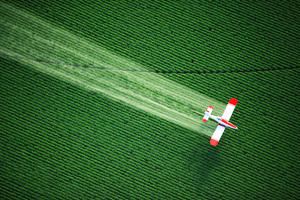
The new Plant Protection Law introduces a permit regime for spraying with aviation equipment. Plant protection products may be applied through aerial spraying only after written permission issued by the Director of the Regional Food Safety Directorate. Such permission may be issued when there is a danger to plants and plant products.
The administrative penalty provisions are structured in a new way, different from the previous law, with the elements of offenses formulated more specifically, the amount of sanctions provided according to the severity of each offense, the boundary between minimum and maximum sanctions widened, and mandatory sanctions introduced for violations of Regulations (EC) No 1107/2009 and No 2003/2003. A new aspect is the introduction of rules for confiscated items - the object or means of committing the offense. With an educational and preventive purpose, the institute of a continuing offense is introduced as an act that to a greater extent violates the established state order and warrants a higher amount of penalties; in this case, the fine and the property sanction are imposed at double the rate. The Transitional and Final Provisions provide for amendments to other laws related to the activities under this law, namely: in the Law on the Bulgarian Food Safety Agency and in the Beekeeping Law regarding the competent authority BFSA; in the Law on Registration and Control of Agricultural and Forestry Machinery and in the Forest Law, thereby introducing the provisions of Directive 2009/128/EC establishing a framework for Community action to achieve the sustainable use of pesticides.