Integrated plant protection in the control of the tomato leafminer
Author(s): проф. д-р Вили Харизанова, от Аграрен университет в Пловдив
Date: 16.12.2017
8637
In 2014 a directive of the European Union on the sustainable use of pesticides entered into force, under which farmers may trade only in products that are produced in accordance with the rules of integrated pest management. It became urgently necessary to move from conventional plant protection to more environmentally friendly methods. Pheromones and other behaviour‑modifying substances that occur naturally in nature are an excellent alternative. The first successful programmes for the use of sex pheromones in integrated pest management systems date back to the 1970s.
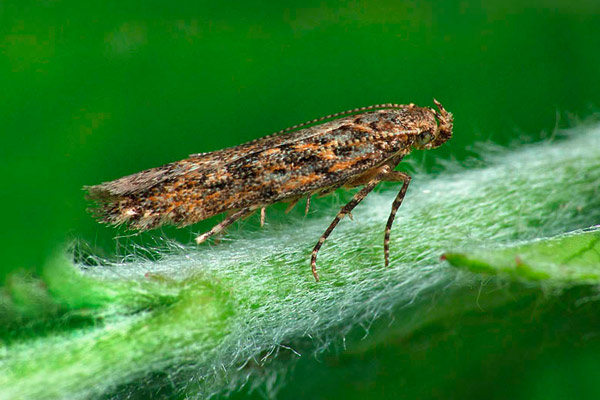
The tomato leafminer (Tuta absoluta Meyrick) is a major pest of tomatoes. The larvae attack the leaves, but the damage is particularly severe when the caterpillars penetrate the fruit. In 1979 the United States began developing a control system through the application of sex pheromones. The industrial use of the pheromone increased in 1980 when the moth became increasingly resistant to insecticides. There were several problems with the use of chemical products: control became very expensive, since the increasing number of spray applications did not produce results; pesticide residues led to rejection of consignments of export‑oriented tomatoes, and there was a mass outbreak of secondary pests that had previously been kept at low population levels by repeated treatments. By the end of the decade, producers of fresh market and processing tomatoes in Mexico had completely switched to IPM programmes using the mating disruption method against the tomato leafminer. The pheromone is particularly interesting because it can be used successfully even under very high infestation pressure of the moth. In most pheromone‑based programmes, their application must start when the pest population is at a low density. Traps and lures were widely used to detect the first emerged moths, which allowed more accurate and timely application of pheromone or insecticide (Jenkins et al., 1991).
The examples are countless and include not only pests of agricultural crops, but also of forests.
Mating disruption method (mating disruption)
The mating disruption method uses synthetically produced chemicals in high concentrations, which confuse the males and reduce their ability to locate females. Individual brands of synthetic pheromones usually contain only the main components, since the aim is not to attract, but to confuse the males. There are several mechanisms that can be used in the mating disruption method. The release of sufficiently large quantities of synthetic pheromone into the atmosphere in different crops confuses the males by:
- Following a “false” trail instead of searching for females
- Affecting the ability of males to respond to pheromone‑releasing females
A false trail is achieved by placing more pheromone sources (tubes, dispensers, sachets or other pheromone sources) per unit area than the expected number of females. The number of males finding females at the end of the trail should be greatly reduced. The pheromone is released at a relatively low concentration so that a plume is created in the direction of the wind, rather than becoming a general background. Males following a false trail expend their mating energy searching for the artificial pheromone sources. As a result, mating is either delayed (with a subsequent negative effect on overall fertility) or prevented. If females do not mate, they cannot lay fertilised eggs, and if mating is delayed, they will lay fewer fertilised eggs over their lifetime. Consequently, the population decreases and fewer larvae remain to damage the crop.
Males of the pink bollworm in cotton have been observed attempting to mate with the hollow tubes used as pheromone sources. These same pheromones were applied in combination with a small amount of contact insecticide (another way of killing the males). The effectiveness of the added insecticide has not been established, but according to growers a dead male is better than a confused one.
There is another practice: to treat with a contact insecticide and at the same time to use pheromones. In this case the aim is to increase the activity of adults so that they spend more time flying and can therefore be hit during spraying.
Reduction of the ability of males to respond is achieved through the additional concentration of pheromone in the air, which “drowns out” the pheromone released by the actual female. Such high concentrations can be obtained through diffuse pheromone sources – microcapsules sprayed in the standard way, or point applications via so‑called dispensers of various types – twist ties, capsules, etc. Specific receptors on the antennae respond to pheromone molecules (Cardé and Minks, 1995). When these receptors are continuously activated by high additional concentrations of pheromone, the resulting electrical signal decreases. The receptor loses sensitivity and the insect cannot orient itself. When the insect’s central nervous system is saturated with signals from the receptors, it adapts and can no longer provide an adequate response. The final result of male disorientation is that they cannot locate the pheromone source and mate (Cardé and Minks, 1995).
The mating disruption method (mating disruption) differs from the chemical method in its different approach. In conventional plant protection systems, insecticides are usually used to target the stages that cause the damage (usually the larva). In contrast, pheromones are directed at the reproductive stage (the adult). Pheromones used for mating disruption are species‑specific and therefore selective. They are non‑toxic and do not affect other organisms.