Against lavender pests, agrotechnical measures are of primary importance
Author(s): проф. д.с.н Иванка Лечева
Date: 27.10.2017
9987
![MultipartFile resource [file_data]](/assets/img/articles/лавандула-заглавна1.jpg)
Lavender is attacked by relatively few pests. The use of pesticides must be minimal, as the presence of residual quantities in the produce is unacceptable. This necessitates relying primarily on preventive protection measures, which should begin already at the establishment of the plantations.
In lavender plantations the following pests occur and cause damage: grasshoppers, meadow spittlebug and northern root-knot nematode, which belong to polyphagous pests, and the lavender moth from the specialized species.
Grasshoppers multiply massively at intervals and cause gradations. Since 2013, a trend of increasing population density of these pests has been observed in Southern Bulgaria, in the regions of Kardzhali, Petrich and Blagoevgrad. In years of mass multiplication, grasshoppers can completely destroy the crop.
Among the bush-crickets – fam. Tettigoniidae, the following are harmful to lavender: the great green bush-cricket and the forest bush-cricket:
Great green bush-cricket (Tettigonia viridissima)
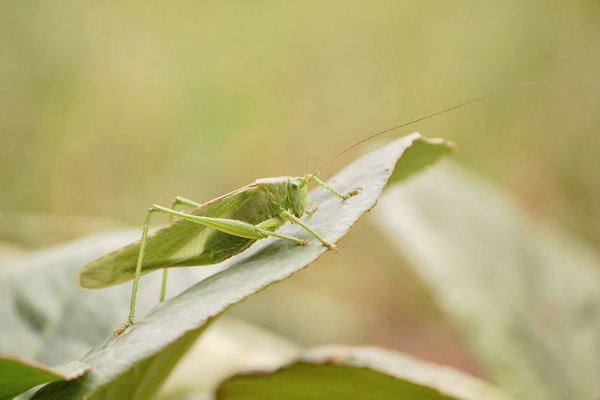
It is widely distributed in the regions where lavender is grown. Both larvae and adults are harmful. The larvae gnaw the leaves, living and feeding individually. The damage caused by adults is greater, as they gnaw the buds and flowers. It develops one generation per year and overwinters as an egg in the soil.
Forest bush-cricket (Isophia tenuicerca)
It most frequently attacks lavender plantations near forests. It occurs at higher density on the southern slopes of Sredna Gora. It develops one generation per year and overwinters as an egg. The larvae hatch in April. Initially they feed on the leaves of broadleaved tree species and herbaceous plants, and later move onto the lavender clumps and gnaw the leaves. At the beginning of June adults appear, which attack the flowering parts and can destroy the crop.
Among the field grasshoppers (fam. Acrididae) the following are harmful to lavender:
Moroccan locust (Docciostaurus maroccanus), Italian locust (Calliptamus italicus)
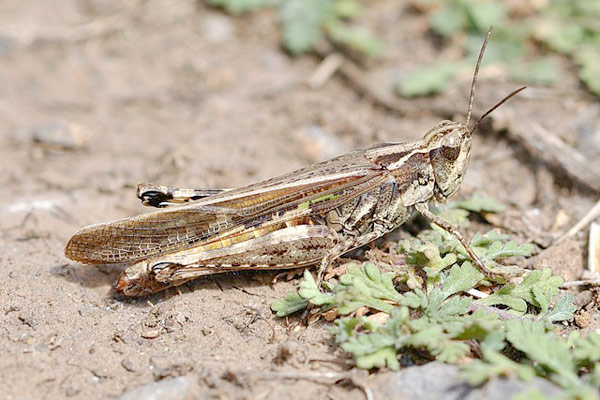
Field grasshoppers cause more significant damage during periods of mass multiplication. They form primary foci in uncultivated grassy areas, meadows and pastures with sparse vegetation, where they prefer to lay their eggs. The two species have similar biology. They develop one generation per year, but unlike the bush-crickets, they overwinter as eggs with a developed embryo in egg-pods in the soil.
The larvae hatch at the end of April–beginning of May, after the air temperature has remained above 17°C for several consecutive days. Larvae and adults cause the same type of damage, but larvae live and feed together in large groups. Gregariousness is more pronounced in the Moroccan locust. The greatest damage is caused by fifth-instar larvae and adults. In years of mass multiplication they can completely destroy the crop.
The Moroccan locust has a cosmopolitan distribution and in our country is found everywhere. It finds favourable conditions for egg laying and development on virgin and abandoned land, meadows, pastures, etc.
At high population density it is capable of destroying vegetation over large areas. Sometimes it can fly up to 50 km per day. Grasshoppers move in swarms, which can extend several kilometres in length and width.
Meadow spittlebug (Philaenus spumarius)
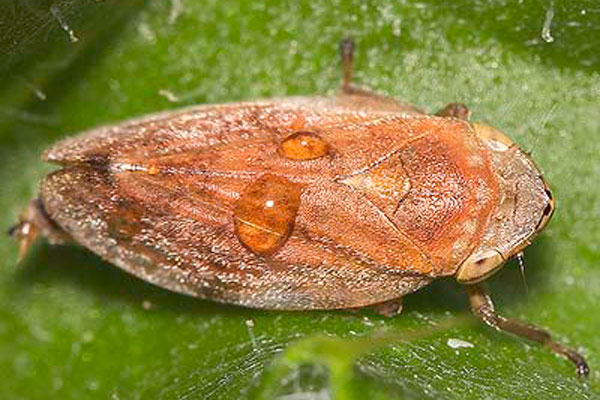
The meadow spittlebug is a widely distributed polyphagous species. Adults and larvae are harmful, as they suck sap from the branches of the lavender clumps. The larvae attach themselves to the branches and are covered with a white foamy substance under which they feed. In cases of severe infestation, the growth of the clumps and the formation of buds are inhibited, which leads to a reduction in yield. It develops one generation per year and overwinters as an egg covered with a waxy coating.
Northern root-knot nematode (Meloidogyne hapla)
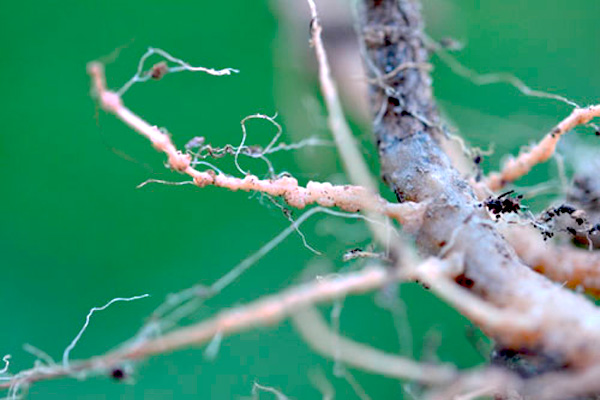
Favourable conditions for its development are sandy soils with good aeration and a dry spring. Small galls form on the roots. As a result of the damage, root growth stops and the roots die. Depending on the degree of infestation, partial or complete drying of the flower buds is observed. Under drought conditions the infested clumps dry out and yields decrease sharply.
Lavender moth (Sophronia humerella)
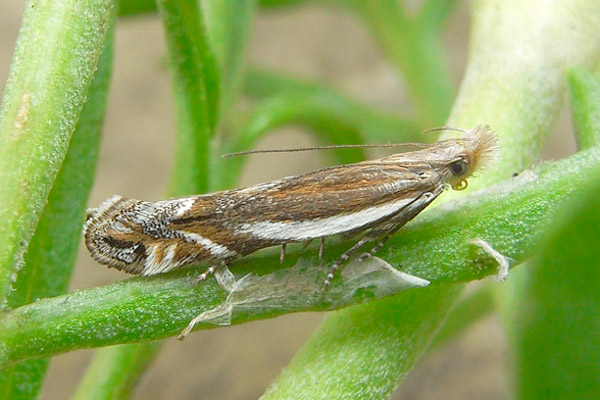
The lavender moth is the only specialized lavender pest in our country. It occurs at varying densities in different years. Since 2014, an increase in its population has been observed in plantations in the Plovdiv, Stara Zagora and Burgas regions. The harmful activity of the moth begins at the “leaf development” phenophase. The larvae are harmful; initially they feed on the leaves, and then they web the vegetative shoot tips with silk threads and gnaw them through. Branches with gnawed tips do not bloom, and clumps with damaged leaves cannot nourish the generative organs. Additional shoots emerging from dormant buds may flower, but the flowers are small. (The larva is green, with light longitudinal stripes on the dorsal side and a dark brown head). The pest develops one generation per year and overwinters as a larva.
In the control of lavender pests, agrotechnical measures are of primary importance:
Proper site selection when establishing plantations. Heavy, compacted soils with shallow groundwater should be avoided;
Spatial isolation between new and old plantations;
Good land preparation before transplanting lavender seedlings;
Use of healthy planting material;
Cultivation of lavender under high agronomic standards:
- inter-row cultivation to loosen the soil and control weeds;
- pruning in the first year in order to avoid premature flowering, which adversely affects the growth and formation of the clumps;
- balanced fertilization to increase crop vigour;
- regular monitoring to determine the presence of pests and assess the phytosanitary status of lavender plantations.
The Bulgarian Food Safety Agency (BFSA) hereby informs that from 24.06–28.06.2024, areas in the municipalities of Petrich and Sandanski, Blagoevgrad region, will be treated by aerial application against the Moroccan locust. The plant protection product does not pose a risk to the life and health of humans and animals.
On the territory of Petrich municipality, areas from the land of the village of Marikostinovo and the land of the village of General Todorov will be treated.
On the territory of Sandanski municipality, treatment will be carried out on areas from the lands of the villages of Djigurovo, Laskarevo, Ladarevo, Lyubovka and Leshnitsa.
The reason for this is the mass multiplication of the economically important pest – the Moroccan locust (Dociostaurus maroccanus).
* The article was updated on 27.06.2024.