The spruce bark beetle is a serious threat to pine forests
Author(s): Растителна защита
Date: 17.07.2017
10742
An increasing number of pine forests in Bulgaria are being affected by the pine shoot beetle, which causes rapid and large-scale dieback of coniferous stands. Experts from the Ministry of Agriculture, Food and Forestry and the Executive Forest Agency discussed urgent measures to limit the attacks of this dangerous pest. One of the main reasons for the mass occurrence of the pine shoot beetle is climate change, which leads to drought and makes trees easily susceptible to various pathogens and pests.
At the end of last week, a meeting was held at the initiative of the Deputy Minister of Agriculture, Food and Forestry, Atanas Dobrev, and the management of the Executive Forest Agency. Forest science experts discussed in detail the damage caused by the pine shoot beetle and what urgent measures need to be taken immediately.
The measures include accelerating the process of assigning the implementation of sanitary and compulsory fellings, as well as engaging all stakeholders in the process of combating the pest. It is extremely important that all forest owners, including private ones, participate in the fight against this forest pest. For this purpose, information seminars will be held with representatives of local authorities, who will assist in the process of identifying and informing private forest owners about limiting the invasion of the pine shoot beetle.
The problem mainly affects artificially established coniferous forests and is caused primarily by their afforestation at lower altitudes than their natural range. Science recommends only the implementation of sanitary and compulsory fellings as a solution, and the removal of infected and damaged dried timber.
The damaged and dried trees are also a potential threat for the occurrence of fires, especially during the summer months. The gradual felling of the affected forest areas must be carried out carefully, without drastic changes to the environment and without exposing bare areas.
To bring the problem under control, joint efforts by all stakeholders are required, as well as the understanding of the public.
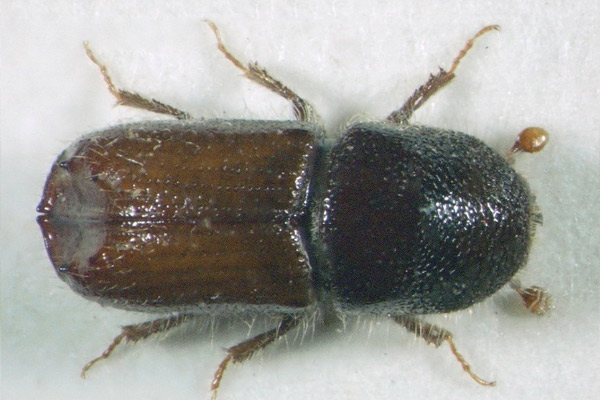
Pine shoot beetle (Ips acuminatus Gyll.)
It is widespread throughout Europe, Asia, North America, as well as in our country. It attacks mainly Scots pine – the upper parts of the crown, the thicker branches and the stem. The maternal and larval galleries interrupt the conductive tissues and the tree dies within a very short period of time. The needles initially fade, and later acquire a characteristic red colour, which is why the affected forests are known as red forests. The damaged timber is devalued, losses are enormous, and forest ecosystems have impaired functions.
Under favourable conditions, the pine shoot beetle produces two generations per year: April – May and July – August. The adult overwinters and in spring creates round exit holes and attacks neighbouring trees. The larvae develop quickly within 20 – 25 days and in August the second generation attacks the neighbouring trees.
Climate change is the main factor behind the development of a second generation in Northern Bulgaria.