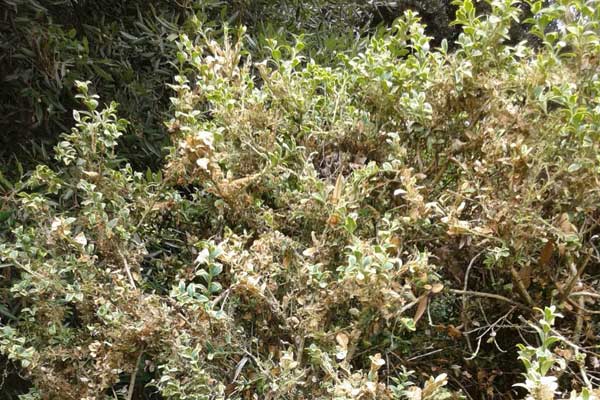

If you notice that the boxwood is turning yellow, you are certainly facing a serious problem. It has been infested by the box tree moth (Cydalima perspectalis). A dangerous pest originating from East Asia, it entered Europe in 2007 and very quickly established itself in various countries – Italy, Russia, the Czech Republic, Hungary, Switzerland, Austria, Belgium, Romania, Slovenia, Slovakia, France, Turkey and the United Kingdom, including Bulgaria
It spreads with planting material, but even if your boxwood has been in your yard for a long time, this is no guarantee that it will not be “visited” by this pest. The reason is that the moth is capable of flying long distances – 10 km is not an obstacle for it. It is considered that trade in planting material over the Internet is one of the pathways for the introduction of the pest into Europe.
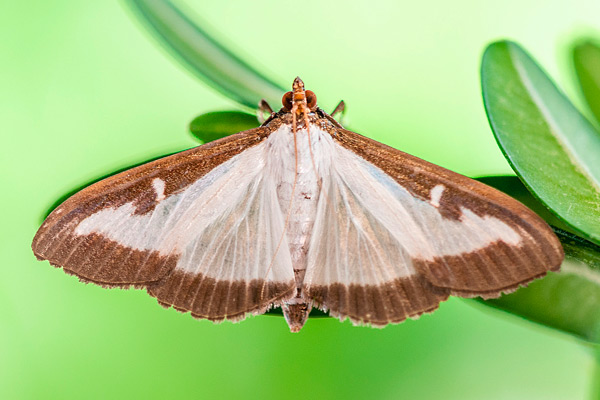
The pest is a moth, usually white, shiny, with a dark brown stripe along the edge of the wings. When the wings are spread, its size is 4 cm. The larvae are light green with characteristic black markings with white spots, with small hairs and a shiny black head.
The damage is caused by the larva. It feeds on the leaves of the boxwood, initially along the edges, and later completely destroys them. At first, the damage is visible as spots on the leaves. Detecting young larvae is quite difficult, as they feed between the leaves. Therefore, it is necessary to open up the shrubs and look for the larvae in the middle. After the third instar they move also onto the leaves in the upper part of the boxwood and can be noticed more easily. The pupae are difficult to detect (light green at the beginning), because they are hidden between the leaves. The eggs are laid in clusters, 1–3 mm in size, and are covered with a transparent whitish-yellowish membrane. During the day the moths hide in the boxwood or in plants located close to it.
Mechanical control
An effective control measure is the manual collection of larvae, which should be carried out every 2–3 days. For larger plantings: alleys, parks, vacuum cleaners can also be used. The box tree moth is attracted to ultraviolet lamps – the ones that are placed in gardens for mosquito control.
Chemical control
The use of contact insecticides (Decis 100 EC) is effective, but it is not suitable in public parks and gardens. Bioinsecticides based on Bacillus thuringiensis var. kurstaki have good efficacy and are environmentally friendly. You may also try Prev-Gold (orange oil), which is suitable for organic farming.