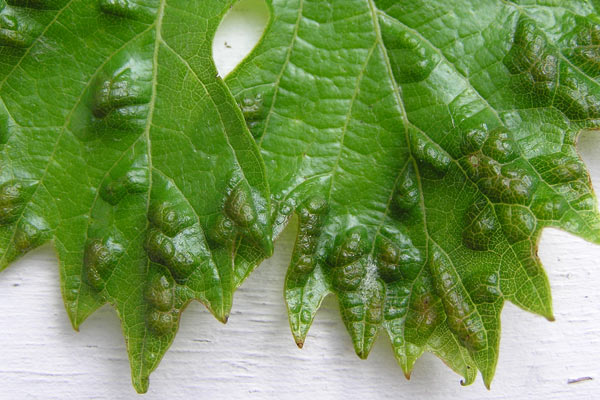
The damage to vine leaves, known as “grapevine blister mite”, is caused by a very small mite (Eriophyes vitis) with a strongly elongated, pointed body. It cannot be seen with the naked eye. Its attack becomes apparent when damage appears on the leaves. The mite is widespread throughout the country, usually in isolated foci. It occurs on all grapevine varieties, with a preference for those with hairy leaves (Pamid, Dimyat, etc.).
Adult female mites overwinter, gathered in large numbers under the bud scales and under the bark of the shoots. In spring they become active and move onto the emerging young leaves, where they lay their eggs. The adult mites and larvae are found on the underside of the leaves and suck sap from them. At the puncture sites the tissues become deformed, proliferate and galls are formed, protruding on the upper side and sunken on the underside. The sunken part of the gall is covered with whitish hairs resembling felted cotton fibres. In them the mites lay their eggs and develop until the leaf dries up, after which they move to other, juicier leaves on the young shoots. Later the galls dry out and turn brown. The shoots cease to develop. During the year this mite develops 3–4 generations. Under heavier infestation over several years, the vines become severely weakened and fruiting deteriorates. The mites continue to develop in summer; in autumn they gather in the buds and remain there to overwinter.
Of all mite species on grapevine, the yellow grapevine mite and the European red mite are of economic importance. Mites cause the most severe damage to the leaves of varieties with a thicker palisade parenchyma – Pamid, Dimyat, Rkatsiteli, Cabernet Sauvignon, Merlot, etc.
The green lacewing (Chrysoperla carnea) is one of the most effective biological agents for integrated plant protection. Under natural conditions the insect is widely distributed in many countries in Europe, Asia and other continents. It is a broad polyphagous species that feeds on many types of arthropods and mites. In the agrobiocenosis, the abundance of lacewings is limited by the influence of temperature and air humidity. Therefore, the green lacewing is used as a method for seasonal artificial release for the biological protection of agricultural crops against various insect pests.
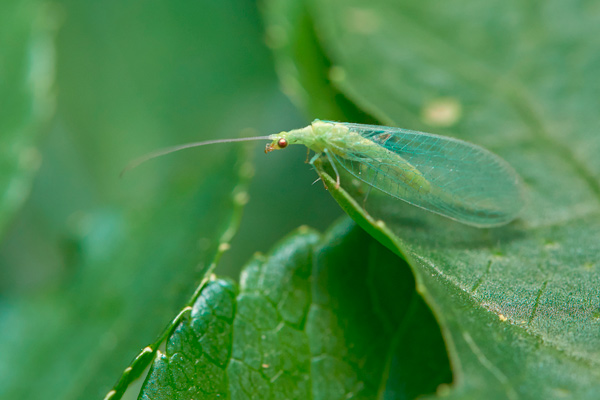
Green lacewing (Chrysoperla carnea)
All harmful mite species also have many natural enemies – acarophages – predatory mites, predatory bugs, lacewings, ladybirds, etc., which play a significant role in the biological regulation of mite populations. The use of acaricides is required when economic threshold levels are reached.
Pest control strategies
In order for spraying against this pest to be effective, it must be carried out at the end of April and the beginning of May, and in this year’s delayed and humid spring – by the end of May, when the shoots are 5–8 cm long, at the time when the mites start to move on the young leaves, before they have formed galls.
At this time the shoots are small and the leaves can be thoroughly sprayed. The areas to be treated are those where there was more severe mite damage in the previous year and there is a risk of a stronger population increase.
Authorised plant protection products
The following products are applied: Thiovit Jet 80 WG (suitable for use in organic farming and registered for control of grapevine blister mite in grapevine) – 1.5 kg/ha, Shirudo (former Masai WP) – 25 g/ha, Apollo 50 SC – 30–40 ml/ha.
*Article updated May 2023