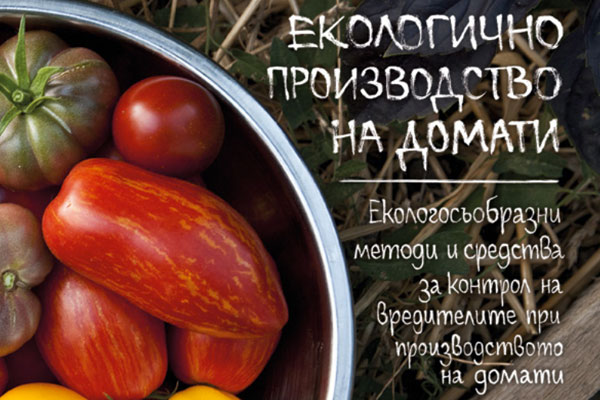
At the end of last year, Greenpeace Bulgaria and the Agricultural Academy, represented by the Maritsa Vegetable Crops Research Institute – Plovdiv, officially presented their first joint report dedicated to ecological farming in tomato cultivation. The document is entitled “Environmentally Sound Methods and Means for Pest Control in Tomato Production” and is focused on methods for organic cultivation of this vegetable crop, which is popular not only in our country.
Tomatoes are a vegetable crop with a rich tradition of cultivation worldwide. Their nutritional, organoleptic and technological qualities are well known and encourage an increasing number of breeders to develop and create new varieties suitable both for fresh consumption and for the processing industry.
The natural and climatic conditions in Bulgaria are favourable for tomato cultivation both in greenhouses and in open-field conditions, as early, mid-early and late production. However, tomatoes are a vegetable crop that is sensitive to many diseases caused by fungi, bacteria, viruses and mycoplasmas. They are also subject to attacks by a large number of pests – tomato leafminer, mites, thrips, whiteflies, cotton bollworm, aphids and others. Naturally, control of these pests is traditionally entrusted to conventional agriculture, which in turn focuses solely on the use of various pesticides and insecticides.
The intensification of agriculture aims to limit the increasing number of pests and diseases not only in tomatoes but also in other vegetable crops, while maintaining high yields. Unfortunately, this is not always the only and most effective method of combating dangerous pests. The consequences of excessive use of chemical agents inevitably lead to pollution and disruption of the biological balance of the environment. Here we can add the results of studies on residues of active pesticide substances in tomato products offered on the market (Eurostat). A routine extensive review in the EU of 12 different food productscovers 209 different pesticides authorised for use in Europe and shows the presence of more than one residue of active pesticide substances in individual samples in 27% of the tomato samples.
Other significant consequences of improper or excessive use of synthetic chemical agents are the economic damages and additional economic costs, which increase with each passing year. The report of the Maritsa Vegetable Crops Research Institute – Plovdiv provides precise data on the economic losses due to the application of pesticides. As an example, the USA is cited, where in a single year 1.5 billion US dollars (1.4 billion euro) were spent on pesticide resistance (Pimentel & Burgess).
Therefore, the team of the Maritsa Vegetable Crops Research Institute decided to look for a solution outside the standard methods of tomato cultivation. They opted for ecological agriculture, which involves the application of a diverse combination of techniques and farming practices. In their report, the leading scientists from the Institute in Plovdiv develop methods based on agro-biodiversity to increase resistance to pests and diseases, ecological tools for combating infestations and infections in orchards, as well as methods for breeding disease-resistant varieties, based on modern biotechnologies.
In fact, breeding programmes in which varieties are simultaneously selected for resistance to economically significant diseases for the country and for ensuring high and stable yields are an essential part of the move towards ecological agriculture and are an important component of good plant protection practice.
An excellent bonus in the work produced by the Maritsa Vegetable Crops Research Institute is the glossary of the terms used and the detailed description of all disease-resistant tomato varieties in Bulgaria. In the chapter “Plant Protection”, the main diseases and pests of the tomato vegetable crop are examined, and for convenience lists of all harmful organisms have been prepared. In addition, there are two chapters dealing with the sources of nutrients in organic production and the application of different types of fertilizers in tomato production.
Ecological tomato production – environmentally sound methods and means for pest control in tomato production.
You can see the full report HERE