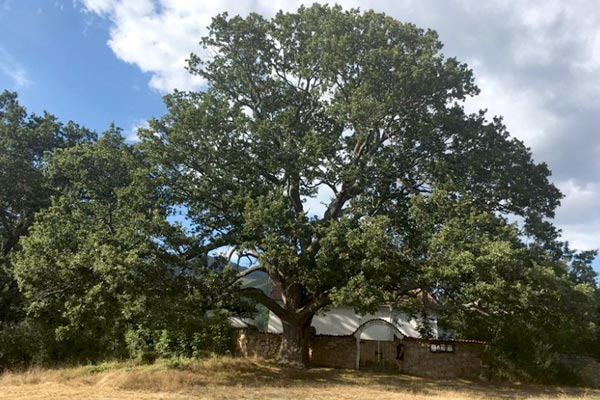
The centuries-old oak by the church in the Tran village of Nasalevtsi is Bulgaria’s nomination for the “European Tree of the Year” competition, which has been held since 2011. Voting will take place from 1 February to 28 February 2017, and the results will be announced at the award ceremony for the winners of the competition, which will be held in Brussels on 21 March 2017.
The centuries-old oak by the church in Nasalevtsi – guardian of the place and the people
Close to the wall of the Nativity of Christ church in the Tran village of Nasalevtsi, a majestic six-century-old oak of the species sessile oak* spreads its branches. For as long as the village can remember, the oak has stood there, and its wide crown is regarded as a protector of the inhabitants from lightning and storms. Under its shade, people from the surrounding area have been holding fairs, christenings and weddings for 6 centuries.
The centuries-old oak in the village of Nasalevtsi, which is a protected species, is Bulgaria’s nomination for the “European Tree of the Year” competition.
“European Tree of the Year” competition
The purpose of the competition is to draw attention to interesting old trees as a significant natural and cultural asset that we must value and preserve. Unlike other competitions, for the “European Tree of the Year” it is not beauty, size or age that are important, but the story and the connection with people. The search is for trees that have become part of the community. The organisers believe that the issue of protecting trees as bearers of local spirit must become a subject of international debate.
The “European Tree of the Year” competition was first organised in 2011 as a continuation of the popular “Tree of the Year” competition, which has been held in the Czech Republic by the Partnership Foundation for many years. The European competition is the final round of the contest, in which the winners of the national competitions participate.
Voting
Online voting continues until midnight on 1 March, and the winner will be announced at an official ceremony in Brussels on 21 March. Sixteen trees from 13 countries are taking part in the contest. During the last week (from 22 to 28 February) the voting will be hidden and the results will not be visible on the web pages. To avoid a purely national bias, as of this year participants in the voting must choose two nominees – in addition to a tree from their own country, they may also cast their vote for another tree of their choice.
Bulgaria is participating for the second time with a rare species of centuries-old tree in the “European Tree of the Year” competition. In 2014 the Old Elm in Sliven became the winner in the contest.
You can vote for the “European Tree of the Year 2017” HERE
sessile oak* or winter oak (Quercus petraea) is a deciduous tree of the beech family. The sessile oak reaches a height of 30–40 m. Its crown is ovoid and rounded, and in old and solitary trees (in the open) it expands in width. The bark is less deeply fissured and thinner than that of the common oak. Its distinctive feature (along with the presence of a leaf stalk) are also the acorns with a specific shape, grouped in clusters of 2–5 on a strongly shortened axis or sessile. Winter and pedunculate oaks are opposites with regard to the presence of a stalk on their leaves and acorns. The leaf is 7–14 cm long and 4–8 cm wide, evenly divided into 5 to 6 rounded lobes on each side, with a stalk about one centimetre long.
The flowers are catkins and are formed in spring. The fruit of the sessile oak is an acorn, 2–3 cm long and 1–2 cm wide, with a ripening period of six months.
In Bulgaria it grows on foothill and mountain slopes up to 1600 m above sea level. It can be found in Rila.