News in the development and application of biostimulants in European agriculture
Author(s): проф. Андон Василев, от Аграрния университет в Пловдив
Date: 16.01.2017
5417

At the end of November 2016, the international conference Biostimulants Europe (respectively, biostimulants in European agriculture) was held in the city of Almeria, Spain. The conference was not held in the Almeria region by chance. This is where Spain's greenhouse vegetable production is concentrated, and the use of biostimulants is constantly increasing. About 150 people participated in Almeria - scientists, specialists from biostimulant manufacturing companies, consulting firms in the European agribusiness, as well as representatives of regulatory bodies. One of the main issues discussed at the meeting was the fact that there is still no adopted document in the countries of the European Union regulating the category of biostimulants in agriculture. According to the financial director of Plant Health Care - Rob Cunnings, the biostimulants market should be determined by the geographical location of the countries, their agricultural area, and the responsiveness of the cultivated crops to the application of biostimulants. Priority crops for the application of biostimulants in Bulgaria are tomatoes, cucumbers, and potatoes among vegetables; apples and grapes among perennial plantations; and sunflower and corn among field crops.
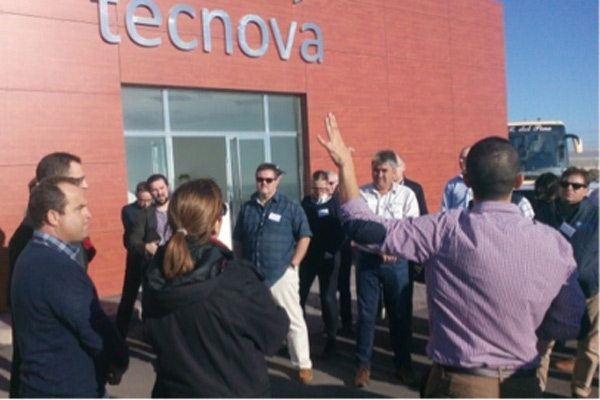
The conference began with a visit to the Tecnova technological agrocenter. The center's activities are aimed at developing new agricultural technologies (mainly in vegetable production), technologies for post-harvest storage and packaging of produce, conducting analyses, consultations, promoting new companies, etc. On a contractual basis, analyses and research are carried out for the founding companies (over 120) and other companies in the agricultural business (over 500). Working seminars with farmers, company presentations are organized, and internships for young specialists are conducted. The Tecnova Center works in close cooperation with the development departments of companies, scientific institutes, and universities. It has modern analytical equipment and performs a significant volume of chemical, technological, sensory, and other analyses.
The biostimulant testing station occupies part of the area in the greenhouse complex of the Tecnova agrocenter. Here, the effects of biostimulants on various crops are comprehensively studied. The characterization of the tested products includes physiological, biochemical, and agronomic indicators, precisely determined with the help of appropriate scientific equipment. Qualified specialists from the station and representatives of the applicants participate in the research.
Visual observations of various greenhouse experiments that were examined showed some positive effects from the application of biostimulants, expressed mainly in greater uniformity and more intense color of the fruits, as well as in other technological qualities of the produce.
Definition, Regulation, and Market of Biostimulants in European Agriculture
One of the first questions discussed at the conference was the definition of the concept of biostimulants, as besides scientific purposes, it is essential for the regulation of products with such qualities in the European Union. There is still no adopted document in the countries of the European Union regulating the category of biostimulants in agriculture. It is expected that the working group created on the problem will propose a definition and regulatory norms in 2018.
Currently, biostimulants fall into the category of "fertilizer products" according to the Harmonized European Fertilizer Regulation (EC 2003/2003; paragraph 2 of 13.10.2003) and are: "substances, mixtures, microorganisms, or other material, applied alone or with other material to plants or their rhizosphere to supply nutrients or improve their efficiency".
The strong competition between biostimulant manufacturing companies motivates the organization of marketing research on the market for these products. According to Rob Cunnings (Financial Director of Plant Health Care), the plant biostimulants market is expected to grow and reach $2.5 billion by 2019. The main arguments for the expected strong growth are three: (1) the growing importance of organic products in agriculture, (2) the increased application of biostimulants in developing countries, and (3) the development of innovative products that meet the specific needs of particular crops. It became clear that 37% of the volume of all agrochemicals is realized in 30 countries. France is in first place among them, but other European countries such as Germany, Italy, Spain, Poland, etc., are also in this group. Rob Cunnings believes that the biostimulants market should be determined by the geographical location of the countries, their agricultural area, and the responsiveness of the cultivated crops to the application of biostimulants. Based on these criteria, countries can be divided into 3 groups by volume and attractiveness of the biostimulants market, with Bulgaria falling into the third group, along with Poland, Romania, Hungary, etc. According to the speaker, priority crops for the application of biostimulants in this group of countries are tomatoes, cucumbers, and potatoes among vegetables; apples and grapes among perennial plantations; and sunflower and corn among field crops.
The entire material from the conference in Almeria, Spain, and the news in the development and application of biostimulants in Europe can be read in issue No. 1/2017 of the magazine "Plant Protection & Seeds and Fertilizers".