

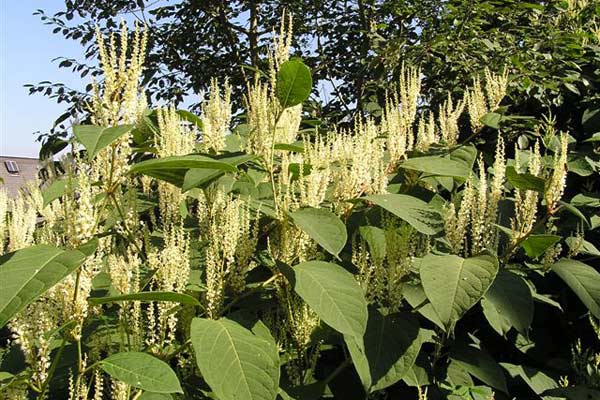
Fallopia japonica (Polygonum cuspidatum in the USA and Japan, Reynoutria japonica in Europe, commonly called Japanese knotweed, Japanese, American or Mexican bamboo, Himalayan honeysuckle, fleeceflower, purple beauty, monkey weed, elephant ears, donkey rhubarb, etc.) is an important invasive weed, introduced in the 19th century from the Far East as an ornamental plant. It is found along rivers, roads, wastelands and in disturbed ecosystems.
It spreads through cross-hybridization, cloning, seeds and vegetatively. It has rapid growth and forms a significant plant biomass. The diversity in reproduction and spread of this invasive species has been traced in four subspecies of the genus Fallopia / Reynoutria (R. japonica var. japonica, R. japonica var. compacta, R. sachalinensis and a hybrid between R. sachalinensis and R. japonica var. japonica - R. × bohemica). Regeneration of plants from rhizomes is more significant than from stems. R. × bohemica (61%) and R. sachalinensis (21%) have a higher restoration potential. The rhizomes of R. japonica var. japonica regenerate in soil but not in water, while for the stems it is the opposite – they recover well in contact with water, but do not develop at all in soil. R. japonica var. compacta forms the longest shoots, and R. × bohemica – the strongest shoots. These data show that rhizomes are more important than stems for the spread of these invasive species. A plant fragment with only one bud is sufficient for its regeneration, growing by about 3 mm per day. New stems and rhizomes can reach a depth of 3 m and a distance of 7 m from the mother plant. These biological characteristics of the species of the genus Fallopia eloquently show how this species has turned from exotic into invasive and has conquered the whole world.
Control
Control of Fallopia spp. is very difficult and is associated with considerable costs. Herbicides and herbicide mixtures are used, as well as agrotechnical measures and bioagents.
In earlier experiments for the control of Fallopia japonica worldwide, dicamba + triclopyr + 2,4-D (85 g + 65 g + 200 g/l), 14 - 110 g/da clopyralid, 60 g/da imazapyr, 110 g/da dicamba, 220 g/da 2,4-D, 340 g/da glyphosate, 300 – 400 g/da tebuthiuron have been tested. Most studies are related to the application of glyphosate and imazapyr alone and in combinations, cutting of stems followed by treatment with glyphosate, picloram, etc., spraying of regrown shoots with glyphosate, use of synthetic auxins, etc. Trials have also been carried out with injection of glyphosate and a mixture of glyphosate : water (5 ml) for faster desiccation of the injected stems, starting from the top of the plants.
Mechanical control of Fallopia spp. consists in cutting the aboveground biomass down to the soil surface and burying it in the soil at a depth of 50 cm. Cutting only the aboveground part reduces the development and new emergence of the weed by 86%, and if the cut plants are also buried, the reduction is 92%. In the second half of the growing season, the belowground biomass of Fallopia japonica exceeds the amount of aboveground biomass. At least four cuttings are necessary to exhaust the rhizome network. The cuttings must be carried out at least seven weeks before the end of the vegetation period of the plants.
Hosts of 186 insect species and 40 fungal species
The invasive species of the genus Fallopia are hosts to 186 insect species and over 40 fungal species. There are many specialized natural enemies of Fallopia spp., but these species do not occur in our country.
The most promising potential agent with a high level of specificity and probable efficacy is the psyllid Aphalara itadori Shinjii [Hemiptera: Psyllidae]. The polyphagous Spilarctia lutea colonizes all species of the genus Fallopia, especially F. sachalinensis. Two oligophagous species, the leaf-feeding beetle Gastroidea viridula [Gastrophysa viridula] and the leaf-mining fly Pegomya nigritarsis attack only the hybrid Fallopia (Reynoutria) X vivax. Female nymphs of the grasshopper Parapodisma subastris feed on the inner tissues of the stems of Fallopia japonica. The larvae of the leaf beetle Gallerucida bifasciata can complete their development on seven species of the genus Fallopia, and the adults feed and lay eggs on ten species, but have a strong preference for F. japonica.
There are two strategies in the use of pathogenic fungi as bioagents – classical, which involves exotic biotrophic fungi developing simultaneously with the target plants, and inundative, using local, typically necrotrophic fungi formulated as mycoherbicides. These local basidiomycete fungi causing wood decay are successfully applied against invasive species by treating the stumps of the plants. In Japan, a growth-inhibiting fungus, Phyllosticta fallopiae, has been isolated from leaf spots of F. japonica. The rust-causing fungus Puccinia polygoni-amphibii var. tovariae is also a potential bioagent against F. japonica. Mycosphaerella polygoni-cuspidati causes leaf spot on F. japonica. This fungus is a natural enemy developing simultaneously with the weed and has high potential as an agent for classical biocontrol. An aqueous extract from the moss Fissidens cristatus has a significantly negative effect on the elongation of F. japonica seedlings.
The useful Fallopia japonica
Alongside the significant negative characteristics that have led to the reputation of Fallopia japonica as a formidable invasive species, this weed has a number of very important applications. The chemical substances contained in the weed (resveratrol, trans-resveratrol and its glycoside polydatin, its analogues piceid, piceatannol glycoside, resveratroloside, anthraglycoside, quercetin glycosides (avicularin, hyperoside, rutin, isoquercitrin, peltatoside), emodin, physcion, rapontin, anthraquinone, catechin, myricetin, tannins, flavones, etc.) make it a valuable allelopathic plant. It can be successfully used for biological control of a large number of crop pests – viral, bacterial and fungal diseases (the biopesticide MOI-106 has been developed against downy mildew in cucumbers, etc.), insect pests, weeds. The abundant aboveground plant biomass remaining after cutting can be incorporated in certain quantities into areas with some weed species sensitive to the allelochemicals contained in the plant. The aboveground plant biomass can be dried and then applied to a given area. It can be ground into powder or made into pellets, i.e. with appropriate technologies a bioherbicide can be produced from the plant.
Fallopia japonica is widely used in Eastern medicine as an herb against a number of diseases. Owing to its large plant biomass, it is used as a source of biofuel and as an energy crop contributing to the reduction of harmful CO2 emissions. The extensive underground network of rhizomes serves to protect steep terrains from soil erosion and flooding, to stabilize deposits with accumulated sediment, and to remediate areas contaminated with heavy metals (copper, zinc, lead, cadmium). As a melliferous plant, Fallopia japonica is a source of nectar for bees in the production of the so-called “Bamboo honey”, as well as an ingredient in many culinary recipes for food and beverages due to its rich content of vitamins A and C, antioxidant flavonoids, potassium, zinc, phosphorus, manganese, etc.
The use of the impressive vegetative biomass of Fallopia japonica for all these important applications can lead to the predominance of the positive characteristics of this species, treating it not as a pest but as a universal, extremely useful and valuable plant, deserving respect and rehabilitation in the eyes of the world. Why should vast resources be spent on its eradication, when it can successfully find such a wide range of beneficial uses!