

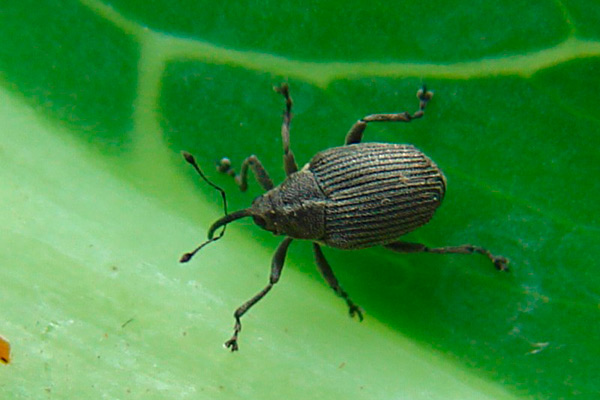
Ceutorrhynchus pleurostigma is a small beetle, a weevil, about 3 mm in length. Its body is elongated-oval, black in color, covered in the thoracic area with grey hairs and yellowish scales. The pronotum is punctured and covered with yellow hairs. On the elytra there are longitudinal rows of grey scales. The body length is 2.5 — 3 mm. The egg is oval, white, and 0.35 mm long. The larva is white, arched, with a brown head, legless, 3—4.5 mm long. The pupa is free, white and 3.7 mm long.
This is a pest that attacks the roots of cabbage. In addition to cabbage it also attacks kohlrabi, turnip, and radish. Damage is caused by the adult and the larva. The adult insect gnaws the leaves, floral parts, stems and roots, while the larva induces the formation of swellings (galls) on the main root below the soil surface. Infested cabbage plants form smaller heads.
The larvae overwinter in the galls (feeding on their interior for 5–6 months) and in the soil. The beetles appear in June. The gall-forming cabbage weevil develops one generation per year and occurs in two biological races that are morphologically similar. One race — the spring race, overwinters as an adult insect and develops on wild cruciferous plants. The other race — the summer race, overwinters as a larva mainly in damaged cabbage stems and is associated with cultivated cruciferous plants
Control
Control measures include: collection and destruction of infested plants; pulling out the cabbage stems in autumn and destroying them together with the larvae; destruction of weeds around the crops. In case of mass occurrence of adults, spraying may be carried out with Agria 1050 - 150 ml/da and Nurelle Dursban - 80 ml/da.