Wheat crops are affected by various diseases, the main causal agents being fungi and, less frequently, viruses and bacteria. Among the most common diseases are:
Fungal diseases
Powdery mildew of wheat.
It is caused by Erysiphe graminis. In addition to wheat, all cereal crops are affected, with the exception of maize, rice and millet. It is widespread everywhere cereals are grown. It reduces yields by 10–30% and deteriorates the quality of the harvested grain. The causal agents of the disease develop throughout the entire vegetation period of the plant. All green organs are attacked, mainly the leaves. On the surface of the affected organs dirty white coatings are formed, as if dusted with flour. These increase in size, merge and eventually densely cover large areas, and at a later stage acquire a light grey colour.
Yellow rust.
It is caused by Puccinia striiformis. In Bulgaria the disease is limited and appears in regions with specific ecological conditions. It is characteristic mainly of wheat, barley and rye. The leaves, leaf sheaths and, less frequently, the stems are affected.
Brown (leaf) rust.
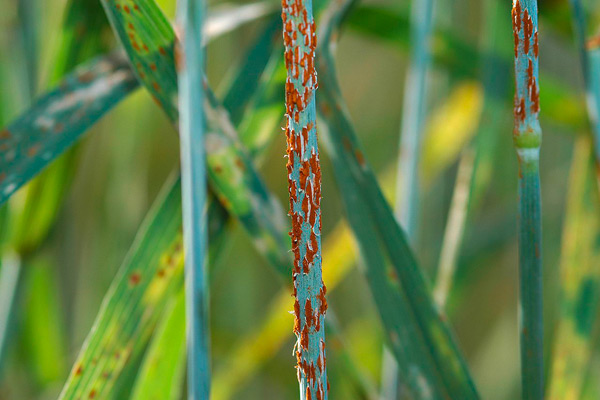
It is caused by Puccinia recondita. Conditions in Bulgaria are extremely favourable for the pathogens. The symptoms are characterised by the appearance of elliptical or slightly elongated rust-brown pustules of uredosori. They often increase in size and cover a considerable part of the leaf blade, which curls and dries. The grain remains small with impaired baking quality.
Black stem rust.
It is caused by Puccinia graminis. The symptoms of the disease appear most often on the stems and leaf sheaths and less frequently on the other green parts of the plants.
Dwarf bunt.
It is caused by Tilletia controversa. The disease is characteristic of higher and cooler regions. Infected plants have severely shortened stems and remain 2 to 4 times shorter than normal. The ears of some of the tillers emerge only halfway from the sheath of the flag leaf, while others do not emerge at all.
Common (stinking, hard) bunt.
It is caused by Tilletia tritici and Tilletia levis. The second causal agent is less common in Bulgaria. The disease is of minor importance for the country.
Loose smut.
It is caused by Ustilago tritici. From the sheath of the uppermost leaf of the affected plant, an ear emerges that is completely destroyed and transformed into a mass of smut spores. The spores reach the flowers of healthy plants and thus infect the grain, in which they overwinter.
Basal rot.
It is caused by Fusarium culmorum.
Snow mould.
It is caused by Monographella nivalis. It is a soil-borne pathogen that infects plants at an early phenological stage of their development and can lead to significant damage.
Ear rot.
It is caused by Gibberella zeae and Fusarium culmorum. At the milk or dough stage of grain maturity, the small ears slowly fade. Severely infected ears remain sterile, while less affected ones form shrivelled seeds.
Early leaf blight.
It is caused by Mycosphaerella graminicola. The symptoms are spots on the leaves, which appear first on the lower leaves. They gradually enlarge and merge, fade in the centre, and their margins turn yellow or brown.
Helminthosporiosis.
It is caused by Cochliobolus sativus. It appears in the form of different types of damage – brown spots, black embryo or root rot.
Basal stem rot and parasitic lodging.
It is caused by Pseudocercosporella herpotrichoides. Plants are infected at the base of the stem. Yellow-brown spots with an elongated elliptical shape and a dark border are formed there. If the damage occurs before the 1–2 node stage, the plant rots and lodges.
Take-all root rot.
It is caused by Gaeumannomyces graminis. The disease also occurs on barley and rye, but is most characteristic of wheat. It appears in fields with light soils of alkaline reaction, without crop rotation and under low agronomic practices. Symptoms appear as early as in young, newly emerged plants, which lag in growth, their leaves turn yellow and dry, and they often die.
Viral diseases
Barley yellow dwarf.
A widespread viral disease caused by Barley yellow dwarf virus. The virus is transmitted from diseased to healthy plants by several species of aphids parasitising on cereals. In Bulgaria the most widespread vectors are Rhopalosiphon padi and Sitobion avenae. Plant growth is severely suppressed (dwarfing), with intense tillering and intensive yellow or red colouring of the leaves.
Wheat dwarf.
It is caused by Wheat dwarf virus.
Wheat streak mosaic.
A viral disease caused by Wheat streak mosaic virus. It is transmitted mechanically (through sap) and mainly by several species of mites. In Bulgaria the most widespread vectors are Aceria tulipae and Aceria tossicella. Wheat is mainly affected, but barley is also attacked. It is manifested by the appearance of small spots, which later develop into longitudinal streaks up to the tip of the leaf blade. Diseased plants acquire a chlorotic appearance. The tillers of diseased plants are weak, stunted and almost never reach the heading stage.
Bacterial diseases
Basal bacteriosis.
It is caused by Pseudomonas syringae. The symptoms manifest in three directions: root and stem rot; leaf, stem and ear spotting; deformation of the ear with sterility or formation of shrivelled grain.