Home composting is often considered the most environmentally beneficial method of managing household biodegradable waste (food scraps and garden “green” waste).
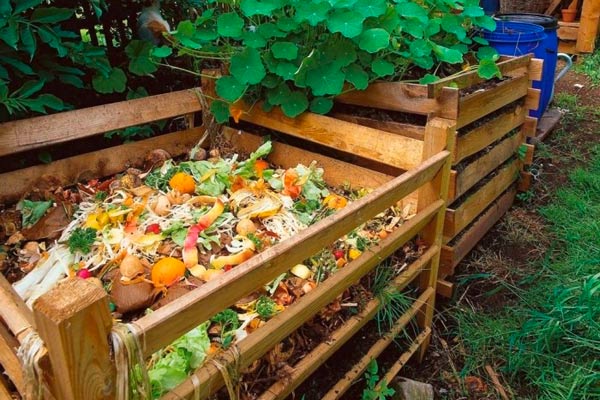
In recent years composting has been included in waste management programmes, because it offers an alternative to separate waste collection, especially in sparsely populated areas of the country. It is prepared from garden leaves, plant residues, kitchen waste such as fruit and vegetable peels, used tea leaves, ground coffee, eggshells. Cardboard, paper and wood shavings can also be added. Composting is a process of decomposition of organic waste in the presence of oxygen, resulting in a homogeneous brownish-black crumbly material suitable for fertilizing agricultural crops and for restoring organic matter in soils.
The most important factors influencing the process are: the presence of oxygen, moisture, the carbon-to-nitrogen ratio, particle size, acidity of the medium and temperature.
For quality compost, an optimal carbon-to-nitrogen ratio of 25:1 is observed, i.e. 25 units of carbon to one unit of nitrogen. “Brown” materials such as branches, straw, dry leaves, wood shavings, cardboard are rich in carbon, while “green” materials such as mown grass, fruit and vegetable peels are moist and rich in nitrogen. Another important factor in composting is the moisture level; it should be around 60%. If a balanced carbon-to-nitrogen ratio is maintained, you will also ensure proper moistening of the compost. The materials should feel moist to the touch, but no water should run out of them. If the compost is too wet, you should add dry “brown” materials. If it is too dry, you risk stopping the composting process; therefore, you should add more nitrogen-rich waste. The microorganisms that form the compost need air to live. During decomposition the volume of the compost decreases drastically, thereby reducing the amount of available oxygen. That is why it is important to turn the contents, ensuring air penetration. The more you turn it, the better. Turning it 1 to 2 times a month is sufficient for a process that will last between 5 and 6 months.
The Ministry of Environment and Water, Waste Management Directorate has prepared a “Home Composting Manual” with the basic rules that must be followed in the composting process in order to achieve excellent results. The manual can be viewed HERE.