Бreznitsa Chestnut – the Bread of the Forest
Author(s): Растителна защита
Date: 07.10.2016
7984
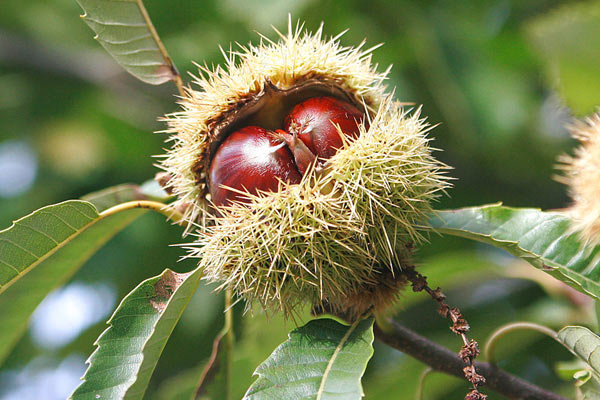
The sweet chestnut (Castanea sativa) originates from Asia. It is found in Southern Europe, Northern Africa, the Caucasus and Asia Minor. There is still debate as to whether its name comes from the Thessalian town of Kastania or the Turkish vilayet Kastamonu on the Black Sea coast of Asia Minor. In Bulgaria it forms natural stands in the south-western part of the country – on the northern slopes of Belasitsa, Slavyanka, Pirin and Ograzhden. The Brezhani chestnut is a unique Bulgarian product that is striving to become a crop of economic importance for the region.
The village of Brezhani is situated at the northern foothills of Pirin and is known for its chestnut forests. In 2003, when the village’s main source of livelihood – the brown coal mine – was closed down, the association “People and Traditions” was established, whose main objective is to protect the area from economic and social isolation and to preserve and promote the well-known edible chestnuts. Even before it was officially registered, the Association began to regularly organise the “Brezhani Chestnut Festival”, which takes place every year in October.
On 21–22 October this year the Brezhani Chestnut Festival will once again be held, featuring a rich culinary and musical programme. “The meaning of this festival lies in the hope it brings to rural people. There is hope when the land of Brezhani bears fruit. The festival is an occasion to highlight Brezhani’s potential, which lies above all in its nature and its people,” says Rumyana Panova, Chair of the Association.
The Brezhani chestnut – a unique Bulgarian product striving for a geographical indication2
As early as 2016, the association “People and Traditions” took a number of steps towards the certification of the Brezhani chestnut as a unique Bulgarian product with a geographical indication from the EC. If it is proven that a given food has important historical significance for a specific region or country, it may obtain European registration, which provides opportunities for increased exports and attraction of investments and tourists. The local association of farmers and chestnut producers will continue the certification stages until the edible chestnut from Brezhani receives its well-deserved place among the other already recognised Bulgarian products.
At the end of 2015, “People and Traditions” and the mayor’s office of the village of Brezhani also launched a nursery with healthy chestnut seeds.
In the future, the establishment of a research unit and a regional centre for chestnuts is envisaged.
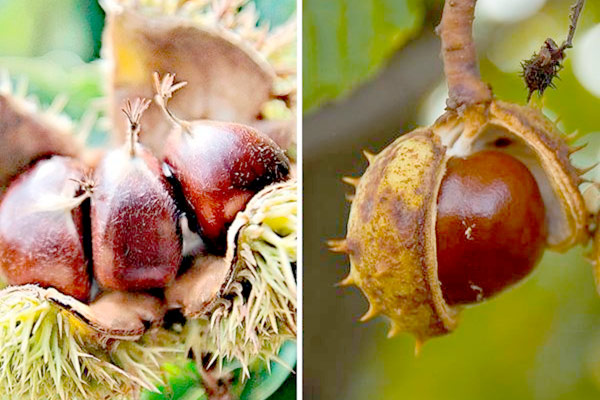
Sweet chestnuts – the bread of the forest
In their properties, sweet edible chestnuts resemble cereals much more than nuts. Due to the high tannin content, chestnuts have an astringent taste and are not eaten raw, but when boiled or roasted part of the starch is hydrolysed into simpler sugars and they become slightly sweet, with the consistency of a bread cream. It is hard to believe, but chestnuts contain almost as much vitamin C as lemons, and they are also rich in vitamins B2, B1 and A. This is why they are an excellent food exactly in their season – late autumn and winter, when the human immune system is weakened. They also contain minerals, the deficiency of which makes us feel tired and exhausted – potassium, phosphorus, magnesium, calcium, sodium, iron, as well as the trace elements copper, fluorine and silicon. Another advantage is the considerable amount of lecithin they contain, which is important for memory, protects against cardiovascular diseases, facilitates metabolism and has an anti-stress effect. It is true that they are full of carbohydrates and quite high in calories (248 calories per 100 grams), but they are rich in fibre and, unlike most nuts, are low in fat.
Sweet chestnuts ripen at the end of September, but can be stored for months, which makes them a suitable alternative to traditional foods during the winter.
Forests of common chestnut (Castanea sativa)
The broadleaved forests in Bulgaria dominated or co-dominated by common chestnut are distributed mainly on the northern slopes of Belasitsa and Slavyanka (above the village of Petrovo, on silicate terrain), the southern slopes of Ograzhden (the valleys of the Gradešnica and Ribniška rivers), Pirin (the northern foothills near the village of Brezhani and near the town of Gotse Delchev) and the Western Balkan Range – in the area of the town of Berkovitsa.
Chestnut forests occupy an area of about 3,000 ha. They develop in the altitudinal range from 300 to 1,150 m (optimum 400–700 m a.s.l.) on slopes with varying steepness and predominantly shady aspects under a moderate and relatively humid climate. Part of the forests are within protected areas – the “Kongura” Reserve, “Belasitsa” Nature Park, “Ali Botush” Reserve and in protected sites of the European ecological network Natura 2000. The common chestnut is also included in the “Red Data Book of Bulgaria”. Forests of common chestnut are of relict origin and host many significant higher plants such as Dactylorhiza incarnata, Ilex aquifolium, Juniperus excelsa, Limodorum abortivum, Medicago carstiensis, Platanthera chlorantha, etc., as well as important fungal species – Amanita caesarea, Boletus luteocupreus.
Diseases of chestnut
Under the influence mainly of climatic factors and in the absence of active silvicultural management, chestnut forests are transforming into communities dominated by beech (Fagus sylvatica) and common hornbeam (Carpinus betulus), which is due to the encroachment of shade-tolerant broadleaved species and the development of degradation processes – crown dieback, defoliation, drying, development of hemiparasites (Loranthus europaeus), diseases (mass development of Cryphonectria parasitica – causing chestnut blight, Melanconis modonia – causing ink disease, etc.).
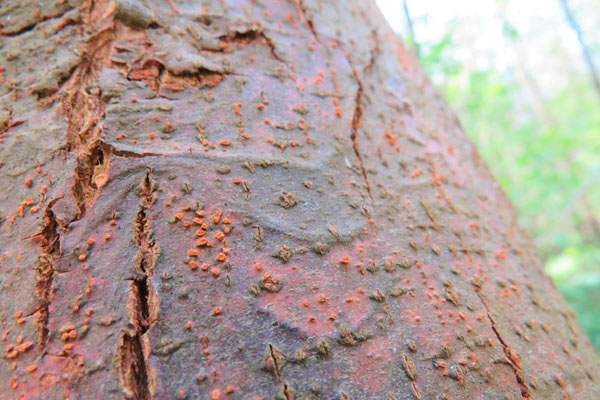
According to specialists, chestnut blight in edible chestnuts was introduced via planting material from East Asia in the 1990s and is difficult to control. Until recently, the disease was considered a quarantine organism in Bulgaria, but it has been detected in the regions of Belasitsa, Petrohan, and others. This parasite is typical of chestnut (Castanea sativa).
The first symptoms appear in summer, when diseased trees turn yellow, young shoots wilt and droop. The leaves are smaller and remain on the branches even in winter. A characteristic sign of the disease is the initial formation of slightly swollen spots, and later of cankers on the smooth bark of the affected branches and stems. The parasite causes rapidly enlarging cankers, and the part above the canker subsequently dies. The trees lag behind in their growth, become physiologically weakened and are attacked by other diseases and insect pests.
The causal agent is the ascomycete fungus Cryphonectria parasitica, but better known under the name Endothia parasitica (Mur.) A. & A..
For the occurrence and development of the fungus, humid weather and mechanical injuries are required, since the spores are spread during rainfall by insects, birds or wind and easily ensure infection through wounds of various origin (artificial or natural). Of particular importance is the weakening of trees due to extreme climate fluctuations, pollution, defoliation of foliage by biotic and abiotic factors. Under our conditions, insufficient tending operations in chestnut stands and plantations should also be noted.
Control measures
Mechanical control – infected trees are removed from stands and plantations, stumps are uprooted and the soil is disinfected with plant protection products. Infected branches are pruned 15–20 cm below the cankers and burned. The cuts are covered with an appropriate wound dressing. Tools used for felling and pruning must be disinfected with pure alcohol or formalin.
Biological control – a hypovirulent strain has been isolated from the fungus, which can be cultured in the laboratory as a pure culture and used for inoculation and suppression of the pathogen in interaction with the normally virulent form of the parasite. This control method is applicable in chestnut orchards for nut production (where cankers are regularly treated) and in chestnut forests of industrial purpose, under conditions of natural spread of the hypovirulent strain.
Chemical control – when the disease appears in nurseries and young plantations, treatment with systemic fungicides can be applied. Work is underway on the identification and introduction of new chestnut varieties resistant to the disease.
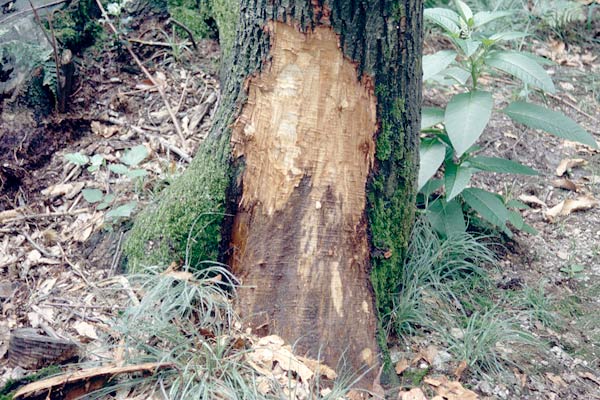
Ink disease of chestnut is manifested by smaller leaves and thinning of the crowns. Gradually the trees die back from the top downwards. These symptoms are a consequence of damage to the root system. On the roots, clearly visible ink-black spots with a diameter of several centimetres are formed. Similar spots also occur at the level of the root collar, from which a dark ink-coloured exudate sometimes oozes. This exudate is considered to be a reaction of the infected tissues against the disease.
The disease is caused by fungi of the genus Phytophthora – Phytophthora cambivora and Phytophthora cinnamomi (the latter has not been reported for Bulgaria). The fungus P. cinnamomi develops in the roots of chestnut, while P. cambivora – most often around the root collar.
Moist, heavy, poorly drained soils are a prerequisite and favourable condition for the development of the disease. The general weakening of chestnut stands and plantations is the reason for the epiphytotic outbreaks of the fungi under consideration. Ink disease affects chestnut stands and plantations of various ages, but is of greater significance in seed orchards and nurseries.
The disease is also widespread in the regions of the Berkovitsa Balkan and Belasitsa and is a cause of dieback in natural and artificial stands.
Control measures
The spread and economic impact of ink disease in chestnut can be limited by various silvicultural measures: sanitary fellings in diseased chestnut stands and plantations; drainage of waterlogged sites in chestnut forests intended for seed production; when establishing plantations and in nurseries, sites where such diseases have been observed should be avoided. Soil disinfection in seedbeds, nursery lines and chestnut plantations is also recommended, using fumigant plant protection products or systemic fungicides. Studies in some countries show that creating suitable mycorrhiza in the soil increases the resistance of chestnut to ink disease. It has been established that some chestnut species show resistance to the disease, e.g. the Chinese chestnut, which can be used as a rootstock to ensure greater resistance of grafted plants.
2 A geographical indication covers two objects of intellectual property, namely – designation of origin and geographical indication. A product that is labelled in Cyrillic and bears a geographical indication is an authentic Bulgarian product. As agriculture is becoming increasingly competitive, the European Commission provides opportunities for financing through the so-called promotional programmes. When there is established production and associations and organisations of producers have been created, they may apply for aid for promotion within the EU and in third countries.
* The article was updated on 20.10.2023.