Drosophila suzukii attacks peaches in the Sliven region
Author(s): д-р Елена Манчева, Виола АЕ – Сливен
Date: 24.06.2016
5143
The Sliven region is known for its peaches, which are grown on 23,124 decares. A large part of the orchards are under drip irrigation. The varietal composition is very diverse; they start ripening from June until the end of August. For many families in the area, peach growing is the main livelihood and they provide the necessary care for them. In 2013 we established damage to ripening and ripe fruits caused by an unknown pest.
Initially, a small hole could be observed on the peaches – like a pinprick; subsequently, water and pathogens enter through this hole, the fruit rots, and as it enlarges, the opening made by the pest also widens.
In 2014 the damage to the fruits reached its peak. There were orchards in which 50–60% of the fruits on the trees fell to the ground. The highest damage occurred in the villages of Kovachite, Panaretovtsi and Rechitsa. We started looking for the cause and assumptions appeared about Drosophila suzukii, but we were not certain.
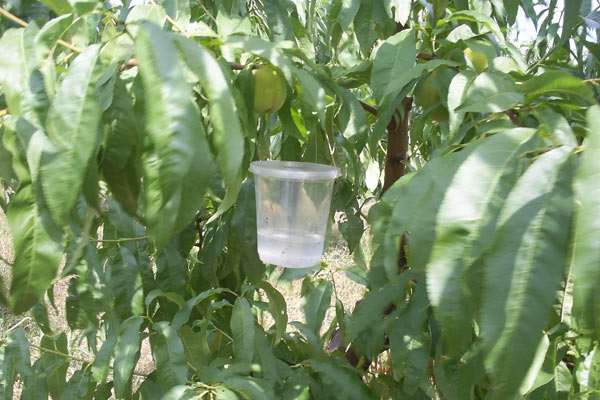
Therefore, in 2015 we set ourselves the goal of identifying the cause of the damaged fruits. We set traps in orchards in the village of Kovachite and the Rechitsa quarter. The traps are transparent plastic cups that can be closed. In 5–6 places on them we pierced small holes with an awl. We prepared a food bait from water, sugar and vinegar. We placed 1 trap per decare, or 5 traps per orchard, at a height of 1.5 m. We set the traps on 15.06.2015. We replaced them once a week (at the end of the week), and we performed monitoring twice a week.
The orchard in the Rechitsa quarter – 160 decares, is oriented north–south. On the north it borders an irrigation canal of the Sredna Tundzha – Sliven branch, where it is more airy and more humid. Therefore, there we recorded a higher number, 15–20 specimens. After 6–7 July the weather turned cooler and only 2–3 specimens were caught in the traps. In our opinion, the high temperatures during that summer were the reason for the lower activity of the Drosophila.
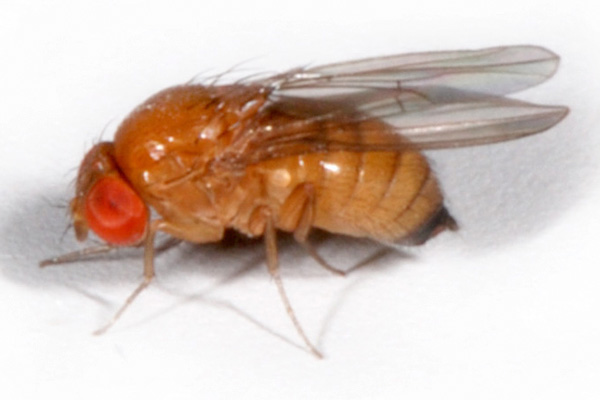
According to the literature, Drosophila suzukii can develop up to 15 generations per year and has a high reproductive potential. The larvae develop inside the fruit.
D. suzukii is active at temperatures of 20–30°C, while the temperatures in the region exceeded 30°C and reached 35–37°C almost throughout July and August. Compared to 2014, 2015 was more favorable for peach producers with regard to the pest due to the high temperatures.
The most heavily attacked varieties were Elegant Lady, Nectarine and Fayette. Against the pest we used pyrethroids – we monitored the individual varieties and sprayed them before ripening. In addition, the control of D. suzukii was carried out simultaneously with the control of the oriental fruit moth and Anarsia. Pheromone traps were installed for both pests. Monitoring was carried out simultaneously.