


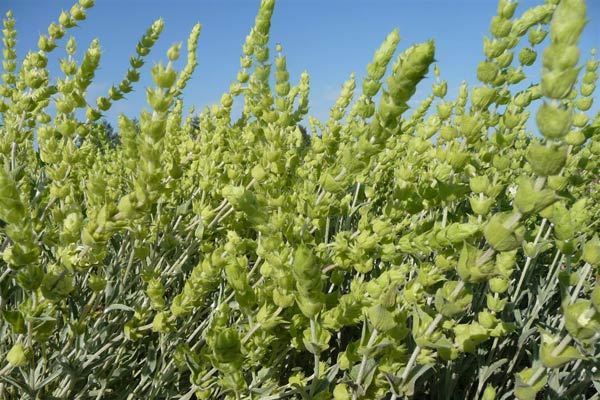
The holiday of Enyovden is associated with Slavic folklore traditions and has very precise correspondences in the customs of other Slavic peoples, where it is linked to similar rituals: lighting bonfires and jumping over them, burning a straw doll, divination for fertility, bathing in rivers, gathering herbs and adorning couples with wreaths. It is believed that on Enyovden various grasses and herbs have their greatest healing power, especially at sunrise. The herbs gathered for winter should be “77 and a half” – for all diseases and for the “disease without a name”. One of these herbs is Mursal tea (Sideritis scardica Grisb.), a Balkan endemic species with the status of endangered for the country, which is known worldwide as the plant of longevity.
Bulgaria is the largest producer and exporter of medicinal plants in Europe and ranks sixth in the world. According to unofficial data, of the 250 species of medicinal plants used in medicine, more than 100,000 tonnes are collected in the country and the larger share is exported. About 50% of the quantities of medicinal plants obtained in Bulgaria are from cultivated plants. The certified organic areas from which wild fruits, medicinal plants and mushrooms are collected amounted in 2014 to 694,251 ha, which is 16,226 ha more than the previous year, according to data from the annual reports of the Ministry of Agriculture and Food. Since the application of the new European legislation in the field of organic farming (2009), the areas occupied by wild-growing crops (mushrooms, medicinal plants and wild berries) have increased from 401,425 ha in 2009 to 678,025 ha in 2013.
The plant of longevity, known worldwide for its properties to slow down ageing, is also part of the herbal diversity of our country. In June and July the Rhodope and Pirin Mountains are coloured in the lemon-yellow flowers of Mursal tea, which is distributed at altitudes from 1,400 to 2,200 metres.
Mursal tea
Mursal tea (Sideritis scardica Grisb.) is included in the Red Data Book of Bulgaria with the status of a Balkan endemic endangered in the country. From 1942 to 2002 it was listed among the protected plant species. At present, the species is subject to a special regime of conservation and use, with a ban on collection from natural habitats.
In Bulgaria it is distributed in Central and Southern Pirin, the Mursal section of the Rhodope Mountains, Rzhana Mountain and Slavyanka Mountain (Alibotush). It is also found in some mountains in Greece, the Republic of North Macedonia and Albania.
Pirin tea (Sideritis scardica) is a perennial herbaceous plant of the family Lamiaceae, reaching 50 cm in height. The flowers are yellowish, arranged in whorls in the axils of lemon-yellow, papery bracts in spike-like inflorescences. It is also known as Mursal, Trigrad, Alibotush and Shar Mountain tea. In fact, the specific epithet scardica comes from Scardus – the Latin name of Shar Mountain, where it was found and described by the Göttingen botanist August Grisebach.
It contains tannins and essential oils, iron, zinc, sodium, magnesium, copper, cobalt. Due to its high content of flavonoids, it has antibacterial and antioxidant effects.
The harvesting of Mursal tea from natural habitats was banned in 2016.
By order of the Minister of Environment and Water, a ban has been introduced on the collection of Pirin (Mursal) tea (Sideritis scardica Grisb.) from natural habitats, including for personal use. Until now, the restriction applied only to commercial activities involving wild-growing tea and the ban did not apply to quantities collected for personal use – up to 2 kilograms of stalks per person per day. The aim is to improve the condition of the natural habitats and to strengthen control over the conservation of the medicinal plant. The sale of medicinal plants from cultivated Mursal tea remains permitted, after the issuance of a certificate by the respective municipal administration containing data on location, area and quantity of medicinal plants produced.
RIEW – Smolyan has sent letters to the Regional Forestry Directorate – Smolyan, municipalities, mayoralties and forest holdings in whose territories Mursal tea occurs, in order to exercise control in accordance with their powers. The fines envisaged in case of established violations range from BGN 100 to 1,000, and the respective property sanctions from BGN 500 to 3,000.