Leaf-chewing caterpillars are major pests of fruit trees
Author(s): Растителна защита
Date: 20.06.2016
10468
Usually, pests are specialized to feed on one or several plant species. But there is one group that “does not choose” – the group of polyphagous pests.
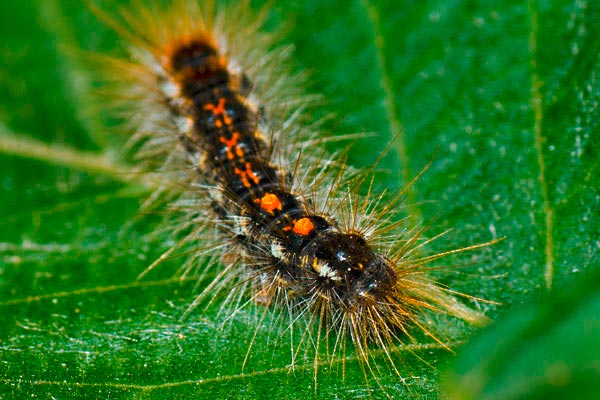
The mild winter created favourable conditions for the overwintering and multiplication of the so‑called leaf‑feeding caterpillars – gypsy moth, lackey moth, brown‑tail moth, goldtail moth, etc. – butterflies. Therefore, this spring there was a “boom” in their harmful activity. Their caterpillars devoured the leaves and flower buds of many fruit species – apple, quince, pear, plum, apricot, sweet cherry, sour cherry, medlar, already early in spring and continued their harmful activity during April–May, when, already grown, they feed most voraciously. They consumed a large quantity of leaf mass, damaged fruit buds, and even defoliated some trees.
A complex control strategy must be applied against leaf‑feeding caterpillars.
The first step in the control of leaf‑feeding caterpillars is taken already in autumn
Orchards should be kept in good condition, because physiologically weakened trees are attacked more severely. Already in the autumn of the previous year, to reduce their numbers, remove and destroy the dried and egg‑ring infested branches, collect and burn the caterpillar nests, scrape off the old cracked bark (with a blunt knife so as not to damage the cambium). After pruning, coat the wounds with oil‑based paint, horticultural putty or ready‑made paste.
Chemical control
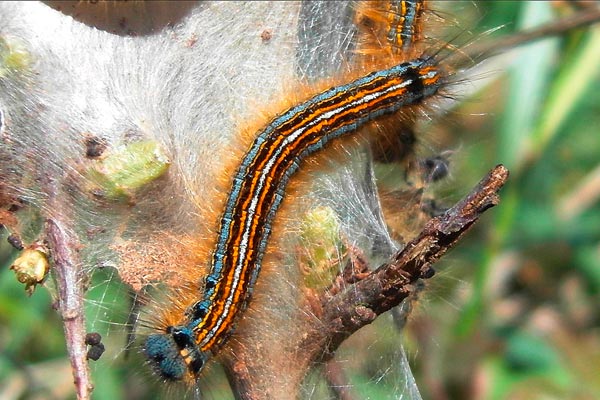
Chemical control of leaf‑feeding caterpillars is effective mainly before flowering, when pest density is high. Target the caterpillars, but you can rely on success only if they are up to the third instar. The “aged” ones are not affected by the products. The caterpillars of the goldtail moth and the lackey moth are easy to recognise because they are very large – reaching 6–8 cm, coloured grey‑brown, with tufts of long hairs on the body, with blue and wine‑red warts, yellow stripes and a large grey head.
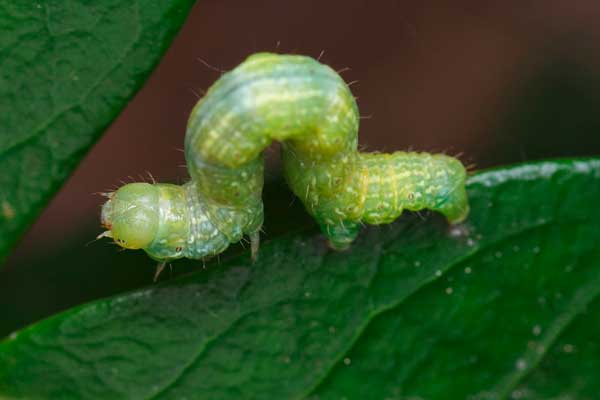
During flowering in orchards you may also be unpleasantly surprised by the caterpillars of inchworms. They are of different species and differently coloured, but they all have one characteristic feature – when moving, they bring the rear part of the body towards the front part, resulting in a span‑like “measuring” movement. The presence of inchworms in the orchard can be easily established. If you clap your hands loudly close to the flowers, the caterpillars immediately raise their heads and remain motionless – in this position they resemble a dried twig.
When fruit trees are in bloom, some leafrollers also cause damage by binding the flowers and leaves in a light webbing. They multiply more in orchards where the soil is not tilled or which are close to forest stands. Spraying is carried out during flowering with bacterial preparations.
It is already mid‑June and you can somewhat relax from these pests, but do not forget them and start your control measures against them already in autumn!