

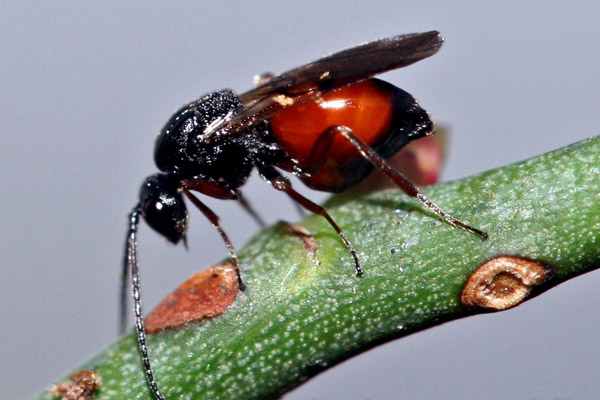
The rose gall wasp (Diplolepis rosae) belongs to the family Cynipidae (gall wasps), which cause the formation of galls. These are the result of a very specific type of relationship between insects and plants. In general, galls appear as a consequence of pathological development of cells – hypertrophy (through an increase in cell size) or hyperplasia (an increase in the number of cells). Galls caused by harmful organisms are called “Cecidozoa”. There are 13,000 known species of insects that cause the formation of galls, representing 2% of all described insect species. Most often, galls are caused by insects belonging to three orders: Diptera, Hymenoptera and Hemiptera.
Gall-forming wasps of the family Cynipidae number about 2,000 species, which are among the best-known gall-forming insects in Europe and North America. Many of the species form various galls, especially on roses and oak (Gullon et all., 2000).
In 2007 we identified the pest in a young rosehip plantation in the village of Babuk, Silistra region, where 30% of the plants were damaged. The galls of the rose gall wasp are 45 to 80 mm in size, reddish-brown, with numerous protuberances on the surface and resembling mossy balls. They are located singly on the shoots. The damage is very specific and can be easily observed on the bushes. In our country the rose gall wasp is listed as part of the complex of pests established on the oil-bearing rose by Nikolova (1969).
From the collected galls, the adults emerged in May, which means that the pest overwinters as a larva or pupa in the galls. The adult insect is a small wasp, 4–5 mm long, with long antennae. The head and thorax are black, and the abdomen is dark brown and laterally flattened. The legs are brown.
The biology of the pest is poorly studied. According to literature data, the larvae overwinter, with each larva located in a separate chamber. For the conditions in Russia it is reported that adults fly in May–June, and for Germany in June–July. The females lay their eggs in the stems of the rosehip. As a result of the specific relationship between the insect and the plant, galls are formed, mainly on the apical part of the stems. The larvae develop inside the galls, where they are protected from predatory insects.
To reduce the population density of the pest and limit the damage caused by it, old galls must be cut out before the flight of the adult insects and burned.