Powdery mildew on vegetable crops of the family Solanaceae
Author(s): проф. д-р Стойка Машева, ИЗК "Марица" Пловдив
Date: 01.07.2022
11729
Powdery mildew is a common disease affecting many vegetable species. The pathogens that cause it are different – Erysiphe spp., Sphaerotheca spp., Leveillula spp. and Oidium spp. Each pathogen attacks only specific plant species.
Among the vegetable crops affected by powdery mildew are tomatoes, cucumbers, peppers, eggplants, carrots, watermelons, melons, other cucurbits, peas, common beans, lettuce, leafy salads, as well as potatoes. For its development, powdery mildew usually does not require a drop of water for the germination of conidia, but it does need high air humidity and temperature.
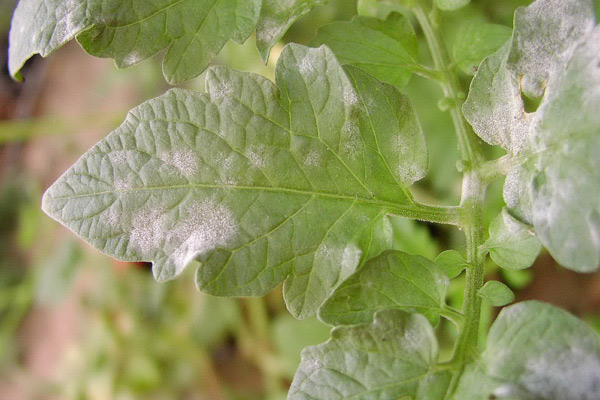
The disease is characteristic of the dry Mediterranean regions in Israel, Turkey, Greece, Spain and others. For some of the cultivated vegetable crops it ranks second in economic importance after downy mildews. The spread of the infection occurs through air currents, which carry the conidia from diseased to healthy plants. When there is a favourable combination of warm weather and air humidity, the conidia germinate and infect the healthy plants. The first symptoms are associated with the appearance of light spots covered with a white, chalky coating on the entire plants – leaves, stems, flowers and fruits. Later, the leaves turn yellow, scorch, and sometimes fall off. As a result, the fruits become exposed and sunscald appears on them. Diseased plants form a lower yield, the fruits remain small and ripen prematurely, and the vegetation period is shortened.
All powdery mildews develop on vegetating tissues. The causal pathogens are obligate parasites; therefore, the presence of cultivated and weed hosts throughout the year is a necessary condition for their development. They cover the surface of leaves, stems and fruits with a white, powdery coating of mycelium and spores of the pathogen. The latter are spread by air currents and infect new plants. The development of the pathogen and the conidia is highly sensitive to direct sunlight.
The disease is widespread worldwide, both in protected cultivation structures and in the open field. Crop losses can reach up to 50% when infestation is severe.
Control
Preventive measures are of great importance for the successful management of this dangerous disease:
- High levels of nitrogen fertilization should be avoided. Optimal and balanced fertilization rates should be applied;
- Optimal crop density to ensure normal air circulation. Crowding and shading should be avoided, as they may lead to increased air humidity around the plants and create favourable conditions for the pathogen;
- Crops should not be irrigated by overhead sprinkling;
- Young plants should not be grown and planted in facilities where there are older diseased plants;
- Cultivation of resistant or less susceptible varieties. This is the most radical method of control. Research shows that different varieties have different susceptibility to the causal agents of powdery mildew. Sources of resistance have been found in wild species;
- Maintaining the fields and the area around them free from weeds;
- Monitoring of the fields. Early detection of the disease is important, because early control will limit the development and the degree of infestation by the pathogen. Monitoring should be carried out weekly;
- Removal of infected leaves is not a good agricultural practice, because in this way the spread of the pathogen spores will increase;
- Treatment with plant protection products (PPP) at the appearance of the first spots or when their occurrence is forecast. The aim is to protect the plants and to destroy the infection that has already appeared. There are registered biological and conventional PPPs that can be successfully used for control. Conventional products are chemical PPPs;
- Biological products may include vegetable oils and extracts, biofungicides, and sodium bicarbonate. Vegetable oils from sesame, rosemary, thyme and neem are effective. Oils should not be applied during drought and at high temperatures, because they will cause scorching. Biofungicides are based on active strains from the genera Bacillus and Streptomyces. Sodium bicarbonate has pronounced antifungal properties and contributes to early control of powdery mildews. The literature reports effective control with aspirin or organic milk. The most effective preventive treatment is with sulphur, with liquid sulphur being more effective than wettable sulphur. Treatment with it should be carried out in the morning or evening, when temperatures are not high, because scorching of the leaves may occur. If the plants have previously been treated with oils, sulphur should be used no earlier than two weeks later. Conversely, if the crops have been treated with sulphur, the use of oils should also be at least 2 weeks later.
In the USA a forecasting model based on meteorological conditions has been developed, which provides information on the approaching risk and the need to treat the plants. Plant protection treatments are usually carried out once a week or after rain, for maintenance and control. The causal agents of powdery mildew easily acquire resistance to the PPPs used. Therefore, they must be alternated. An important element is high-quality application – complete coverage of the leaf surface;
- When choosing PPPs, account must be taken of their pesticidal properties, effectiveness, pre-harvest intervals and period of application, their impact on honey bees, their effect on beneficial species and on the environment;
- Maintaining the relative air humidity below 85.4%;
- Ensuring good air circulation within the crops;
- Removal of plant residues at the end of the vegetation period;
- Cultivation of resistant varieties;
- Introduction of crop rotations.