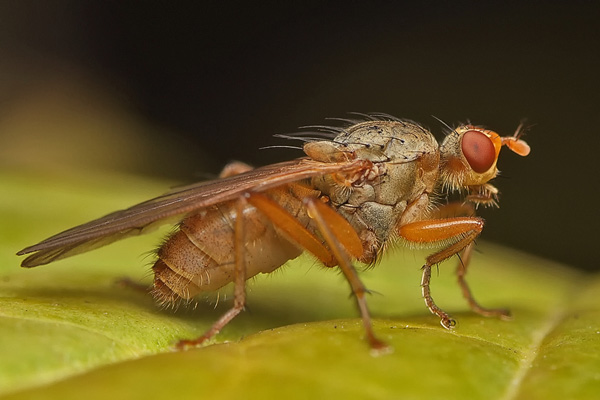
At the first warming of the weather in February, as soon as the temperature exceeds 10°C for 6–7 days, the flight of the fly is expected. This coincides with the appearance of the housefly. The garlic fly resembles it, but it is hairy and rust-brown in colour.
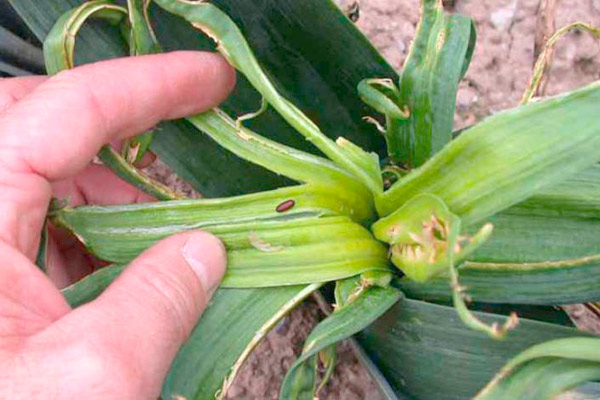
The adults of the garlic fly fly low or crawl on the soil surface, choosing sunny, warm places. The flies lay 1 egg each around the base of the plants or on the soil in their immediate vicinity. They prefer healthy and better developed plants – with 2–3 leaves and a height of 10–15 cm. The attack is stronger on areas heavily fertilised with farmyard manure. After hatching, the larvae bore into the central leaf of the young plant and move downwards towards the unformed bulb. The leaf wilts, turns yellow, droops and curls like a spiral, and eventually dries out. Later, all the leaves turn yellow, wilt and dry out. Only one larva is found in a single plant. Damaged plants lag in growth and development, weaken, in some the stem remains hollow and the bulb softens. When pulled out, the plants break at the damaged site. After about 28–35 days the development of the larva is completed and it gnaws through the bulb, goes into the soil, where it pupates at a depth of 10–18 cm. In this way it remains until the following year. The garlic fly attacks winter garlic and onions sown in the previous autumn.
Successful control of this pest can be achieved only if a system of measures is applied:
- Do not grow garlic on the same plot or close to a plot where the same crop was grown the previous year.
- Plant on areas not fertilised with farmyard manure.
- Deep ploughing of the area after harvesting the garlic in order to destroy the pupae.
- In yards and on small areas the adults are attracted and caught in food traps prepared as follows: 5–6 cloves of garlic are crushed into a paste, 40 ml wine vinegar, 40 g sugar and 150 ml water are added, mixed well and placed in small containers, which are arranged in a chequerboard pattern. Every few days they are checked for captured flies, thus determining their appearance, mass flight and population density.