'Ground bees are disappearing, and with them, part of our food'
Author(s): агроном Роман Рачков, Българска асоциация по биологична растителна защита
Date: 19.05.2026
1398
![MultipartFile resource [file_data]](/assets/img/articles/заглавна-пчели-20-май.jpg)
Early warming and extreme weather put key pollinators in Bulgaria and entire ecosystems at risk.
Highlights:
- Mountain bumblebees are increasingly retreating to higher altitudes to escape the warming climate, but mountains are not infinite, and their habitats are gradually shrinking.
- Warmer winters awaken bees earlier, and subsequent cold spells destroy flowers, leaving colonies without food.
- Droughts, heavy rains, hailstorms, and pesticides act as a "lethal cocktail" for bumblebees in Bulgaria.
- The disappearance of bumblebees threatens not only biodiversity but also the production of fruits and vegetables, as they are among the most effective pollinators for crops such as tomatoes, peppers, and strawberries.
- In some regions of Bulgaria, bee colony mortality already reaches 80–90%.
On May 20, the world marks Bee Day. We celebrate these invaluable pollinators and remind ourselves how essential an element they are in our ecosystem. But at the same time, one of the most important species for nature and for us humans—the bumblebee—is disappearing from parts of Bulgaria. Climate change disrupts its life cycle: from early spring warming and late frosts to prolonged summer droughts.
The Invisible Crisis
Forget about honey for a moment. This is about something more fundamental—nature's ability to reproduce itself. Bulgaria is one of the most biodiverse countries in Europe, but scientists and beekeepers are recording alarming changes. Populations of bumblebees (Bombus)—the furry, slow cousins of the honeybee—are under unprecedented pressure.
They are quietly disappearing from our meadows and forests, and the main culprit is the changing climate. Their delicate life cycle, synchronized with the changing seasons for millennia, is now being rapidly and irreversibly disrupted.
The Special Buzz That Feeds Ecosystems
The importance of bumblebees for ecosystems cannot be overstated. They are among the most effective pollinators in the temperate climate zone. Unlike honeybees, which are social insects with large colonies, bumblebees live in smaller families but compensate for this with exceptional efficiency in pollinating certain crops.
Their ability to perform so-called buzz pollination—buzzing at a specific frequency that releases pollen from the anthers—makes them indispensable for tomatoes, peppers, eggplants, blueberries, and strawberries, as well as a number of other plants. Therefore, their disappearance also represents a serious economic threat.
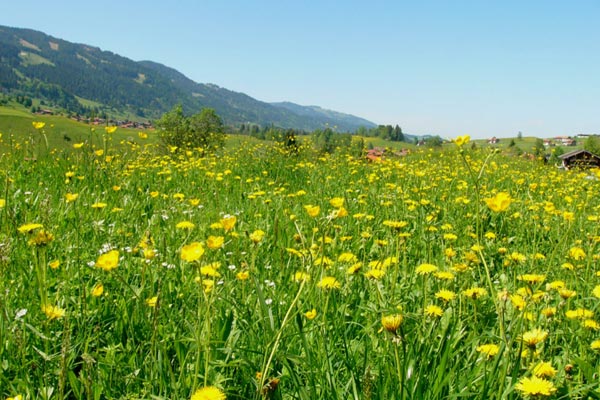
Natural meadow / Source: Wikipedia

Economic Consequences Without the Super-Pollinator
Value of Pollination
According to various estimates, the economic value of insect pollination globally is assessed at over 150 billion euros annually. Bumblebees contribute a substantial share to this sum, especially for high-value crops.
In Bulgaria, the production of tomatoes, peppers, and strawberries is highly dependent on them. The decline in their numbers is already leading to poorer pollination, fewer and more deformed fruits. This is felt by producers of cherries, apples, and peaches in the country, with 2025 being described as an "absolute zero" year for cherries in some regions.
Farmers report 50-70% lower yields in fruit crops, attributed to a combination of late frosts that destroyed blossoms and a lack of pollinators during the short flowering window.
In the long term, the continued decline of pollinators could lead to a restructuring of agriculture. Farmers will be forced to abandon crops that are highly dependent on pollination and switch to cereals or others that do not require pollination. This would lead to loss of livelihood and a deterioration of the nutritional balance.
The Twins: The Generalist and the Specialist
In Bulgaria, as in all of Eastern Europe, the most common species are two very closely related but ecologically distinct ones: "Bombus terrestris" – the buff-tailed bumblebee and "Bombus lucorum" – the white-tailed bumblebee.
Scientists considered them identical for a long time, as they are difficult to distinguish visually. Only with the help of genetic analysis have we been able to peer into their secrets in recent years. They have fundamentally different habitat requirements, which makes them an excellent indicator of climate change.
A 2020 study in Romania and Bulgaria revealed an important difference: the two species are distributed according to altitude.
The buff-tailed bumblebee is an exceptional generalist: it thrives in open, warm, and even heavily human-modified landscapes. This is the species we most often see buzzing around gardens and parks in the lowlands. It has successfully colonized urban environments and copes relatively well in agroecosystems, provided there are sufficient food resources. The generalist could survive in warmer conditions and is more flexible in its food choices. This is likely why it will occupy an even larger territory in the lowlands, becoming the dominant species.
Its close relative, the white-tailed bumblebee, however, is in a much more vulnerable position.
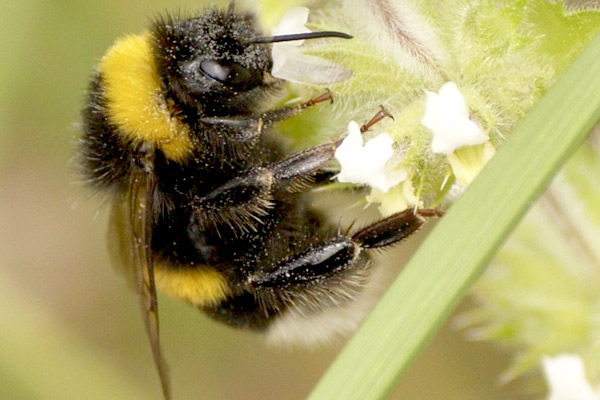
Buff-tailed bumblebee (Bombus terrestris), The Generalist. Source: iNaturalist
|
The white-tailed bumblebee can only flee from warming in one direction — upwards. It is a timid specialist, closely associated with cool and moist forest habitats. In our country, it is found mainly in the mountains and at higher altitudes, seeking refuge in the cool, damp forests of Rila, Pirin, the Balkan Mountains, and the Rhodopes. This dependence makes it highly vulnerable to climate change. As temperatures rise, suitable habitats gradually shrink, and the bee is pushed higher and higher towards the peaks. If this continues as a trend, the species will face a serious risk of local extinction. |
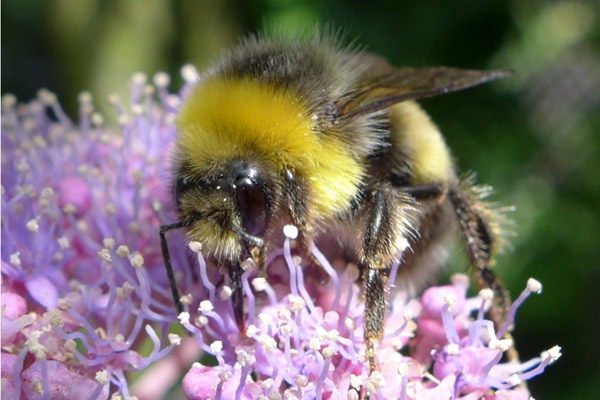
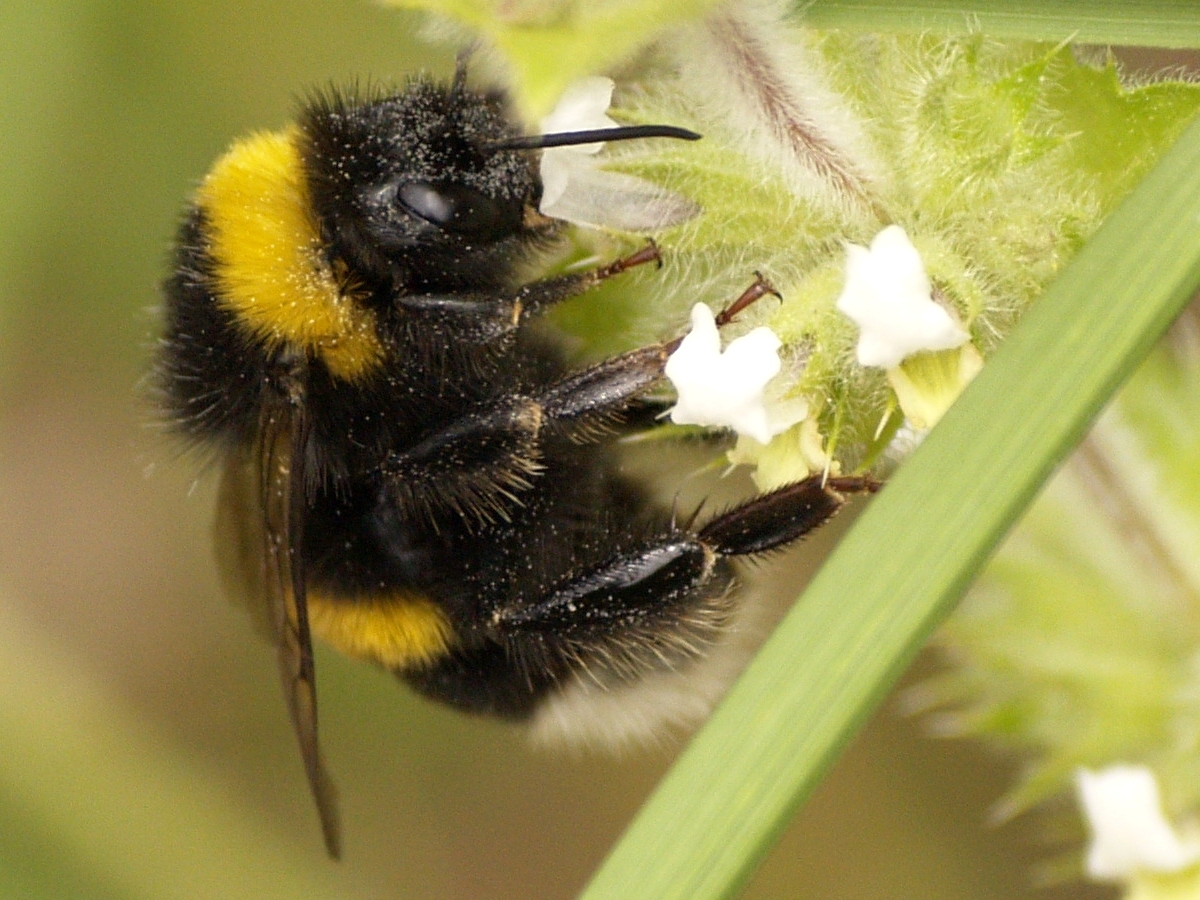
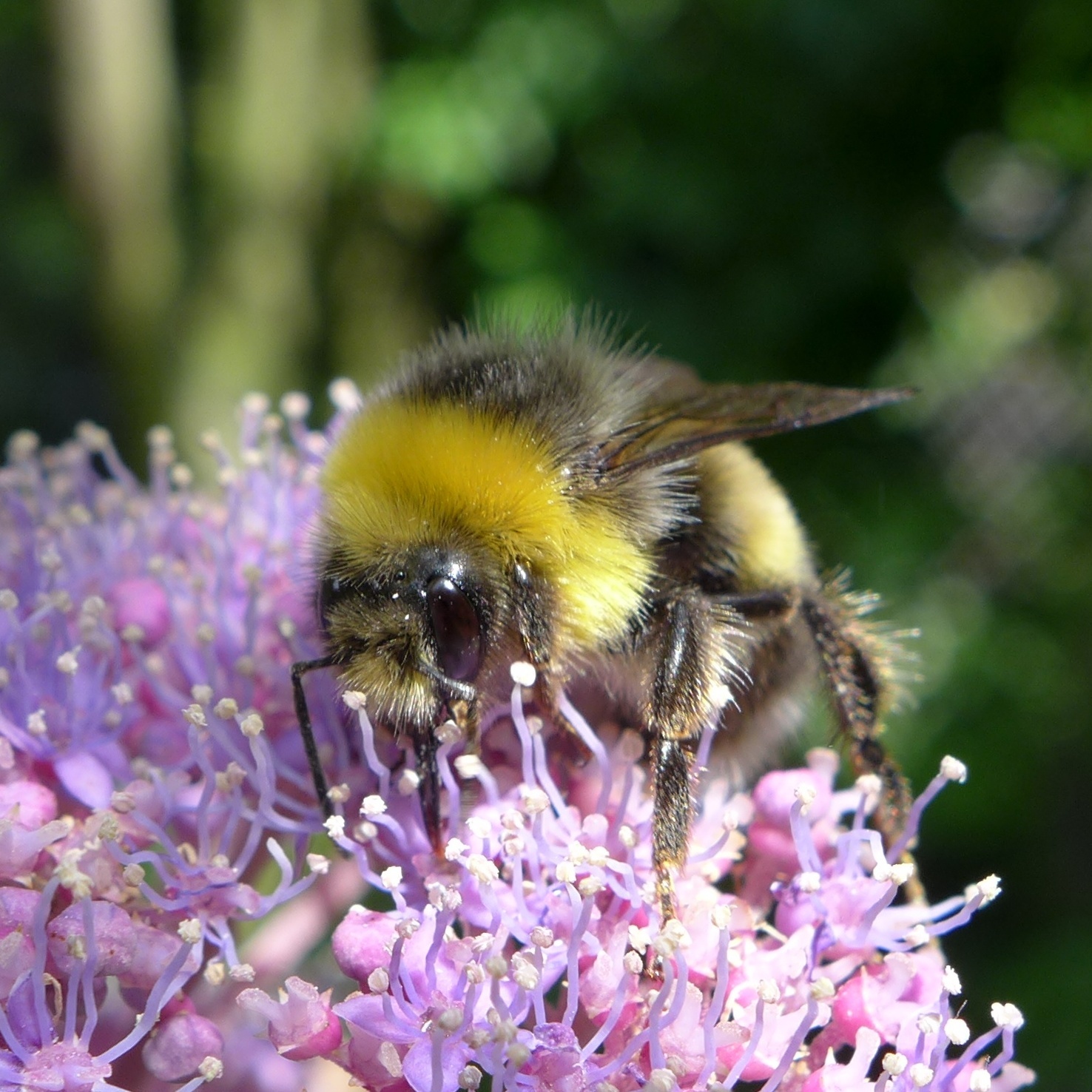
Bumblebee worker collecting pollen / Source: iNaturalist
Flowers, Cold, and Hunger
The main blow of climate change to these important insects is not the rise in average temperatures, but the extremity and unpredictability of the weather. In recent years, winters have become milder, with January and February often surprising us with spring-like temperatures. This is a trap for bumblebees.
Early warming disrupts their biological rhythm. The queens—the only survivors from the previous year—must establish new colonies, but they awaken from hibernation earlier, set out to find food, and nature is not yet ready. Plants, also deceived by the warm weather, may sprout, but there are still no flowers for nectar.
Late spring frosts are now common even in April and May. They destroy the young shoots and blossoms of fruit trees and wild plants. Thus, the awakened and hungry queens cannot find food to nourish their first generation and perish before establishing a colony.
The Cascading Effect
If weakened by malnutrition due to early awakening or if it cannot find enough food, the queen either dies or produces fewer and weaker workers. This leads to a downward spiral: weaker colonies produce fewer new queens at the end of the season...
With the decline of successful colonies, the overall population decreases. This leads to a loss of genetic diversity, which further reduces the species' ability to adapt to changes. Isolated populations in the mountains become increasingly vulnerable to local extinction from random events such as fires and diseases.
From Cold to Desert: Summer Droughts
If the colony nevertheless manages to establish itself, the next challenge awaits—summer. In recent years, we have observed rapidly arriving summers, extremely high temperatures, and severe drought, sometimes lasting 4 to 6 months. This turns flower fields into dusty deserts: plants stop blooming and producing nectar.
Bumblebees, which have short tongues and rely on shallow flowers like clover and dandelion, are left without food during the peak of the hot season, precisely when their colony needs the most resources to raise new queens for the following year.
About Heavy Rains and the Bumblebee
Extreme weather events such as heavy rains, floods, and hailstorms have become more frequent in recent years. Bumblebees nest primarily in the ground—in abandoned rodent burrows, under stones, or in hollows. Thus, entire nests are flooded and destroyed. Hailstorms kill bees but also cause serious damage to plants by destroying flowers and leaves.
The Toxic Cocktail – Climate, Pesticides, Diseases
Climate also interacts with other stress factors, most notably the widespread use of pesticides in agriculture and the spread of diseases and parasites.
A large-scale study by biologists from Plovdiv University "Paisii Hilendarski" over the last seven years found over 35 different pesticides with toxic effects in samples from dead bees.
Under conditions of climatic stress—malnutrition, dehydration, and disease—the bees' immune system is weakened. Toxins that might not kill them under normal conditions now cause irreversible damage at the cellular level. The combination of chemical and climatic stress proves fatal.
The situation is further aggravated by the presence of banned substances. Pesticides with the active ingredient chlorpyrifos have been banned in the EU since 2019, but they continue to be detected in honey samples and in winter bee food. This indicates either illegal import and use or extremely slow degradation of these substances in the environment.
Intensive Land Use
A 2025 study in the Ihtimanska Sredna Gora mountains reports low bumblebee activity near agricultural areas. Scientists link this to the intensification of agriculture over the last decade and the gradual disappearance of wild spaces around fields. Comparison with data from previous years shows a serious decline in the diversity and abundance of pollinators. Wild and uncultivated territories prove to be important refuges for pollinators.
The Domino Effect Across the Entire EcosystemBumblebees pollinate a large number of wild plants. Their decline leads to poorer pollination and weak seed reproduction of these plants. This affects plant communities and leads to the dominance of wind-pollinated species or species that reproduce vegetatively. Other animals that depend on the fruits and seeds of these plants also suffer. |
High Bee Mortality is a Chronic Problem for Bulgaria
Data from various regions of Bulgaria piece together an overall alarming picture for the country. In Northern Bulgaria (Ruse region), winter mortality in 2025 is between 50 and 70%. Beekeepers from the region report that the problem is worsening every year and that traditional methods of winter feeding are no longer sufficient.
In Southern Bulgaria (Yambol region), mortality reaches 80–100% in some apiaries. This is due to a combination of a warmer climate, more intensive agriculture, and higher pesticide use.
In the Ihtimanska Sredna Gora mountains, 2025 studies show very low bumblebee activity near agricultural areas, while relatively normal activity is still observed in more remote forest areas. This confirms the thesis that forested areas serve as a refuge for more sensitive species.
Beekeeping organizations are calling for urgent state aid, noting that high mortality is already a chronic problem. The result is long-term physiological degradation—the fat body and hemolymph of bee larvae change, underdeveloped and deformed bees with low viability, reduced immunity, and a lower tolerance threshold for parasitism emerge.
The Way Forward
Saving the bees requires simultaneous political decisions, changes in agriculture, and greater public engagement. A National Strategy for the Protection of Pollinators is needed to limit pesticide use, introduce stricter controls on spraying and the illegal import of banned substances, as well as early warning systems for beekeepers.
An important step is also the creation of buffer zones around arable land, sown with native plants that bloom throughout the season and provide refuge and food for pollinators.
In agriculture, the application of integrated pest management and biological methods instead of heavy reliance on chemical preparations is becoming increasingly necessary. Maintaining diverse habitats—hedgerows, forest belts, and old forests—will provide places for feeding, nesting, and overwintering. Pollinator-friendly production practices, which can be encouraged through special certifications and market incentives, will also become increasingly important.
Society also has a role—through educational campaigns and participation in initiatives for monitoring wild pollinators. Even small actions like planting nectar-rich native flowers, leaving unmowed areas, and avoiding pesticides in home gardens can help create a more favorable environment for bees and other pollinators.
The fate of bumblebees shows how closely climate, nature, and our food are connected. When pollinators disappear, the consequences do not remain in the wild; they also catch up with agriculture, food prices, and the resilience of the ecosystems on which we humans depend.
Cover photo: Photo by Sandy Millar / Sandy Millar - source: Unsplash for free use
Source: Climateka
Sources used in the text:
- Plovdiv24. (2025). Producers from the Plovdiv Region: Bees are Dying, Fruits are Disappearing, the Natural Balance in Bulgaria is Collapsing : www.plovdiv24.bg
- Geue, J.C. & Thomassen, H.A. (2020). Unraveling the habitat preferences of two closely related bumble bee species in Eastern Europe. Ecology and Evolution, 10(11), pp.4773-4790 : pmc.ncbi.nlm.nih.gov/articles/PMC7297791/
- Kozuharova, E., Ljubomirov, T. & Uzunov, D. (2025). Where have the bumblebees and other wild bees gone? – preliminary results of rapid evaluation in grassland habitats near agricultural fields in Ihtimanska Sredna Gora Mts (Bulgaria). Historia Naturalis Bulgarica, 47(4), pp.69-84 : nmnhs.com/historia-naturalis-bulgarica/
- Rasmont, P., et al. (2015/2025). Climatic Risk and Distribution Atlas of European Bumblebees. Pensoft Publishers: Emory Libraries / FAO AGRIS
- Zemedeleca.bg. (2025). Why do bees continue to die from substances that are supposedly not used? :/zemedeleca.bg
- Zemedeleca.bg. (2025). Beekeeping organizations call for urgent aid due to high winter mortality: zemedeleca.bg
- Potts, S.G., et al. (2016). The European Pollinator Monitoring Scheme: A proposal. STEP Project Final Report: ec.europa.eu
- IPBES. (2016). The assessment report of the Intergovernmental Science-Policy Platform on Biodiversity and Ecosystem Services on pollinators, pollination and food production. Secretariat of the Intergovernmental Science-Policy Platform on Biodiversity and Ecosystem Services, Bonn, Germany.
- A short guide to 10 bumblebee species key for Bulgaria: bumblebee.cv