'Agrotechnical activities in perennial plantations during May'
Author(s): ас. Кирил Кръстев, Институт по декоративни и лечебни растения – София
Date: 05.05.2026
1175
![MultipartFile resource [file_data]](/assets/img/articles/заглавна-агро-май-2026.jpg)
In May, the atmosphere over Europe will gradually transition to a more typical summer regime, but without lacking periods of instability. For Bulgaria, this means a month with frequent changes – alternating warmer and sunnier days with periods of precipitation, thunderstorms, and temporary cooling.
May will be typically spring-like, with a dynamic atmosphere and active convection. Prolonged cold spells are not expected, but consistently summer-like weather throughout the entire month also seems unlikely. The most precipitation is expected around mid-month, while the end of May will bring more sunshine and a feeling of approaching summer.
Temperatures are likely to remain around or slightly above the norm, and precipitation – around and in some places above the climatic values, especially in mountainous and western regions.
Around the middle of the first ten-day period, a brief passage of a cold front is possible, which could strengthen the wind and bring local thunderstorms. Precipitation will not be widespread, but in some places it could be intense. Towards the end of the period, it will warm up, but precipitation will arrive.
The second ten-day period is likely to be the most unstable period of the month. During this period, meteorological conditions will lead to the development of cumulonimbus clouds and spring storms. More rainy days are expected, with a risk of heavy, short-lived downpours, hail, and thunder in some places. The western, central, and mountainous regions could be the most affected.
Temperatures will be variable – in the morning between 9°C and 14°C, and daytime values between 18°C and 24°C, reaching up to 26°C on warmer days. After the passage of precipitation, they will temporarily decrease.
Towards the end of the month, the probability of weather stabilization increases. Precipitation will not disappear completely but will be more localized and mainly in the afternoon – typical for late spring. There will be more dry days. Minimum temperatures will be between 11°C and 16°C, and maximum temperatures – between 24°C and 29°C. In the warmest regions of the country, the first 30°C may briefly be reached.
In Fruit Nurseries
In nurseries, the proper development of grafted buds is monitored. If necessary, new shoot thinning is performed on the rootstock's sprouted shoots. In case of risk of constriction, the bindings on rootstocks re-grafted in spring are loosened. Seedbeds, mother plants, and nurseries are cultivated. If necessary, plants in seedbeds are thinned.
In Fruit Orchards
At the end of flowering, beehives are moved to another location – at least 5 km away.
In newly planted peach orchards with a vase-shaped or improved vase-shaped crown, formative pruning is performed.

Care is taken for the proper establishment and development of trees in newly planted orchards – hoeing, shoot removal, watering if necessary. Trees in young, dense plantations are tied to a wire trellis. Strong two- and three-year-old branches are bent and tied to the wires to reduce their growth vigor. In young – 2 and 3-year-old plantations, part of the fruitlets on the leader - the central branch, are removed.
Work on thinning peach fruits continues. After the final completion of fruitlet drop, the orchards are irrigated.
The organic matter from green manure crops is plowed in. The soil around the trees and in the inter-rows, if not grassed, is kept free of weeds and loosened through regular shallow cultivation with a cultivator or harrow.
At the end of the month, fruit-bearing trees are fertilized with a complex fertilizer, with a predominant amount of phosphorus and potassium.

Harvesting of early cherry varieties continues.
In Strawberry Plantations

Spring-summer planting of strawberry seedlings stored in a refrigerator continues. After planting, sprinkler irrigation is applied, and areas planted in April are weeded. In higher regions, straw is placed under the flower stalks until the end of the month.
Harvesting continues. When fruits are transported over longer distances, they can be picked slightly earlier.
During drought at the time of fruit ripening, sprinkler or furrow irrigation is necessary.
In Raspberry Plantations
Regular soil cultivation is carried out. The canes of some varieties are tied to the support structure, while for other varieties, care is taken to prevent them from drooping into the inter-rows.

During flowering, it is good to provide two bee colonies for every 10 decares.
In Blackcurrant Plantations
Care continues – cultivation and irrigation for the rooting beds. Weak and excess basal shoots are removed, and during drought, abundant watering is performed. Work on organizing the harvest of blackcurrant fruits begins.
In Plantations with Other Crops
Lemon rootstocks are grafted using the budding method. Grafting of persimmon continues.
The soil surface is kept free of weeds and regularly loosened through shallow cultivation. Frequent and regular waterings are ensured until the second ten-day period.

Planting of Actinidia chinensis outdoors continues. After planting, it is watered. The vines of actinidia are regularly tied to the auxiliary support branches. The stem should not be allowed to wrap around the support branch, and lateral shoots on it are removed. Three bee colonies are provided for every 10 decares of actinidia.
In Vineyards

In young vineyards, shoot thinning and pinching are performed. When plantations are cultivated close to the ground using the Guyot and goblet training systems, the plants are not shoot-thinned. In vineyards for trunk-trained cultivation of vines, formed in the usual way, shoot thinning of the shoots on the future trunks must be carried out, keeping only 2–3 at the top. This should be done when the shoots are still small, 2–4 cm long. If shoots sprout from reserve buds and at the base of the vines, the shoot thinning should be repeated.
Pinching involves removing the growth tip along with 1–2 underdeveloped leaves. Depending on the training system, it should be applied when the shoots reach 10–15 cm above the supporting wire. Fruiting vines are shoot-thinned and pinched.
In commercial vineyards with training systems featuring free-hanging shoots, shoot thinning and pinching are not applied. Exceptions are made only when, due to frost damage, a compensatory load has been left, as a greater number of barren shoots are formed, increasing shading, which necessitates the removal of some of them. Usually, shoot thinning is carried out immediately after the separation of the inflorescences. It is also necessary when shoots sprout from dormant buds on the trunks. In vineyards trained to a medium trunk, as well as for vines in private plots where a smaller feeding area is provided, the removal of some barren shoots is essential to improve the light regime. Weak shoots and those developed from reserve buds are most often removed. The most favorable ratio between fruitful and barren shoots for wine grape varieties is 3:1, and for table grape varieties – 1:1 or 1:2.
In years with favorable conditions for poor fruit set and millerandage, and for varieties such as Misket Cherven, Bulgar, Cardinal, Saperavi, etc., which show a tendency towards poor fruit set and consequently millerandage, pinching is also carried out in fruiting vineyards. Usually 5–6 days before flowering, this achieves a cessation of shoot growth for 10–15 days and improves the nutritional regime of the inflorescences.
Mother blocks are shoot-thinned, disbudded (removing lateral shoots), and tied. The number of shoots left during shoot thinning depends to a large extent on the vigor of the vines, their age, soil fertility, and the level of applied agricultural practices. Usually, 6 to 12 shoots are left per head. It is best to perform shoot thinning twice. The first shoot thinning should be carried out when the shoots reach a length of 15–20 cm, always leaving 2–3 more shoots than planned. The second shoot thinning is performed during the first tying, when the shoots reach about 60 cm in length. Then all excess shoots are removed.
Upon the appearance of lateral shoots on the main shoots, it is necessary to remove them promptly to obtain a high yield of standard cuttings. This practice is carried out periodically depending on the rootstock: for Rupestris du Lot every 5–6 days, and for other rootstocks – every 8–10 days. Lateral shoots should not be allowed to grow longer than 5–6 cm. Immediately after disbudding, the shoots are guided along the supporting wires and loosely tied in a figure-eight pattern under the respective wire.
Green grafting begins. The most widely used method is simple whip grafting. It is applied in the same cases as cleft grafting. Immediately before grafting, it is necessary to shoot-thin the vine, leaving only 2–3 shoots. For head-trained cultivation, 2–3 shoots are left per cordon, which totals 5–6 shoots per vine.
Before the grafting itself, the physiological state of the shoots is checked. If a drop of liquid appears after making a cross-section 40–50 cm from the base of the shoot, the moment is favorable for grafting. Otherwise, 2–3 days before grafting, water abundantly.
At the time of grafting, all leaves, lateral shoots, inflorescences, and tendrils on the rootstock shoots are removed. To keep the scion shoots fresh, they are placed in a container with water. The scions are cut with one bud each, leaving about 2 cm above it and almost the entire internode below it. The leaf blade is shortened, leaving only a small part of it. The highest percentage of take and rapid shoot growth is obtained when the summer bud of the scions has just sprouted and the lateral shoot has reached no more than 2–3 cm in length.
The cut on the rootstock shoot is made on the side of the bud in the woody part of the internode, close to the base, with a length about 2–3 times greater than the diameter of the shoot. A similar cut is made on the scion a few millimeters below the bud.
The grafting site is tightly wrapped with cotton thread or other materials, tightening it well to achieve good contact between the two components. Then the two ends of the thread are not tied but twisted. To protect them from the wind, the grafted shoots are tied to a stake.
Green grafting should be performed during the cooler hours of the day – early morning or in the evening. Even better is in cloudy or even rainy weather. The success of the grafting is determined after 2–3 days by the condition of the lateral shoot on the scion. If the lateral shoot is fresh and green, the grafting is successful. If the scion has dried out, the grafting can be repeated at a lower internode. Upon successful grafting, the binding is removed after 2–3 weeks.
If you have not grassed the inter-rows, soil cultivation still continues. This aims to destroy weeds and maintain the soil in a loose state. Cultivations are performed shallowly with a cultivator, rotary tiller, or harrow.
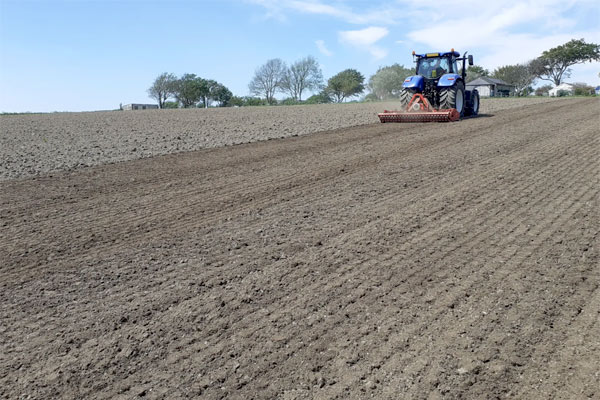
Care is provided for the vines in the rooting beds. During this month, regular watering of the vines in the rooting beds is of great importance. Soil moisture in the ridges and inter-rows should be maintained between 75% and 90% of field capacity. Immediately after watering, soil cultivation is performed with a cultivator. And when a thick soil crust forms on the ridges, it is necessary to loosen and break it up promptly to facilitate the development of the shoots.
Upon settling of the ridges, the grafted cuttings become exposed, necessitating their immediate coverage with loose soil. In cases where sprouting is uneven, the ridges are loosened down to the union of the rooted cuttings, and if the soil layer placed on the grafted cuttings is thicker, it is carefully reduced.