'Thrips - a serious threat to vegetable crops'
Author(s): проф. д-р Винелина Янкова, Институт за зеленчукови култури "Марица" – Пловдив, ССА
Date: 04.05.2026
2954
![MultipartFile resource [file_data]](/assets/img/articles/трипсове-рзвитие.jpg)
Summary
Vegetable crops are preferred hosts for thrips. The main species encountered are the onion thrips (Thrips tabaci Lindeman) and the western flower thrips (Frankliniella occidentalis Pergande). They cause direct and indirect damage as vectors of viruses. The damage leads to significant economic losses, reduced product quality, and decreased yields. Thrips are difficult to control, posing serious challenges for crop protection. Management requires an integrated approach, ranging from good agricultural practices to the use of biological agents.
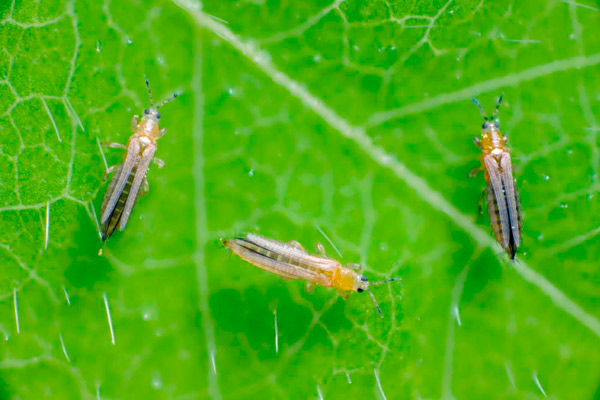
Thrips (Thysanoptera:Thripidae) have become one of the economically important pests of vegetable crops in recent years. Climate change and global warming favor their successful overwintering. They cause damage throughout the entire growing season. As polyphagous pests with high reproductive potential, great mobility, and specific development (protected egg and nymph stages), they multiply and spread rapidly.
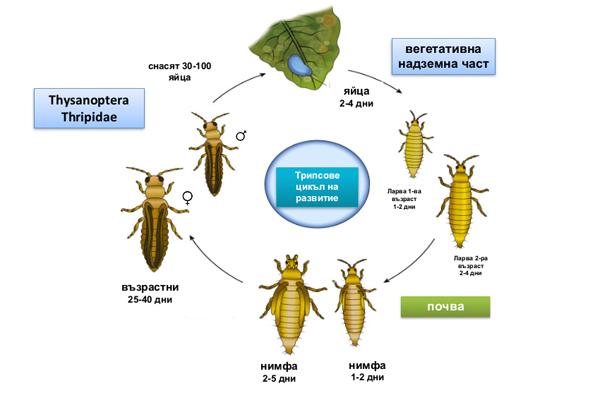
Thrips – Development Cycle
Among the thrips species affecting vegetable crops, the main ones encountered are the onion thrips (Thrips tabaci Lindeman) and the western flower thrips (Frankliniella occidentalis Pergande). Mixed populations of both species are often observed. F. occidentalis usually dominates in greenhouses. Thrips develop 8-12 generations per year; they primarily overwinter as adults; females lay their eggs in the parenchyma, directly beneath the epidermis of leaves, petals, or fruits; first-instar larvae are highly mobile and prefer leaves and the growing tip; during the second instar, their mobility decreases; nymphs do not feed and are immobile, this stage occurs in the soil. Thrips are sucking, very small insects (about 1–2 mm), appearing as tiny “splinters” on plants. They have an elongated, spindle-shaped body. Their coloration varies from yellow to brown or black, depending on the species or developmental stage; if you try to approach them, they will likely jump or fly away. They are difficult to see clearly without a magnifying glass. To detect them, it is necessary to shake the plant or flowers over a white background (paper) to see them well. Thrips can be problematic to control effectively with insecticides, creating serious risks for crop protection.
The two thrips species are difficult to distinguish. Coloration: adult F. occidentalis varies from yellow to dark brown. T. tabaci is usually paler, ranging from pale yellow to light brown. The western flower thrips differs from the onion thrips in body size (T. t. 1.2-1.4 mm, F. occ. 1.2-1.6 mm), the number of setae on the wing veins (T. t. - the first longitudinal wing vein lacks setae in the middle, with 2-5 setae towards the tip; F. occ. - the first and second longitudinal wing veins have setae along their entire length), the number and coloration of antennal segments (T. t. - antennae are seven-segmented, with the third and fourth segments bearing paired sensilla; F. occ. - antennae are eight-segmented, with the third and fourth segments bearing paired sensilla), the size of the median pair of ocellar setae (T. t. - the head has two pairs of ocellar setae; F. occ. - the head has three pairs of ocellar setae), and the length of setae on the pronotum (T. t. - the posterior margin of the pronotum has two pairs of long setae, while the anterior margin has none; F. occ. - the posterior and anterior margins of the pronotum each have an additional two pairs of long setae).
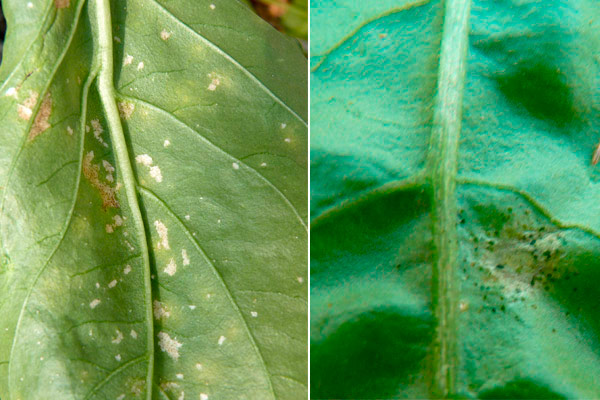
Thrips damage on pepper leaves
Damage from thrips can appear on leaves, stems, buds, fruits, and flowers. Thrips suck out plant cells and green chlorophyll. The spots from thrips feeding turn white because the underlying space is hollowed out. However, the epidermis and cell walls remain intact. A “window” is formed that allows light to pass through.
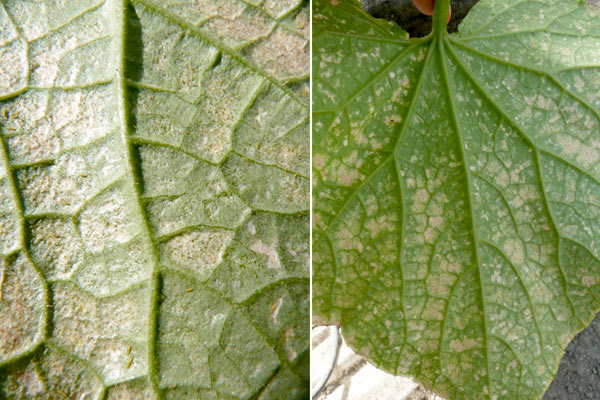
Thrips damage on cucumber leaves
The main symptoms are as follows: leaves develop silvery-white spots, later turning brown; the leaf loses its thickness (papery); it dries out and falls off; petals may develop dark streaks and spots, exhibiting so-called “color break” and dropping; fruit sets and fruits become deformed; fruits show streaking, with brown to silvery marks; at the site of egg-laying or feeding, punctate spots with lighter “halos” may appear; plants become stunted in growth. The western flower thrips primarily attacks flowers.
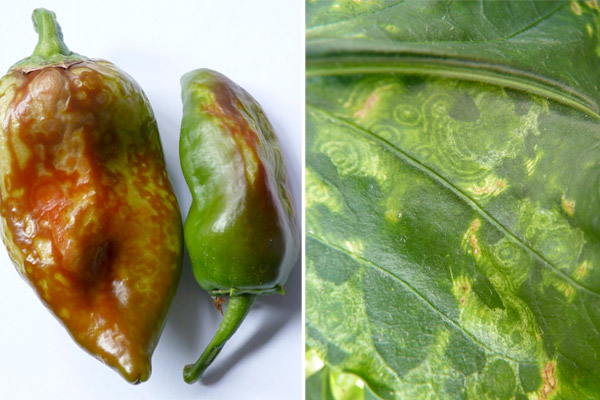
The viral disease Tomato Spotted Wilt Virus (TSWV) on pepper
In addition to direct damage, thrips are vectors of the viral disease Tomato Spotted Wilt Virus (TSWV). Once infected as larvae, adult thrips typically transmit tospoviruses for life. Uninfected adult thrips cannot acquire the virus. Infection with the virus occurs during the 1st or 2nd larval instar; the virus circulates and replicates in the thrips’ salivary glands.
Both larval and adult stages of thrips are vectors that can actively feed on virus-infected host plants, but only early-stage larvae can acquire the virus; later-stage larvae and adults can then transmit the virus after a latent period. Thus, each new generation of vector thrips must acquire the virus as larvae. Adults transmit the virus to plants for the remainder of their lives but do not transmit it transovarially (to their eggs).
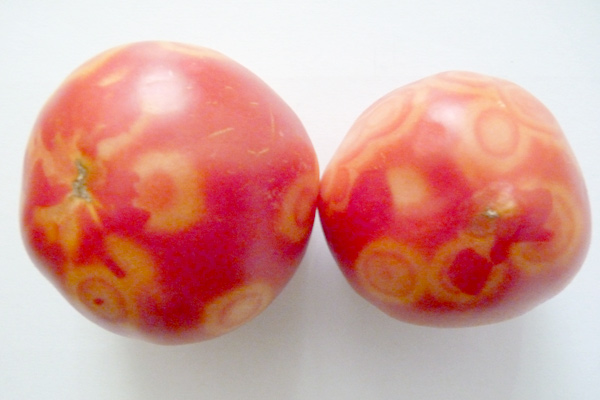
TSWV is one of the most important diseases affecting tomatoes, capable of causing up to 100% losses. Due to the significance of this viral disease, considerable research has been conducted in recent years on virus particles, disease vectors, transmission, and control methods. Genetic resistance appears to be the best solution for controlling this disease. It can be supplemented with other control strategies aimed at reducing the amount of inoculum or avoiding transmission.
Control
Prevention is crucial for protecting plants from thrips infestation.
- Monitoring;
- Place blue sticky traps and tapes. Sticky traps can be placed not only above the plants but also close to the soil surface;
- Keep plants well-watered and optimally fertilized;
- Light-reflective mulches can help with protection. Silver, gray, and white films are suitable and most effective as colors;
- Destroy weeds, which serve as virus reservoirs and shelters for vectors. Keep areas around greenhouses and crops free of weeds;
- Promptly destroy and remove infected plants from the crop area;
- Crop rotation and spatial isolation;
- Use repellent plants.
If necessary, carry out treatments, aiming to rotate products with different active substances. Plant protection products: Azatin EC 100-150 ml/decare; Benevia 75-112.5 ml/decare; Biavrio 480 SC 15.8-20 ml/decare; Volket 15.8-20 ml/decare; Decis 100 EC 7.5 – 12.5 ml/decare; Detsa EC/Dena EC/Dasha EC/Poletsi/Super Delta/Deltin 30-50 ml/decare; Dikarzol 10 SP 556 g/decare; Limocide 400-800 ml/decare; Neemik Ten 390 ml/decare; Oikos 100-150 ml/decare; Requiem Prime 500-1000 ml/decare; Sineis 480 SC 10-37.5 ml/decare; Milsah/Spinline 15.8-20 ml/decare; Tulga 480 SC 15.8-20 ml/decare; Naturalis 100-150 ml/decare. When using plant protection products, observe the pre-harvest intervals indicated on the label!
In greenhouses, some bioagents such as Amblyseius cucumeris, Hypoaspis aculeifer, Orius spp., and others can be introduced for thrips control. When applying insecticides, the presence of beneficial species that need to be preserved must be considered. A comprehensive approach is necessary for successful control of these pests.
References
- Bahariev D., B. Velev, S. Stefanov, E. Loginova, 1992. Diseases, Weeds, and Pests of Vegetable Crops. Zemizdat-Sofia, 338.
- Trenchev G., O. Karadzhova, 1992. The Western Flower Thrips Has Established Itself in Our Country Too. Plant Protection Magazine, 3, 14-16.
- Ingwell L. L., S. D. Eigenbrode, N. A. Bosque-Pérez, 2012. Plant viruses alter insect behavior to enhance their spread. Sci Rep 2:578.
- Mauck K., N. A. Bosque-Pérez, S. D. Eigenbrode, C. M. DeMoraes, M. C. Mescher, 2012. Transmission mechanisms shape pathogen effects on host-vector interactions: evidence from plant viruses. Funct Ecol 26: 1162–1175.
- Roselló S., M. Jo, Diez, F. Nuez, 1996. Viral diseases causing the greatest economic losses to the tomato crop. I. The Tomato spotted wilt virus - a review. Scientia Horticulturae 67, 117-150.