'Leaf Aphids - Known and Unknown Pests Dangerous to Vegetable Crops '
Author(s): проф. д-р Винелина Янкова, Институт за зеленчукови култури "Марица" – Пловдив, ССА
Date: 13.04.2026
4636
![MultipartFile resource [file_data]](/assets/img/articles/заглавна-листни-въшки-2026.jpg)
Summary
Most vegetable growers are well acquainted with and frequently observe aphids in their crops. They are among the most common and widespread pests. In vegetable crops, they are observed year-round. They have a wide range of host plants, which favors their development. In addition to direct damage, they cause indirect losses as vectors of viral diseases. Controlling them is difficult due to their high reproductive potential and the emergence of resistance in populations to commonly used insecticides. Successful control requires monitoring and an integrated approach.
Aphids (family Aphididae) are among the most common pests of vegetable crops. They can be found both in the field and in cultivation facilities. Many of them are polyphagous – they attack various species of cultivated and wild plants. The diversity of host plants favors their development. Aphids have a high reproductive capacity. They develop a large number of generations and form dense colonies on young, apical plant parts. They suck sap from them and excrete a sticky, sweet liquid called "honeydew," on which sooty saprophytic fungi develop, contaminating the produce and hindering photosynthesis.
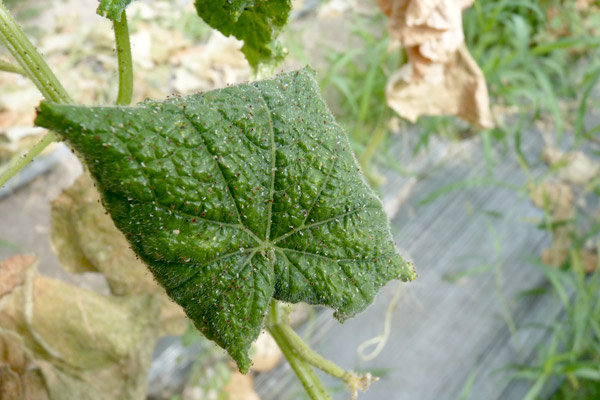
Deformations caused by aphids
As a result of the damage, plants become deformed, turn yellow, and lag in development. Often, damaged fruits and leaves remain small and drop off. Damaged seed plants produce few and poor-quality seeds.
Aphids are characterized by both sexual and asexual reproduction. The sexual generation appears in the autumn. The aphids lay fertilized winter eggs. In spring, larvae hatch from them, and the adults are called fundatrices (foundresses). The fundatrices give birth parthenogenetically to larvae, forming fundatrigeniae generations. The offspring of the fundatrices consist of wingless individuals that reproduce without fertilization (virginoparae) and winged, viviparous females (alatae or dispersers). In migratory aphids, the alatae move from the primary host to intermediate host plants. There, they give birth parthenogenetically and produce a series of generations called virginogeniae. In non-migratory aphids, the alatae move to plants of the same species.
In autumn, as the weather cools, winged individuals called remigrants appear in the colonies. In migratory aphids, these return to the primary hosts and give birth to sexual individuals.
In the seasonal development of aphids, one sexual generation alternates with many parthenogenetic (asexual) generations. Such aphids overwinter as eggs on the primary host plants specific to the species and have a holocyclic type of development. Other aphid species reproduce only parthenogenetically, without overwintering on primary hosts. They exhibit anholocyclic development.
Under favorable conditions, aphids develop very quickly and pose a serious threat to plants. In heated greenhouses, they can be observed year-round. Typically, high temperatures accompanied by low air humidity have a strong depressing effect on them. These pests develop many generations per year and quickly create resistant forms to the applied insecticides, complicating control efforts.
Aphids also pose risks as vectors of viral diseases in vegetable crops. Often, damage from viruses leads to greater losses compared to direct damage. A large proportion of plant viruses depend on vectors for their transmission and survival. Insects are the most common vectors, and among them, aphids are involved in transmitting 50% of insect-borne viruses. Aphids are exquisitely designed for their role as vectors. They are distributed worldwide, with more than 200 identified vector species.
Several characteristics of aphids contribute to their success as vectors of plant viruses. These include:
- The polyphagous nature of some aphid species;
- The ability to reproduce parthenogenetically, facilitating the rapid production of large numbers of offspring;
- Sucking mouthparts facilitate the delivery of virions into plant cells without causing visible damage.
Active dispersal of aphids over long distances is limited. Only winged aphids disperse over far distances. Mass flights are observed at dusk, in calm and windless weather. With air currents, aphids can be transported over long distances. Dispersal occurs directly and indirectly through human activity, mainly through the transport of planting material and sometimes with the produce.
Aphids are variously colored. Yellow is the base color, while the green pigment is of chlorophyll origin. Larvae are usually lighter in color. For example, in the cotton aphid, three differently colored aberrations are observed: lutea (yellow), viridis (green), and obscura (black). Studies have been conducted on color variation in A. gossypii at different temperatures. With increasing temperature, the body color of the aphids gradually changes from green to yellow, and from yellow to green as the temperature decreases, with a drop in average daily temperatures during the second ten-day period of September leading to the appearance of the black aberration. Conducted tests show that there is no correlation between the change in body color and the host plant, light, or cultivation method. The difference in coloration correlates only with temperature.
Some of the most common aphid species on vegetable crops are:
Peach aphid (Myzus persicae Sulz.)
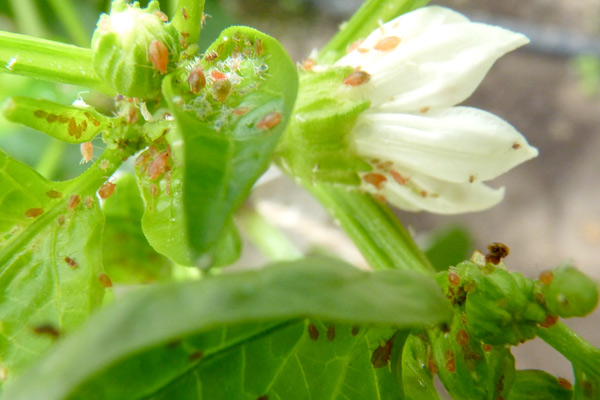
Peach aphid (Myzus persicae Sulz.)
It is distributed worldwide and has a large number of host plants. It damages peppers, tomatoes, eggplants, potatoes, cucumbers, lettuce, cabbage, beets, etc. It develops 40-47 generations. During one growing season on field crops, it develops 16 generations. It transmits over 50 different viral diseases, including cucumber mosaic, potato mosaic and potato black ring, potato leafroll, common and yellow bean mosaic, and others.
Cotton aphid (Aphis gossypii Glov.)
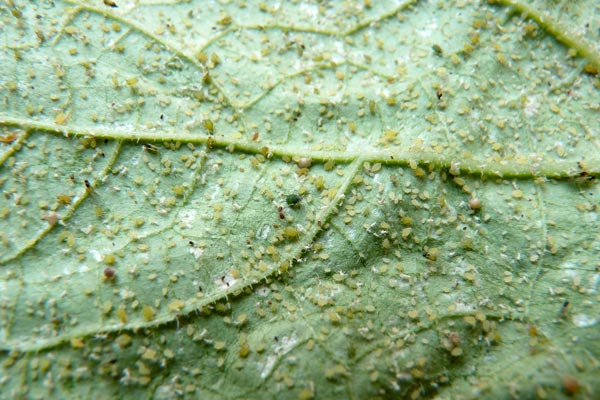
Cotton aphid (Aphis gossypii Glov.)
It has a cosmopolitan distribution and a large number of host plants. It damages cucumbers, watermelons, melons, pumpkins, as well as peppers, tomatoes, beans, okra, parsnips, peas, etc. It develops 31 generations, and on outdoor pumpkins up to 18. It transmits the viral diseases bean mosaic, potato mosaic, and others.
Potato aphid (Macrosiphum euphorbiae Thomas)
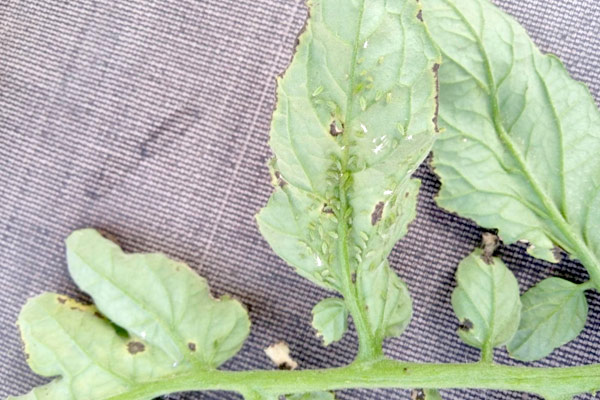
Potato aphid (Macrosiphum euphorbiae Thomas)
Widely distributed. It damages tomatoes, potatoes, eggplants, etc. It develops over 10 generations. It transmits viral diseases such as potato leafroll, potato black ring, and others.
Pepper aphid (Aphis nasturtii Kaltenbach)
Widely distributed. It damages peppers, tomatoes, potatoes, pumpkins, okra, etc. It develops 43 generations. It is often found in mixed populations with the peach aphid.
Pea aphid (Acyrthosiphon pisum Harr.)
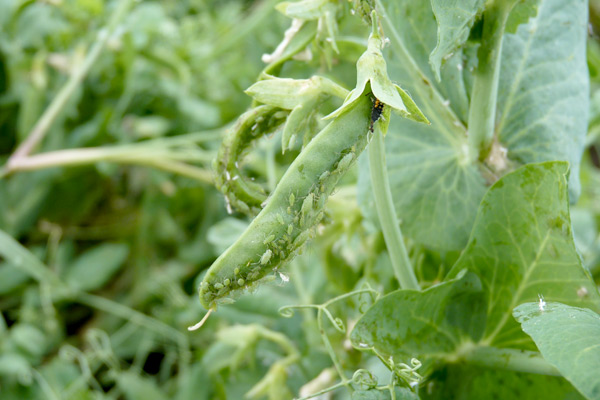
Pea aphid (Acyrthosiphon pisum Harr.)
It is distributed throughout the country. It damages peas, broad beans, vetch, and other leguminous crops. It develops 18-20 generations. It transmits the causative agents of several viral diseases such as common pea mosaic, alfalfa mosaic, and others.
Black bean aphid (Aphis fabae Scop.)
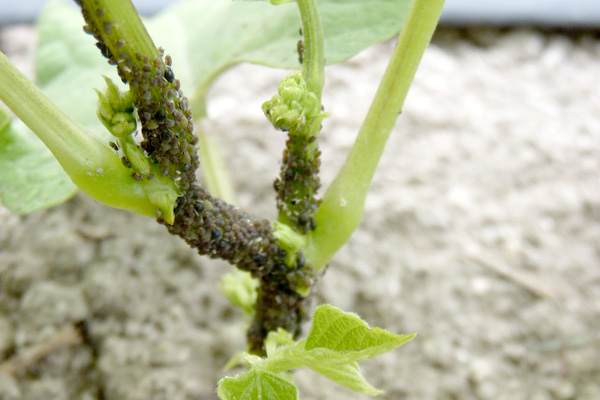
Black bean aphid (Aphis fabae Scop.)
It is distributed throughout the country. It mainly damages beans and broad beans. It develops 6-7 generations. It transmits viral diseases such as yellow bean mosaic, common bean mosaic, soybean mosaic, and others.
Alfalfa aphid (Aphis craccivora Koch.)
It is distributed throughout the country. It mainly damages beans and broad beans. It develops 10-12 generations. It transmits the viral disease common bean mosaic.
Foxglove aphid (Aulacorthum solani Kalt.)
Widely distributed. It damages potatoes, tomatoes, peppers, lettuce, etc. It is a vector for over 40 plant viruses.
Cabbage aphid (Brevicoryne brassicae L.)
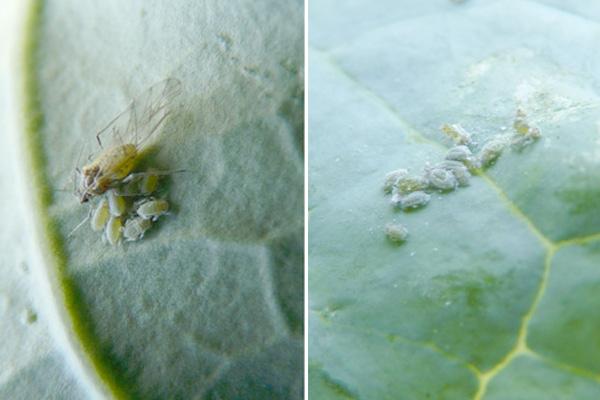
Cabbage aphid (Brevicoryne brassicae L.)
It is found throughout the country and causes significant damage to all cultivated and wild cruciferous plants. It damages cabbage, broccoli, turnips, radishes, etc. It develops 18-20 generations.
Control
Prevention is important for protecting plants from aphid infestation.
- Do not over-fertilize plants, as this can lead to more damage. Avoid excessive application of nitrogen fertilizers;
- Keep plants well-watered;
- Place yellow sticky traps and tapes;
- Early planting can reduce the intensity of virus symptoms;
- Reflective mulches can help protect plants. Silver, gray, and white films are suitable and most effective as colors;
- Destroy weeds that serve as virus reservoirs and shelters for vectors. Keep areas around greenhouses and crops free of weeds;
- Crop rotation and spatial isolation;
- Use repellent plants;
- Regularly inspect the areas.
Carry out treatments if necessary. Rotate plant protection products with different active substances to limit the risk of resistance development. You may use: Azatin EC 100-150 ml/dca; Ampligo 150 ZC 40 ml/dca; Delmur 50 ml/dca; Deltagri 30-50 ml/dca; Deca EC/Dena EC/Desha EC/Poletsi/Super Delta/Deltin 50 ml/dca; Closer 120 SC 20 ml/dca; Chrysant EC 60 ml/dca; Lamdec Extra 28-60 g/dca; Maverik 2 F 20 ml/dca; Mospilan 20 SG 25 g/dca; Neemik Ten 390 ml/dca; Oikos 100-150 ml/dca; PyreGard 60-75 ml/dca; PyreChris 70-150 ml/dca; Sivanto Prime 45 ml/dca; Scato 30-50 ml/dca; Sumi Alpha 5 EC/Sumicidin 5EC/Oikos 5EC 20 ml/dca; Teppeki/Afinto 10 g/dca; Flipper 1-2 l/dca; Shirudo 15 g/dca.
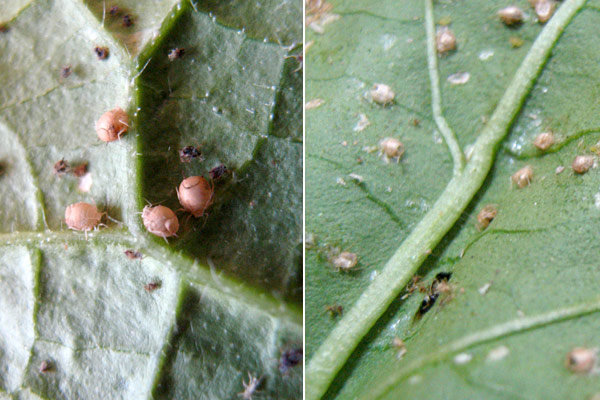
Bioagents Aphidius spp
In greenhouses, bioagents such as Aphidius spp. and Aphidoletes aphidimyza can be introduced for pest control. Other predators and parasitoids such as ladybugs, lacewings, syrphid flies, and predatory bugs are also important for reducing aphid density. When using insecticides, the presence of beneficial species must be considered to protect them. Localized treatments can be carried out, or selective/low-toxicity products can be used.
During harvest, observe the pre-harvest intervals of the plant protection products specified on the labels.
Literature
- Bahariev D., B. Velev, S. Stefanov, E. Loginova, 1992. Diseases, Weeds and Pests of Vegetable Crops. Zemizdat-Sofia, 338.
- Grigorov St. 1980. Aphids and Their Control. Zemizdat, Sofia, 284.
- Rashev S., Ya. Dimitrov, N. Palagacheva. 2012. Aberrations in the Cotton Aphid (Aphis gossypii Glover) and Conditions for Their Expression. Field Crop Studies, v. VIII-1, 179-184.
- Carr J. P., T. Tungadi, R. Donnelly, A. Bravo-Cazar, S-J Rhee, L. G. Watt, J. M. Mutuku, F. O. Wamonjea,c, A. M. Murphy, W. Arinaitwe, A. E. Pate, N. J. Cunniffe, C. A. Gilligan, 2020. Modelling and manipulation of aphid-mediated spread of non-persistently transmitted viruses. Virus Research, 277:197845, doi: 10.1016/j.virusres.2019.197845.
- Dalmon A., F. Fabre, L. Guilbaud, H. Lecoq and M. Jacquemond, 2008. Comparative whitefly transmission of Tomato chlorosis virus and Tomato infectious chlorosis virus from single or mixed infections. Plant Pathology, 58, 221–227.
- Mauck K., N. A. Bosque-Pérez, S. D. Eigenbrode, C. M. DeMoraes, M. C. Mescher, 2012. Transmission mechanisms shape pathogen effects on host-vector interactions: evidence from plant viruses. Funct Ecol 26: 1162–1175.