Mealy diseases on fruit species caused by pathogens of the genus Podosphaera
Author(s): гл. експерт д-р Анелия Райкова, Институт по земеделие – Кюстендил, ССА
Date: 16.04.2026
2554
![MultipartFile resource [file_data]](/assets/img/articles/заглавна-ябълка-брашнеста-мана-2026.jpg)
Abstract
Powdery mildews on fruit crops, caused by species of the genus Podosphaera, represent a widespread and economically significant phytopathological problem in fruit growing. They affect both pome and stone fruit species and are characterized by high adaptability to various agro-ecological conditions. The management of these diseases is based on an integrated approach, combining agrotechnical measures, the use of resistant and low-susceptibility cultivars, appropriate control methods, as well as the application of predictive models for assessing infection risk. Economically significant representatives include apple powdery mildew, caused by Podosphaera leucotricha (Ellis and Everh.) E. S. Salmon, and peach powdery mildew, caused by Podosphaera pannosa (Wallroth) de Bary, which necessitates the implementation of environmentally sound control measures against the pathogens.
Apple powdery mildew
The genus Podosphaera encompasses fungal pathogens causing powdery mildews, which have been identified on a number of fruit crops, as well as on strawberry, currant, and hazelnut [1,12,15,18]. Economic damage is caused mainly on apple, with the primary pathogen Podosphaera leucotricha (Ellis et Everhart) E. S. Salmon, with conidial stage Oidium farinosum Cooke [1,9,20], and on peach - Podosphaera pannosa (7,15). According to data from the EPPO Global Database, the causal agents of powdery mildew on fruit crops belong to the genus Podosphaera, family Erysiphaceae, order Erysiphales, class Ascomycetes. Both species are obligate biotrophic ascomycete pathogens, specialized for tissues of living hosts [11,12]. The causal agent of apple powdery mildew, P. leucotricha, has a polycyclic development and overwinters as mycelium, which attaches to the plant organ via appressoria (specialized branches), and obtains nutrition from the plant cell through haustoria. On the mycelium in infected leaf and mixed buds, conidiophores are formed, bearing 6-9 single-celled spores arranged in a chain. The fruiting bodies of the pathogen are cleistothecia, but they are rarely formed in our country [3]. Cleistothecia are dark, spherical in shape, and possess two types of appendages - simple and dichotomously branched. One ascus is formed within the fruiting body, containing single-celled ascospores [4]. In spring, a systemic form of the disease develops, while during the growing season, disease spread occurs via conidiospores. The pathogen develops over a wide temperature range (4-30° C) and a water droplet is not required for conidial germination, due to their ability to germinate at air humidity above 34%. Authors report that mycelium ceases development at temperatures above 33°C [3].
Apple powdery mildew
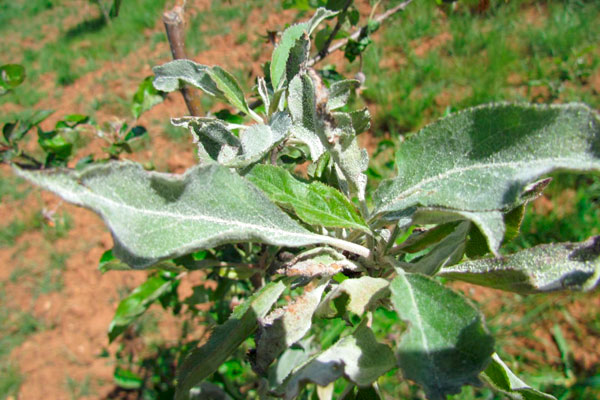
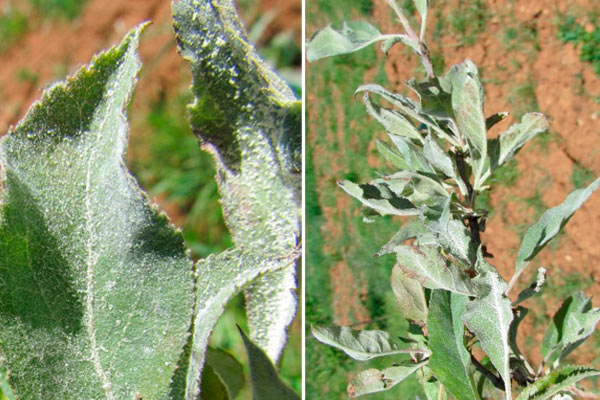
Symptoms on apple caused by P. leucotricha are observed on leaf and mixed buds infected during the preceding year (systemic form of the disease). Infected leaf buds give rise to weakly developed shoots covered with a dense white coating consisting of the fungal mycelium and spores. Infected mixed buds produce leaves and flowers entirely covered with a powdery coating, causing yellowing and premature dropping. Infected flower buds are small, deformed, do not set fruit, turn brown, and drop. In the case of infection during the same growing season (local form of the disease), a grayish-white coating is observed on the leaves, which ceases development at the site of damage, and deformation of the leaf blade is observed. Powdery spots are also observed on petioles, covered with mycelium, which reaches and encompasses healthy buds. The fungus has the potential to colonize the fruits of highly susceptible cultivars, showing signs of a russet network that covers the fruit in various forms and depths. Highly susceptible cultivars such as 'Golden Delicious', 'Jonathan' [14,19,4] have been described by numerous authors, whose yield can be significantly reduced if disease control is not implemented. Data from long-term field observations in the Dresden-Pillnitz breeding program show that apple cultivars 'Remo', 'Regia', 'Rewena', and 'Rebella' are characterized by a high degree of resistance to powdery mildew [10]. In a more recent field study under similar conditions of natural infection pressure, it was found that the cultivars 'Delicious', 'Demir', 'Dayton', and 'Burgundy' did not exhibit disease symptoms and demonstrated a high degree of field resistance over two consecutive growing seasons [8]. Cultivars 'Gala', 'Honeycrisp', 'Mutsu' [4,23] were found to have moderate susceptibility. Long-term studies at the Institute of Agriculture - Kyustendil show that control of the pathogen can be facilitated by the use of more resistant cultivars, reducing the infection pressure. Research conducted at the Institute has established varying degrees of susceptibility among apple cultivars, highlighting low-susceptibility 'Prima' and 'Erwin Baur' [1,20], moderately susceptible 'Mutsu' [21], and highly susceptible 'Moira' [1,9].
Peach powdery mildew
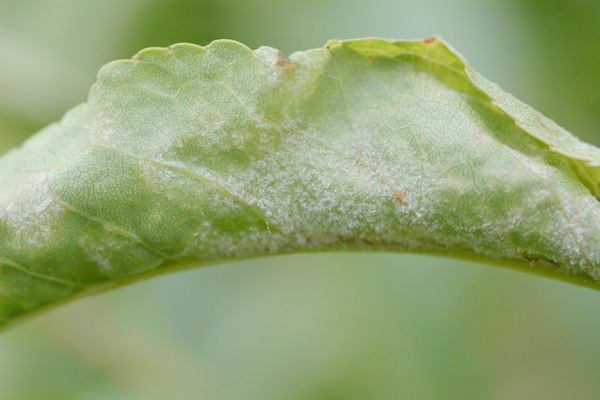
The symptoms of peach powdery mildew, caused by Podosphaera pannosa (Wallroth) de Bary, with conidial stage Oidium leucoconium Desmazières, are similar to those on apple. The disease affects the green organs of the plant, including leaves, young shoots, and fruits. The pathogen manifests in two forms - systemic (diffuse) and local, with the systemic form being of particular importance in the early stages of vegetation. In spring, upon the bursting of infected buds, shoots develop with a characteristic powdery coating, leading to stunted growth and development [4]. Under favorable conditions, the disease can also affect young fruits, resulting in deformations and a permanent deterioration of the commercial quality of the produce. The infection process of Podosphaera pannosa is typical for obligate biotrophs, with the pathogen penetrating plant tissues by directly crossing the cuticle and forming haustoria in epidermal cells [17].
Control Strategy
Agrotechnical Measures
The main agrotechnical measures against the causal agents of powdery mildew include:
- Selection of appropriate cultivars that are resistant or have low susceptibility to the pathogen, which will significantly reduce the infection pressure and the need for fungicide treatments [1,14].
- Selection of a suitable site and planting distances, along with a well-formed canopy, which improve aeration and limit the formation of a favorable microclimate for pathogen development [1,2].
- Balanced fertilization contributes to optimal vegetative growth and limits susceptibility to powdery mildew, while excessive nitrogen fertilization increases susceptibility [2,13].
- Pruning aimed at removing infected shoots and branches, reducing the amount of primary inoculum, is a key measure for limiting early infections in spring [2,23].
Chemical and Biological Control Approach
The application of fungicide sprays approved against the disease has a limiting effect, and control strategies should be aimed at effectively limiting primary and secondary infections. The most widely used group of active substances against P. leucotricha are ergosterol biosynthesis inhibitors (Demethylation inhibitors - DMI, FRAC group 3), including myclobutanil, penconazole, tetraconazole, difenoconazole, and flutriafol [23,25], and strobilurins (Quinone outside inhibitors - QoI, FRAC group 11) [25]. Rotation of active substances should be observed to prevent resistance to DMI and QoI fungicides. It is important that fungicide treatments be carried out in accordance with the plant protection products approved for the disease in the country.
Alongside chemical control, interest in biological agents for limiting the causal agent of apple powdery mildew has increased in recent years. Among the best-studied biological agents against powdery mildews are representatives of the genus Bacillus, which show effectiveness against various Podosphaera species, including on fruit crops, mainly by increasing chlorophyll content and improving photosynthetic activity, contributing to better physiological condition of plants and enhanced resistance to infection by P. leucotricha [16]. Studies are also available on the effectiveness of yeasts in reducing the degree of attack by P. leucotricha by 37.4% [5,6].
Last but not least is the use of predictive models for disease development as an important tool for optimizing the control of apple powdery mildew. Models such as RIMpro use meteorological data, the phenological development of the crop, and biological parameters of the pathogen to forecast periods of increased risk of primary and secondary infections, allowing for more precise and timely application of plant protection measures. Research in Europe and Bulgaria shows that the use of such models contributes to reducing the number of treatments without compromising control efficacy and supports the management of fungicide resistance by limiting unnecessary applications [13,20,22]. Although most predictive models were initially developed for apple scab, many of them, including RIMpro, successfully integrate modules for powdery mildew as well, making them a valuable element of modern Integrated Pest Management (IPM) against P. leucotricha under changing climate conditions.
Powdery mildews remain one of the key phytopathological challenges of economic importance, especially under conditions of intensive production and changing climatic conditions. Combining resistant or low-susceptibility cultivars with an integrated disease management approach, including agrotechnical and plant protection measures supplemented by predictive models, provides an opportunity for a long-term effective and promising control strategy [16,21,23,24].
References
- Borovinova, M. (2007). Economically Important Fungal Diseases of Apple and Sour Cherry and Their Control in Integrated Fruit Production Institute of Agriculture - Kyustendil.
- Dzhuvinov, V., Gandev, S., Arnaudov, V., Rankova, Z., Nacheva, L., & Dobrevska, G. (2016). Apple. Biofruit BG - EOOD.
- Nakova, M., Nakov, B., Karov, S., & Neshev, G. (2015). Special Phytopathology. IMN Publishing House - Plovdiv.
- Stancheva, Y. (2021). Diseases of Perennial Crops. INFINITY BOOKS.
- Alaphilippe, A., Elad, Y., David, D. R., Derridj, S., & Gessler, C. (2008). Effects of a biocontrol agent of apple powdery mildew (Podosphaera leucotricha) on the host plant and on non-target organisms: an insect pest (Cydia pomonella) and a pathogen (Venturia inaequalis). Biocontrol Science and Technology, 18(2), 121-138. https://doi.org/10.1080/09583150701818964
- Alaphilippe, A., Elad, Y., Derridj, S., & Gessler, C. (2007). Effect of introduced epiphytic yeast on an insect pest (Cydia pomonella L.), on apple pathogens (Venturia inaequalis and Podosphaera leucotricha) and on the phylloplane chemical composition. IBOC Bull, 30, 259-263.
- Ashraf, M. A., Khan, A. S., Shireen, F., Nawaz, S., Ayyub, S., Mohibullah, S., Asim, M., Riaz, T., Khalid, B., & Azam, M. (2025). Peach diseases in a changing climate: Pathogens, resistance, and sustainable solutions. Microbial Pathogenesis, 108110.
- Awan, S. I., Thapa, R., Svara, A., Feulner, H., Streb, N., & Khan, A. (2023). Evaluation of Malus Germplasm Identifies Genetic Sources of Powdery Mildew and Frogeye Leaf Spot Resistance for Apple Breeding. Phytopathology®, 113(7), 1289-1300. https://doi.org/10.1094/phyto-11-22-0417-r
- Borisova, A., Borovinova, M., & Kamenova, I. (2014). Major diseases of apple trees in Kyustendil region of Bulgaria. Turkish Journal of Agricultural and Natural Sciences, 1(Special Issue-1), 695-700.
- Fischer, M., & Fischer, C. (2004). Genetic resources as basis for new resistant apple cultivars. Journal of Fruit and Ornamental Plant Research, 12(Spec. ed. 2).
- Gañán-Betancur, L., Peever, T. L., Evans, K., & Amiri, A. (2021). High Genetic Diversity in Predominantly Clonal Populations of the Powdery Mildew Fungus Podosphaera leucotricha from U.S. Apple Orchards. Applied and Environmental Microbiology, 87(15), e00469-00421. https://doi.org/doi:10.1128/AEM.00469-21
- Glawe, D. A. (2008). The powdery mildews: a review of the world's most familiar (yet poorly known) plant pathogens. Annu. Rev. Phytopathol., 46(1), 27-51.
- Holb, I. (2014). Apple powdery mildew caused by Podosphaera leucotricha: some aspects of disease management.
- Holb, I. J. (2009). Apple powdery mildew caused by Podosphaera leucotricha: some important features of biology and epidemiology. International Journal of Horticultural Science, 15(1-2), 45-51. https://ojs.lib.unideb.hu/IJHS/article/view/1096
- Leus, L., Dewitte, A., Van Huylenbroeck, J., Vanhoutte, N., Van Bockstaele, E., & Höfte, M. (2006). Podosphaera pannosa (syn. Sphaerotheca pannosa) on Rosa and Prunus spp.: Characterization of Pathotypes by Differential Plant Reactions and ITS Sequences. Journal of Phytopathology, 154(1), 23-28. https://doi-org.salford.idm.oclc.org/10.1111/j.1439-0434.2005.01053.x
- Liu, B., Xu, Y., Ji, S., Zhang, P., Zhang, H., Han, J., Fan, H., Wang, J., Qi, J., Ma, Y., & Liu, Z. (2023). Isolation and identification of Bacillus and abilities of 3 functional strains to control powdery mildew and promote seedling growth of Malus sieversii. European Journal of Plant Pathology, 167(1), 11-24. https://doi.org/10.1007/s10658-023-02680-5
- Marimon de María, N. (2020). Towards an integrated control of peach powdery mildew (Podosphaera pannosa) through the application of molecular tools in epidemiological and genetic resistance studies [PhD, Universitat de Lleida].
- Marimon, N., Eduardo, I., Martínez-Minaya, J., Vicent, A., & Luque, J. (2020). A Decision Support System Based on Degree-Days to Initiate Fungicide Spray Programs for Peach Powdery Mildew in Catalonia, Spain. Plant Disease, 104(9), 2418-2425. https://doi.org/10.1094/pdis-10-19-2130-re
- Morariu, P. A., Sestras, A. F., Andrecan, A. F., Borsai, O., Bunea, C. I., Militaru, M., Dan, C., & Sestras, R. E. (2025). Apple Cultivar Responses to Fungal Diseases and Insect Pests Under Variable Orchard Conditions: A Multisite Study. Crops, 5(3), 30. https://www.mdpi.com/2673-7655/5/3/30
- Petrova, V., & Borovinova, M. (2014). Control of Powdery Mildew (Podosphaera leucotricha) and European Red Mite (Panonychus ulmi) At Scab Resistant Apple Cultivars. Bulgarian Journal of Crop Science, 51(4-5), 7-11. https://agriacad.eu/ojs/index.php/bjcs/article/view/3687
- Petrova, V., Dimitrova, S., & Georgieva, V. (2025). Biological manifestations of three apple cultivars and degree of attack by apple scab and powdery mildew. Bulgarian Journal of Crop Science, 62(6), 103-110. https://doi.org/10.61308/OBJS5429
- Rossi, V., Salinari, F., Poni, S., Caffi, T., & Bettati, T. (2014). Addressing the implementation problem in agricultural decision support systems: the example of vite. net®. Computers and Electronics in Agriculture, 100, 88-99.
- Strickland, D. A., Hodge, K. T., & Cox, K. D. (2021). An Examination of Apple Powdery Mildew and the Biology of Podosphaera leucotricha from Past to Present. Plant Health Progress, 22(4), 421-432. https://doi.org/10.1094/php-03-21-0064-rv
- Strickland, D. A., Spychalla, J. P., van Zoeren, J. E., Basedow, M. R., Donahue, D. J., & Cox, K. D. (2023). Assessment of Fungicide Resistance via Molecular Assay in Populations of Podosphaera leucotricha, Causal Agent of Apple Powdery Mildew, in New York. Plant Disease, 107(9), 2606-2612. https://doi.org/10.1094/pdis-12-22-2820-sr
- Vielba-Fernández, A., Polonio, Á., Ruiz-Jiménez, L., de Vicente, A., Pérez-García, A., & Fernández-Ortuño, D. (2020). Fungicide Resistance in Powdery Mildew Fungi. Microorganisms, 8(9), 1431. https://www.mdpi.com/2076-2607/8/9/1431