March – time for pre-flowering sprays in the orchard and care for the vine plantations
Author(s): ас. Кирил Кръстев, Институт по декоративни и лечебни растения – София
Date: 12.03.2026
3763
![MultipartFile resource [file_data]](/assets/img/articles/заглавна-март-защита.jpg)
![MultipartFile resource [file_data]](/assets/img/articles/екскориоза-козя-март.jpg)
More suitable conditions for conducting pre-bloom sprays in fruit trees will occur at the beginning of the second ten-day period.
In fruit crops during the second half of the month, the following phases will occur: bud swelling, bud break, bud formation, and flowering in some early-flowering stone fruit species. The forecasted minimum temperatures in field regions are above the critical levels for fruit trees that are more advanced in their development.
The expected precipitation for the period 20.03 -26.03. 2026 will limit the conduct of plant protection sprays in fruit trees. However, by the end of the month, conditions for conducting plant protection sprays in fruit trees will be present again.
In fruit tree nurseries
Before planting seeds and cuttings in mother blocks and first-year nurseries, for control of soil pests, treat with one of the following products - Ercole GR (1-1.5 kg/decar), Trica Expert (1-1.5 kg/decar), localized, only in the planting furrow, near the plant roots.
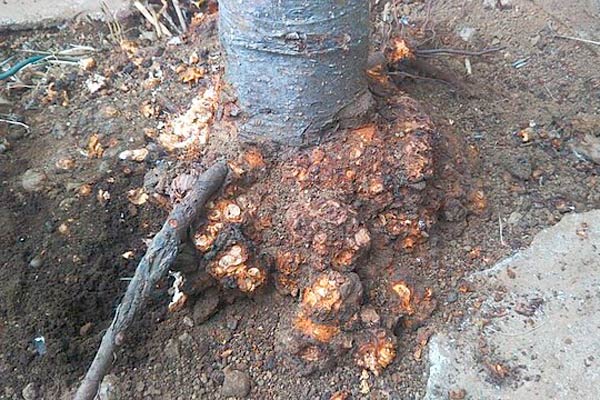
Bacterial canker in stone fruit trees is a serious disease caused by Agrobacterium or Pseudomonas. It manifests through tumor formations, swellings, and depressions on the trunk, roots, and branches. The pathogen spreads through planting material, tools, and soil.
Against soil pathogens - types of root rot and bacterial canker, roots are soaked in a solution of a fungicide with an active base of copper oxychloride – Cupro Key, Codimur 50 WP, Cuprozin 35 WP (18-30 g/10 l water).
The infected by powdery mildew apical parts of clonal apple rootstocks intended for planting in first-year mother blocks and nurseries are cut out, and heavily infected ones are discarded. All planting plants with tumors from bacterial canker on their roots are also discarded.
Poison baits made from boiled corn or wheat grains, Actellic 50 EC or Biona Sincar (4 l per 1 kg grain) and vegetable oil are placed, or Mesurol Schneckenkorn (250 g/decar) is buried against the garden snail in seedbeds.
In mother plantations for the production of apple rootstocks, shoots infected with powdery mildew are cut out to the base. In the presence of eggs from the California scale insect before bud break, all trees are sprayed with a winter spray of 3% Acarizin or ParaZomer.
In fruit orchards
March is the final deadline to complete the repair of machinery. The plant protection products necessary for controlling diseases, pests, and weeds during the second quarter are procured. If not done in previous months, the materials with which the stems of young fruit trees were wrapped are collected and burned.
Before buds have broken, winter spraying of fruit orchards can be carried out if this was not done in February.
Daily observations are made under a microscope using the Holz method on the maturation of ascospores of the causal agent of apple and pear scab, red leaf spots on plum, shoot blight on quince, orange leaf spots on almond, cylindrosporiosis on cherry, and other diseases. Spraying against scab is announced as soon as yellowing of ascospores and their ejection after a two-hour stay in a humid atmosphere in a Petri dish is established.
Isolator frames are placed on materials collected the previous year from the apple and plum fruit sawfly and the cherry fruit fly in connection with monitoring their development.
On trees heavily infested by the leafminer moth the previous year, stem traps are placed to establish the flight of the first generation moths and determine the timing for spraying. Protecting apple orchards from it depends on the timely and high-quality control of the first generation.
The density of the cherry fruit sawfly in cherry and peach orchards is established through soil excavations. Under 10 trees, two excavations with dimensions of 50/50/25 cm are made. The same excavations are used to establish the density of the cherry fruit fly in cherry orchards, with the excavated soil being sieved.
Branches from 5-10 peach trees are examined to establish the density of the peach twig borer, which overwinters in buds, at the base of one-year-old growth, and in mummified fruits.
If this was not carried out in November, 1000-2000 mummified almond fruits are collected from the trees or from those fallen on the soil. They are placed in traps to monitor the beginning of flight, mass flight, and end of flight of the almond seed wasp. The first spray is conducted after flight.
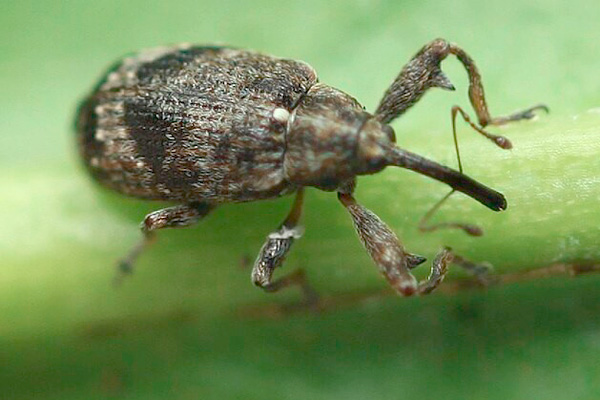
The apple blossom weevil (Anthonomus pomorum L.) is found everywhere in our country. It mainly attacks apple trees but has also been found on pear trees. It causes damage primarily in fruit orchards where regular plant protection is not conducted.
To establish the density of the apple blossom weevil, at the end of the month, a beating tray sampling is performed on 10 apple trees, evenly distributed in the orchard. The apple blossom weevil develops one generation per year and overwinters as an adult insect mainly under the old and cracked bark of apple and pear trees and very little under fallen leaves. When the weather warms, they leave their hiding places, feed for some time, and then lay their eggs. This period is most suitable for controlling the adult insect. If the beating tray sampling reveals more than three beetles per tree, spray with Sumicidin 5 EC (0.02%), Decis 100 EC (7.5-12.5 ml/decar), Deca EC (30-50 ml/decar).
The trunks and thick branches of apple trees infested by apple clearwing moth and bark tortrix are sprayed with Coragen 20 SC (16-30 ml/decar), Sumicidin 5 EC (0.02%).
Where peach tree buds are in the swelling phase, spray with a 1% Bordeaux mixture, Champion 50 WP (300 g/decar), Funguran OH 50 WP (150-250 g/decar), Cupro Key (240-300 g/decar) to control leaf curl, shot hole, and brown rot. Against shot hole and brown rot, spraying can be done up to the bud stage.
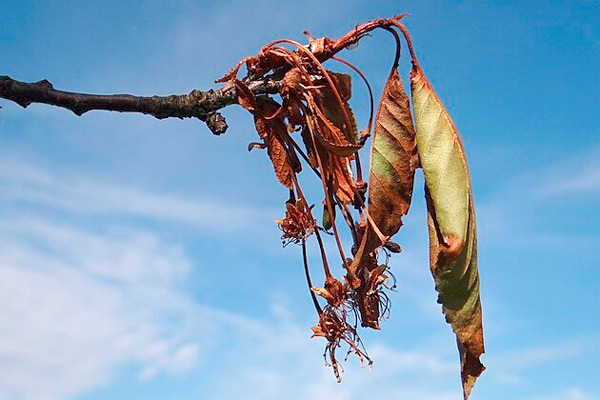
Early brown rot occurs on all stone fruit species, as well as on blackthorn, apple, and pear. The disease appears from the flowering of trees until fruit ripening. Under favorable conditions, the disease causes significant losses to susceptible varieties.
Pre-bloom spraying of apricot, plum, and cherry trees is conducted against shot hole – fungal and bacterial – and brown rot, and of almond trees against cercospora leaf spot, shot hole, orange leaf spots, and scab with the same products. Spraying with Coragen 20 SC (16-30 ml/decar), Sumicidin 5 EC (0.02%) against leaf-eating caterpillars and other pests is also carried out.
Upon signal from the forecasting and warning stations of the BAPH, pome fruit trees are sprayed against scab, again with the same products and at the same concentration.
Bloom spraying of apricot trees is conducted with Score 250 EC (0.02-0.03%) against brown rot. Early brown rot is the most dangerous disease on apricots. For bloom spraying of apricots, copper-containing chemicals should not be used.
Soil moisture in March is forecast to be sufficient for uniform germination of weed seeds. On the other hand, it favors the action of soil herbicides, and therefore their application in March is always effective. Only the row strip of the orchards is treated. Before herbicide application, the soil is loosened and leveled. Herbicides are sprayed with sprayers that are not used for spraying other pesticides. When this is not possible, after spraying, the tanks, pipelines, and nozzles of the sprayers are washed abundantly with water in which 2% soda ash or quicklime is dissolved.
Stomp-Aqua or another herbicide is used for both pome and stone fruit species at a concentration of 250-300 ml/decar.
If drought occurs after herbicide application, sprinkler irrigation is carried out with an irrigation rate not exceeding 30-35 l/m², as water can wash the herbicides into lower soil layers.
If you do not want the inter-rows to be in the form of black fallow, you can grass the area with grass mixtures. This is done at the first warming of the weather, after fertilizing with manure and mineral fertilizers. The following mixtures can be used in the following ratio per 1 decar: red clover (1.6 kg seeds) and timothy grass (1 kg); red clover (1.5 kg) and crested dog's-tail (1.4 kg); red clover (1-1.2 kg), timothy grass (0.6 kg) and French ryegrass (0.7 kg); red clover (1.5 kg), Italian ryegrass (1 kg) and timothy grass (0.6 kg); Grassed orchards are mowed 3-4 times per year.
In strawberry plantations
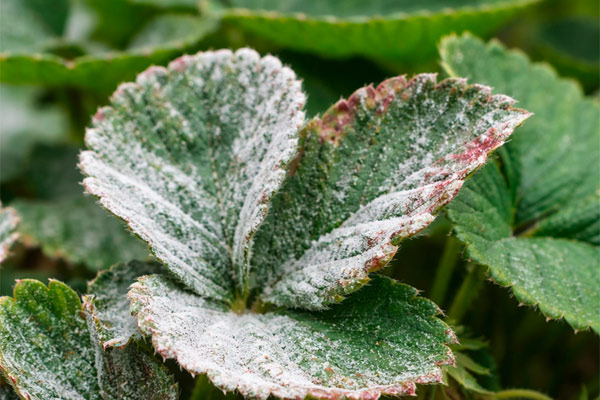
Powdery mildew occurs mainly in strawberries grown under greenhouse conditions or in the field in micro-regions with high atmospheric humidity and highly susceptible varieties. The causal agent of the disease survives as mycelium in buds; in recent years, it has been proven that overwintering fruiting bodies called cleistothecia are also formed.
Dried leaves in strawberry plantations are collected and burned to destroy the causal agents of white and violet-brown leaf spots, powdery mildew, etc.
In raspberry plantations
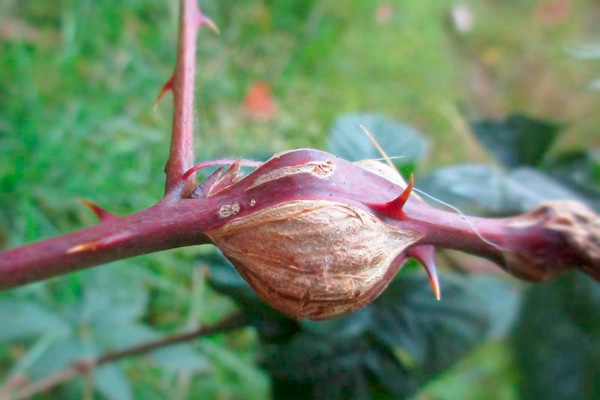
The raspberry cane midge (Lasioptera rubi) causes galls on plantations, which form in the middle and lower parts of the canes. The thickening impedes the movement of sap in the plant, and it gradually weakens and then dries out. In spring and autumn, it is good to treat raspberry bushes with a 1% Bordeaux mixture solution.
Raspberry canes infested by raspberry moth, spur blight, coniothyrium, raspberry cane midge, raspberry clearwing moth, etc., are cut out and burned.
In currant plantations
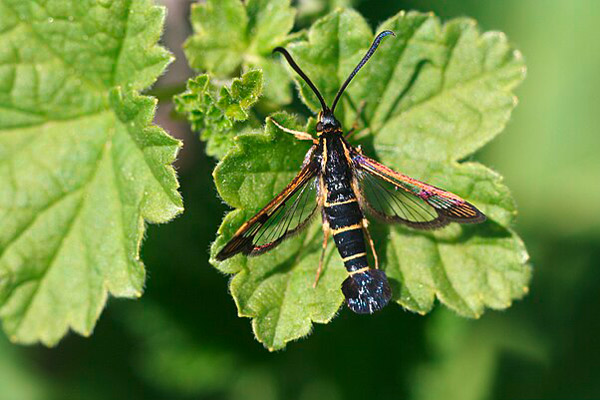
Currant clearwing moth (Synanthedon tipuliformis)
Branches infested by clearwing moth, anthracnose, etc., are cut out without leaving stubs and burned.
In vineyards
Vineyards are treated with herbicides and soil tillage is performed. Stomp-Aqua is used at a concentration of 250-300 ml/decar. If drought occurs after herbicide application, sprinkler irrigation is carried out with an irrigation rate not exceeding 30-35 l/m², as water can wash the herbicides into lower soil layers.
If you do not want the inter-rows to be in the form of black fallow, you can grass the area with grass mixtures. This is done at the first warming of the weather, after fertilizing with manure and mineral fertilizers. The following mixtures can be used in the following ratio per 1 decar: red clover (1.6 kg seeds) and timothy grass (1 kg); red clover (1.5 kg) and crested dog's-tail (1.4 kg); red clover (1-1.2 kg), timothy grass (0.6 kg) and French ryegrass (0.7 kg); red clover (1.5 kg), Italian ryegrass (1 kg) and timothy grass (0.6 kg); Grassed vineyards are mowed 3-4 times per year.