Agrotechnical Methods for Prevention and Control of the Black Borer (Capnodis tenebrionis L.)
Author(s): гл. ас. д-р Мария Христозова, Институт по овощарство – Пловдив, Селскостопанска академия, София; главен експерт Даниела Ангелова, Институт по овощарство – Пловдив, Селскостопанска академия, София; доц.д-р Мариета Нешева, Институт по овощарство – Пловдив, ССА; гл.експерт Лейда Тодорова, Институт по овощарство – Пловдив, ССА
Date: 06.07.2026
4372
![MultipartFile resource [file_data]](/assets/img/articles/заглвна-агро-черна-златка.jpg)
Abstract
The control of pests in agricultural crops involves a set of measures that limit pest density and improve the phytosanitary condition of plants, leading to an increase in the quantity and quality of production.
The flatheaded wood borer (*Capnodis tenebrionis*) is one of the main pests in fruit crops, responsible for destroying thousands of decares of fruit plantations over the years.
Control against this pest is extremely difficult due to the resistance of adults to insecticides and the hidden lifestyle of the larvae. Solving this problem requires the application of a series of agrotechnical measures, as well as the use of chemical and biological plant protection products.

Pictures 1 and 2. Planting material in container cultivation
One of the main ways the flatheaded wood borer spreads is through planting material. The larvae burrow into the root collar area or the roots and often go unnoticed. When establishing new plantations, healthy planting material, free from diseases and pests, should be used (Fig. 1 and 2).
In orchards where trees have dried up due to pest attack, they must be uprooted and destroyed. When replanting with new trees, new holes should be made in which to place the saplings. Under no circumstances is it advisable to use the old holes from the uprooted trees, as part of the root system remains in the soil and there are often larvae of the flatheaded wood borer in them.
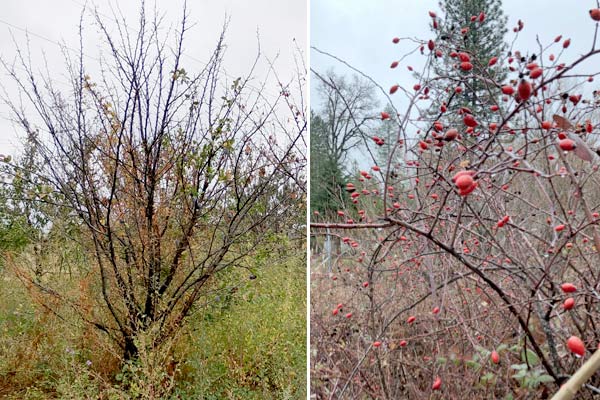
Pictures 3 and 4. Wild-growing host species
Abandoned areas and plantations are a source of diseases and pests, as no plant protection is carried out there. Adults of the flatheaded wood borer often move from untreated to treated areas, feed and lay eggs in them, subsequently causing serious damage. When establishing new plantations, it is necessary to choose areas where there are no abandoned fruit orchards in the vicinity. The presence of thorny bushes, wild pear, and other wild-growing host plants should not be allowed near fruit plantations, as they are intermediate hosts of the flatheaded wood borer (Fig. 3 and 4).
The first signs of the presence of adult flatheaded wood borers are gnawed leaf petioles, fallen leaves around the tree, and defoliated one-year-old branches. Upon detecting the first adults in the plantation, it is recommended to collect them mechanically.
Another sign of the pest's presence in the plantation are dried-up trees attacked by bark beetles (Fig. 5 and 6). In our studies, it was found that the root system of these trees contains larvae of the flatheaded wood borer. Bark beetles attack trees that are developing poorly and suffering from a lack of moisture, exactly the type of trees attacked by the flatheaded wood borer.
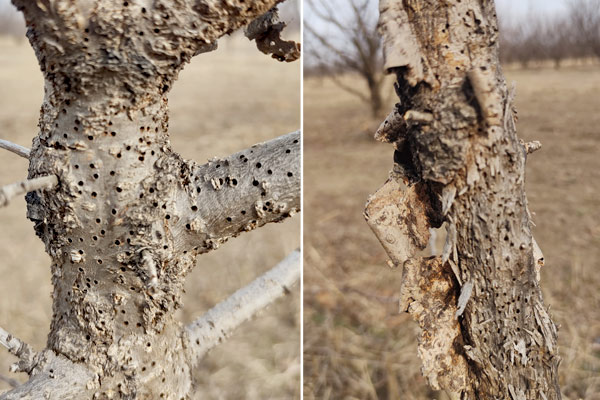
Pictures 5 and 6. Damage from bark beetles
In our conducted research, it was established that the primary pest in the plantation is the flatheaded wood borer, and the bark beetles are secondary. Since the damage from the borer remains hidden and unnoticed, control is directed against the bark beetles, but measures against them have no effect on the flatheaded wood borer. Pruning and removing branches damaged by bark beetles is insufficient. Such trees must be removed along with the root system and destroyed.
Soil cultivation around the tree trunk with a deflector tine cultivator (Fig. 7 and 8) is a key measure for limiting pest density. Loosening the soil disrupts the normal conditions for egg-laying by females. Also, if there are already laid eggs or newly hatched larvae, cultivation brings some of them to the surface soil layer, where they most often dry out or are eaten by predators and birds. This measure limits not only the density of the borer but also that of many other pests in fruit crops (Baspinar et al., 2017).
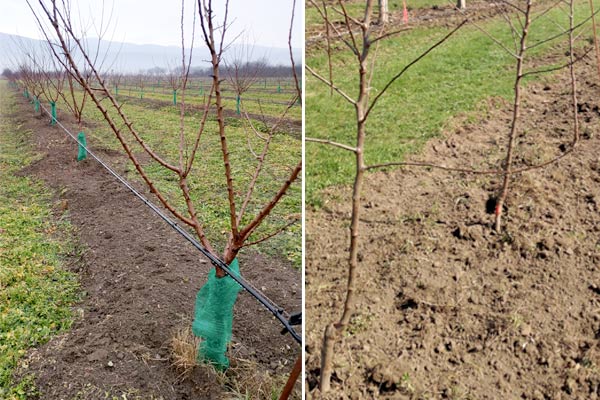
Pictures 7 and 8. Soil cultivation with a deflector tine cultivator
Irrigation is an important element in the cultivation of any fruit crop. The flatheaded wood borer is a thermophilic species that prefers a dry and warm climate. It has been established that in orchards where there is no installed irrigation system and the trees are not watered, pest attack is significantly higher. Females prefer to lay their eggs in dry soils, and newly hatched larvae move more easily and quickly to the roots of the trees (Malagón et al., 1990). In orchards with installed irrigation systems and regular watering, the attack is weaker, as a large number of eggs laid in moist soil do not hatch. Also, the movement of newly hatched larvae towards the roots is hindered.
Due to the resistance of adult beetles to the chemical agents used and the hidden lifestyle of the larvae, controlling the pest is extremely difficult. The application of a set of measures, each of which leads to a limitation of the flatheaded wood borer's density, is essential for reducing damage and preserving fruit orchards.
References:
1. Malagón, J., Garrido, A., Del-Busto, T., & Castaner, M. (1990). Influencia de algunos factores abioticos en la oviposicion de Capnodis tenebrionis (L.) Coleoptera, Buprestidae. Investigación agraria. Producción y protección vegetales, 5(3), 441-446.
2. Baspinar, H., Doll, D., & Rijal, J. (2017). 12 Pest Management in Organic Almond. Handbook of Pest Management in Organic Farming, 328.
3. Berville, P. (1948). The wood-boring beetle problem in Provence.
* The article is part of the seminar: "Science and Practice in Plant Protection", held on 19.02.2026 at the International Agricultural Exhibition AGRA 2026