Agrotechnical activities in permanent crops during March
Author(s): ас. Кирил Кръстев, Институт по декоративни и лечебни растения – София
Date: 10.03.2026
1688
![MultipartFile resource [file_data]](/assets/img/articles/заглавна-агро-март-2026.jpg)
March is characterized by frequent weather changes, as the month is transitional between winter and spring. An important feature is also the presence of stratospheric warming. The increase in day length and solar radiation lead to a noticeable rise in temperatures.
In March, fruit crops will go through the phases: bud swelling, bud burst, bud formation, and flowering in early-flowering stone fruit species (almond, apricot, peach, cherry). The forecast minimum temperatures for the month, down to minus 7°C, will be critical for fruit trees that have entered the bud formation and flowering phases.
Towards the end of the first ten-day period, temperatures below the climatic norm are expected, especially in Northern and Eastern Bulgaria. Snowfall is not excluded, including in the lowland areas, albeit rather short-lived. In the mountains, conditions will be created for a new snow cover. Minimum temperatures in the basins can be negative, and morning frosts will be a frequent occurrence.
Following the expected brief cooling at the end of the first ten-day period, for most days of the second - average daily temperatures above the biological minimum are forecast. Daytime temperatures will reach spring values, especially in the plains and the Danube Plain. The weather, however, will remain dynamic. Passing Mediterranean cyclones can bring precipitation – mainly rain, but during brief coolings in the high fields, wet snow is also possible. Contrasts between warm and cooler days will be characteristic.
During the third ten-day period of March, the development of agricultural crops will proceed at temperatures above climatic norms, with more sunshine hours and typical spring dynamics. Precipitation will be mainly rain, often in the form of short but intense spring showers. Morning frosts will be possible only in clear and calm weather, mainly in the basins. Brief coolings cannot be completely ruled out.
In fruit nurseries
Sowing of seedbeds and planting of rootstocks in the nursery is being completed.
Mother plants are planted no later than the end of the first ten-day period. Two-year-old mother plantations are cut back to a stub – 3-4 cm above the soil.

Seedbeds with pome fruit species, mother plants, and second-year nurseries are fertilized with 10-12 kg/decare ammonium nitrate or with the same amount (equivalent to 10-12 kg/decare ammonium nitrate) of another nitrogen fertilizer. The seedbeds are cultivated to break up the soil crust, destroy weeds, and incorporate the nitrogen fertilizer.
If necessary, thinning of the rootstock material is carried out. Plants from pome fruit species are left 6-8 cm apart, and from stone fruit species – about 4 cm apart.
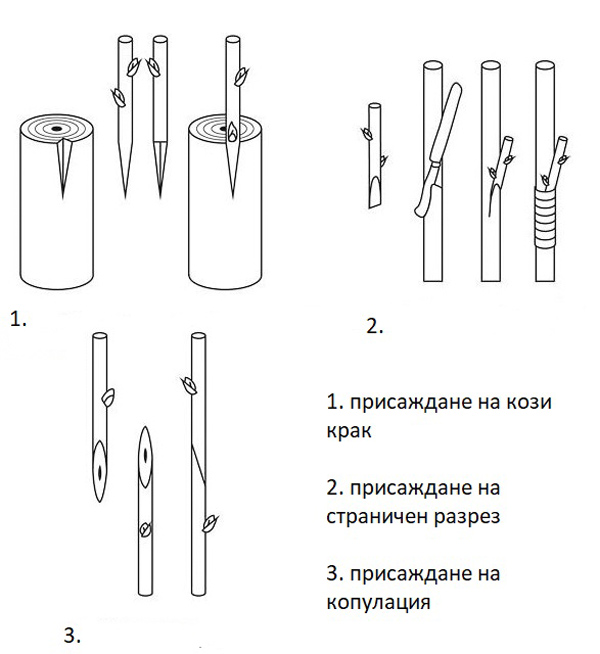
Rootstocks in nurseries that did not take the graft are re-grafted. In practice, they are most often re-grafted using whip and tongue, side veneer, or splice grafting.
In fruit orchards
Pruning for production and rejuvenation of pome and stone fruit species and crown formation in young orchards can be carried out up to the 'mouse ear' stage of the buds.
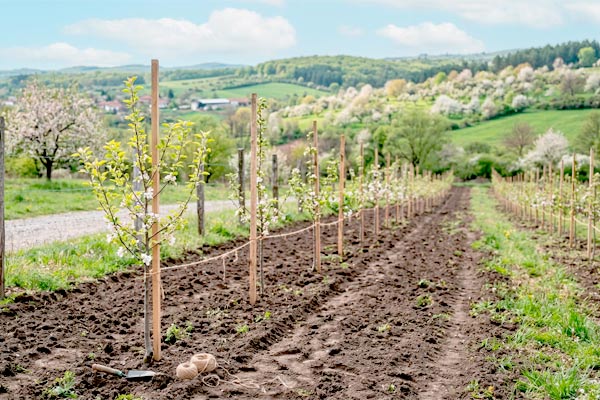
New fruit orchards are planted, and the first pruning is carried out simultaneously.
Replacement of dead trees in young orchards continues.
The first top-dressing with nitrogen fertilizers is carried out. In young orchards, only the tree rows are fertilized, while in older ones – the entire inter-row spaces. The fertilizer is broadcast on the surface and incorporated with shallow cultivation. The amount of fertilizer required is determined based on the results of leaf analysis conducted the previous year. If no analysis is available, fertilize with 15-20 kg/decare ammonium nitrate or the same amount of another nitrogen fertilizer.
Bee colonies are provided for flower pollination. For 10 decares, 3-4 sufficiently strong bee colonies are provided. It is most appropriate to place them on both sides of the row. Bees achieve maximum pollination capacity on sunny and calm days with temperatures of 20 – 22 °C, when they can travel up to 3 km from the hive.
Measures are taken to protect plants from late frosts. Control measures include heating, smoke generation and air movement, sprinkling or irrigation, and chemical products. Heating the air is achieved by burning high-energy fuels – fuel oil, naphtha, natural gas, old car tires. They are lit one hour before the temperature drops to the critical point for the plants, and the fire is maintained for one hour after sunrise.
For smoke generation, special smoke pots or inert materials such as straw, wood shavings, branches, and peat are used. They are arranged in piles in the rows, 30-60 m apart from each other and 5-6 m apart within the row. About 100 kg of combustible material is needed per decare, distributed in 10 piles.
With overhead sprinkling, the property of water to release heat upon freezing is utilized, while by irrigating the orchards, the thermal conductivity and radiation of the soil are increased, resulting in an air temperature rise of 2-3 °C. To prevent the crystallization of cellular water in the buds and protect against sub-zero temperatures, you can use products based on polymers and copolymers, such as Scudo Therm (1-2 l/100 l water) or biostimulants like Grow Plant Stop Freeze, Stop Freeze.
Preventively or in case of frost damage to fruit buds and flowers, to stimulate flowering, if the fruit species are still in this developmental phase, you can foliar feed them with a liquid fertilizer specialized for application during flowering - Cynoyl Z Special, ERT 23 plus, Archer OsmoCare or gibberellic acid.
Frost cracks are nailed with small nails. Longitudinal frost cracks are coated with tree wound dressing.
If necessary, irrigation is applied before or during flowering. It is usually mandatory when the winter is dry, followed by a spring with insufficient rainfall.
Mature trees and trees of low-value varieties are re-grafted.
The scaffold branches are shortened, usually just above the second scaffold subdivisions, and the leader – slightly above the level of the scaffold branches. The thicker scaffold subdivisions are used for re-grafting, being shortened depending on their position of growth – lower-positioned ones are left longer, and higher-positioned ones – shorter. Very good results are obtained when grafting using the whip and tongue method.
In strawberry plantations
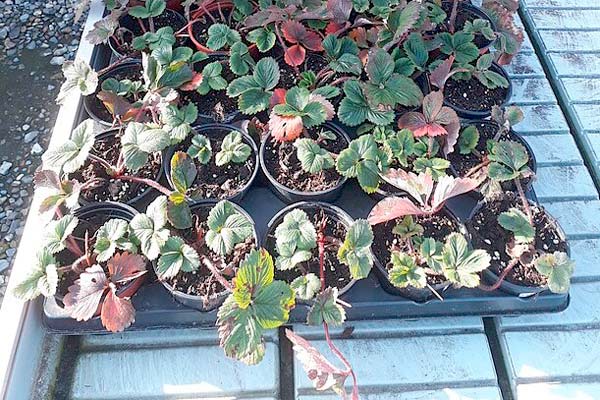
Empty spots in new strawberry and fruiting plantations are filled. Fertilize with 10-12 kg/decare ammonium nitrate or the same amount of another nitrogen fertilizer and hoe.
In heated greenhouses, when the fruits begin to ripen, the soil temperature is raised to 15-18 °C, and the air temperature – to 20-25 °C. During the warm hours of the day, the greenhouses are ventilated.
To ensure good pollination in greenhouses, 2-3 bee colonies per 10 decares are introduced.
In raspberry plantations
Filling of empty spots in the plantations continues. If they were not cut after harvest, the canes that fruited last year are cut out and burned.
In two-year-old plantations, all weak root suckers are cut back to the soil surface, leaving 2-3 of the strongest for bush formation.
In older plantations, pruning for shortening is carried out. Replacement canes are also thinned. The plantations are top-dressed with 10-12 kg/decare ammonium nitrate or the same amount of another nitrogen fertilizer and hoed.
If autumn fertilization with manure and phosphorus and potassium fertilizers was not carried out, it is done now. Apply 50-60 kg ordinary superphosphate or 25-30 kg double superphosphate, 15-20 kg potassium sulfate – or the same amount of other phosphorus and potassium fertilizers and 2-3 tons of well-rotted manure per decare. The fertilizers are plowed in, requiring deeper tillage.
In currant plantations
Planting of stored currant cuttings in the rooting bed continues. Top-dressing is carried out with 10-12 kg/decare ammonium nitrate or the same amount of another nitrogen fertilizer and shallow cultivation. Last year's rooting beds are cultivated.
In plantations with other crops
Seeds of Caucasian persimmon are sown in a nursery. In-row spacing is 5 cm with 80 cm between rows, and sowing depth – 3 – 4 cm.
Cuttings from fig, pomegranate, and sea buckthorn are collected and planted outdoors. With in-row spacing of 10-15 cm and row spacing of 80-100 cm. The soil around the cuttings is well firmed, after which they are covered with 1-2 cm of soil above the top bud. Immediately after planting, water abundantly.
Grafted onto grown rootstocks of Caucasian persimmon is Paradise apple.
Planting of trees not planted in autumn – Paradise apple, sea buckthorn, pomegranate – continues. Pruning for pomegranate formation and production is carried out.

Lemon seeds are planted outdoors in beds at a spacing of 20x5 cm. The soil should be loose, enriched with well-rotted manure.
In vineyards
New vineyards are established. Areas subsoiled in autumn are cultivated several times and leveled. Using a marking wire, the location of each vine is determined. First, the road network is traced, outlining the plots. Then, at half the inter-row distance from the longitudinal outermost access path, the first row is marked. Perpendiculars are raised from its two endpoints, on which the inter-row distances are marked using a measuring tape.
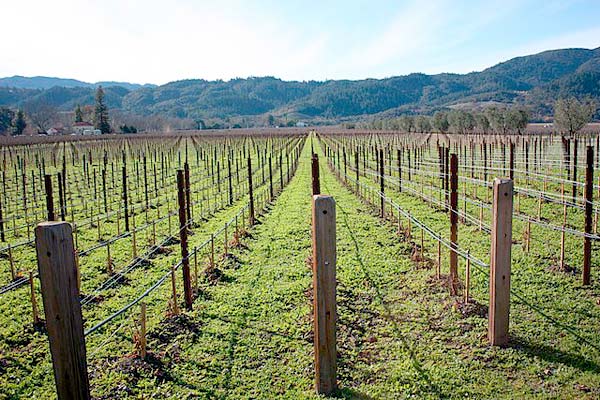
When choosing planting distances, we must consider the biological characteristics of the varieties, soil type and nutrient reserves, irrigation possibilities, terrain slope, and others.
For wine varieties with moderate growth vigor under non-hilling conditions, depending on soil type and terrain slope, 3240 to 5550 vines per hectare are planted, and under hilling conditions – 5450 to 5550 vines, on single-trunk bilateral cordons with a trunk height of about 80 cm.
For dessert varieties under non-hilling conditions, depending on soil type, terrain slope, and exposure, 3030 to 4200 vines per hectare are planted, and under hilling conditions – no more than 5000 vines per hectare, and they are formed on a double-arm Guyot with a trunk height of 80-100 cm.
The rectangular shape is most suitable for commercial vineyards, with the row direction preferably north-south. If the terrain is sloping, to avoid soil erosion, rows are arranged across the slope. Where strong winds blow, rows are oriented in the direction of the prevailing wind. On terraced terrain, rhomboid, triangular, or staggered patterns are