

![MultipartFile resource [file_data]](/assets/img/articles/заглавна-златка-тема-2026.jpg)
![MultipartFile resource [file_data]](/assets/img/articles/таблица-3-IPM-матрица.jpg)
Summary
Capnodis tenebrionis (L.) is one of the primary pests of stone fruit species, causing significant losses in Middle Eastern countries and gaining increasing importance in Europe and Bulgaria. The management of this species represents a significant challenge due to the lack of reliable monitoring tools, limited efficacy and regulatory restrictions on insecticides, as well as the difficulty in controlling the larvae – the most significant damaging stage, which develops protected within the root system. Among the additional complicating factors are the lack of resistant rootstocks, the scarcity of natural enemies, and the limited efficacy of entomopathogenic agents under field conditions, which are still subjects of research and refinement for practical implementation.
Targeted training for agricultural producers and workers is of key importance, which should emphasize the correct identification of C. tenebrionis, knowledge of its life cycle, monitoring of adult populations, diagnosing affected trees, and implementing integrated management strategies.
New research (2025) shows promising efficacy of entomopathogenic fungi against the egg stage, opening additional possibilities for biological control and integrated pest management.
Global warming could have a substantial impact on a number of biological characteristics of this thermophilic species, leading to increased survival of overwintering stages, shortening of the larval stage duration, earlier emergence and wider distribution of adult individuals, as well as increased fertility and population numbers. These factors may favor the transition from a two-year to a one-year life cycle of Capnodis tenebrionis (Bonsignore, 2012; Nasouri, 2024).
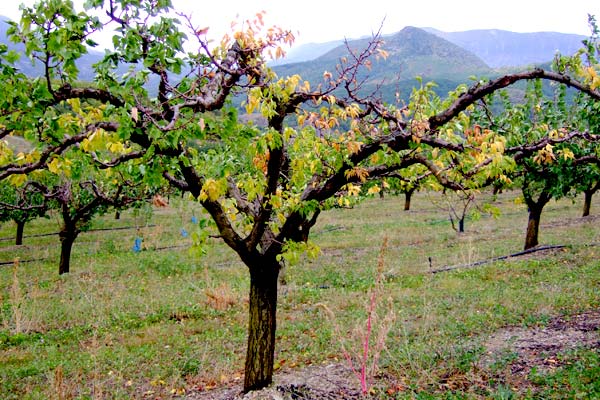
Capnodis tenebrionis (L.) is a serious pest of stone fruit species, especially in regions characterized by hot and dry summers
The black borer is characterized by a prolonged life cycle. Adult individuals can live for more than one year and overwinter twice, i.e., survive two consecutive winters in a state of dormancy (diapause or reduced activity). They are a thermophilic species and become active in spring with rising temperatures, beginning to feed on young shoots, twigs, buds, and leaf petioles. Adult feeding is typically observed on fruit-bearing trees, but significant damage is also recorded in nurseries and young plantations (Karaca & Demirel, 2021). During the summer, females lay their eggs in dry soil around the base of weakened trees. The number of eggs varies depending on temperature, with oviposition starting in spring at about 23 °C and continuing until September. It is most intense at optimal temperatures of 30–34 °C in July and August. Under favorable conditions, a single female can lay over 1000 eggs per year (Arapostathi et al., 2024).
First-instar larvae, freshly hatched from eggs, penetrate the root system and begin feeding on the bark and cambium. They cause substantial damage by constructing galleries in the roots and the lower part of the trunk. The presence of just a few larvae can lead to the death of a large tree within two years (Nasouri, 2024). The development duration of larvae varies between 6 and 18 months under field conditions, depending on temperature and the rootstock used. After completing their development, the larvae chew an exit hole in the wood, usually at the base of the trunk, where pupation occurs. Overwintering of C. tenebrionis is carried out by both adult individuals and larvae in various developmental stages (Karaca & Demirel, 2021).
The management of Capnodis tenebrionis remains a serious challenge, due to a number of limitations in the available strategies. Among the main problems are:
- the lack of reliable and effective tools for population monitoring (Nasouri, 2024);
- the limited efficacy of available insecticides and regulatory restrictions related to the ban of key active substances in the EU (Karaca & Demirel, 2021);
- the impossibility of successful control of larvae – the most damaging stage, which develops protected in the root system (Bonsignore, 2012);
- the absence of resistant rootstocks capable of limiting attacks (Nasouri, 2024);
- the scarcity of effective predators and parasitoids to provide biological control;
- the lack of optimized entomopathogenic agents, which are still in the process of laboratory and field research (Arapostathi et al., 2024).
Chemical control of Capnodis tenebrionis has traditionally been the main method for limiting its harmful activity. However, excessive reliance on insecticides has led to a number of negative consequences – adverse effects on non-target organisms, development of resistance, and rejection of fruit shipments due to high residue levels (Nasouri, 2024). These problems necessitate the search for alternative management strategies, including biological control, use of resistant rootstocks, and application of cultural practices (Karaca & Demirel, 2021).
Since the beginning of the 21st century, a number of researchers have been exploring the potential of biological agents. Entomopathogenic nematodes and fungi demonstrate high pathogenicity against larvae and adults of C. tenebrionis under laboratory and semi-field conditions. Some nematode strains have proven effective even under field conditions, defining them as promising for integrated management programs (Arapostathi et al., 2024).
Achieving sustainable management requires the adoption of an integrated approach (IPM), which combines different control methods to overcome the limitations of each and ensure long-term efficacy (Nasouri, 2024). However, the available information on the integrated management of this pest is limited, and its practical application is hindered by the reluctance of farm owners to adopt alternative strategies instead of relying solely on chemical control, especially in developing countries. Additional gaps exist in knowledge regarding monitoring and trapping, field efficacy of biological agents, optimal timing for combined biological and chemical control, as well as suitable formulations of biocontrol products.
Synthetic-organic insecticides were long considered the primary option for managing Capnodis tenebrionis. Organophosphate and carbamate compounds were widely used, with their application targeted against adult individuals or first-instar larvae, before their penetration into the root system (Nasouri, 2024). Two main methods are practiced: (1) foliar application to eliminate feeding adults and (2) soil treatment around the trunks before the onset of oviposition.
Repeated foliar application throughout the entire period of adult activity is not recommended, as this period coincides with fruit harvest and can lead to unacceptable insecticide residue levels. Therefore, limited treatments in spring (April–May) are recommended, targeting adult individuals leaving overwintering sites, as well as one additional application at the end of summer against newly emerged specimens (Karaca & Demirel, 2021).
Among the insecticides used, pyrethroids (deltamethrin, cypermethrin) demonstrate high contact toxicity but limited efficacy via ingestion. Organophosphates (chlorpyrifos, methiocarb, carbosulfan, azinphos-methyl) exhibit strong toxicity both by contact and ingestion, but most of them have been banned in the EU after 2020 (Bonsignore, 2012). Of the systemic neonicotinoids, imidacloprid is no longer used in the EU, while acetamiprid remains the only approved insecticide for foliar application against C. tenebrionis in Spain (Nasouri, 2024).
Spinosyns (spinosad and spinetoram), obtained through fermentation of Saccharopolyspora spinosa, are registered for foliar application in Italy and are approved for use in organic production of stone fruits. Applying insecticides via soil treatment reduces the risk of direct impact on the tree but requires larger quantities of the product. Laboratory and semi-field analyses demonstrate high efficacy of methiocarb, carbosulfan, and azinphos-methyl, as well as significant larval mortality when treated with chlorpyrifos (Arapostathi et al., 2024). However, due to regulatory restrictions, currently in Bulgaria there are no approved insecticides for soil treatment against this pest.
Injecting systemic insecticides into the main trunk is considered a promising method but requires additional research to assess its efficacy and safety (Nasouri, 2024).
Chemical control of Capnodis tenebrionis is limited by a number of challenges. Among them are the difficulty in determining the optimal timing for application, the risk of insecticide residues on fruits, the adverse impact on non-target organisms and the environment, as well as the development of resistance to the active substances used (Nasouri, 2024). Additionally, the lack of available insecticides following the ban of a number of organophosphate and carbamate compounds in the European Union significantly limits the possibilities for effective chemical control (Bonsignore, 2012; Karaca & Demirel, 2021).
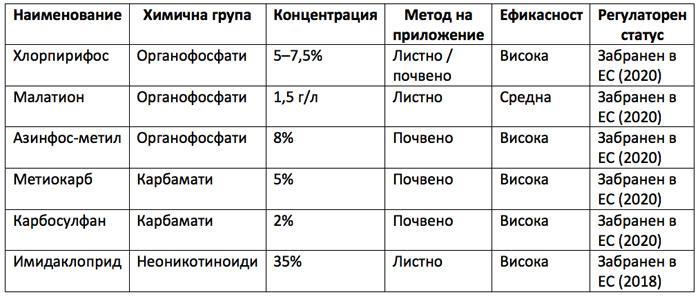
Table 1. Insecticides with discontinued registration in the European Union (after 2018–2020)
Notes:
- Chlorpyrifos, methiocarb, azinphos-methyl, carbosulfan, and malathion have been banned in the EU after 2020 (EFSA, 2020).
- Imidacloprid has been banned in the EU since 2018 (EFSA, 2018).
- The data are presented for historical reference and do not reflect current usage recommendations.
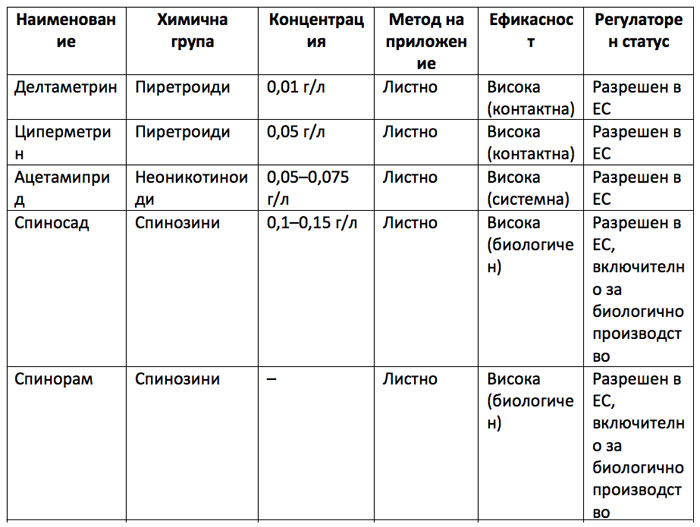
Table 2. Currently approved insecticides against Capnodis tenebrionis in the European Union
Notes:
- Acetamiprid is the only systemic neonicotinoid approved for foliar application against C. tenebrionis in Spain (Nasouri, 2024).
- Spinosyns (spinosad and spinetoram) are approved for organic production in Italy.
- In Bulgaria, as of 2025, there are no registered insecticides for soil application against C. tenebrionis (BFSA, 2025).
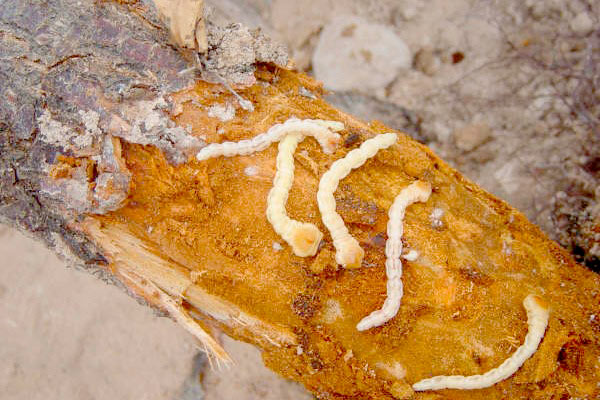
Larvae of Capnodis tenebrionis (L.)
Agrotechnical measures represent an important element of the integrated management of Capnodis tenebrionis.
Manual collection of adult individuals is practiced as a control measure in some countries. It is carried out in spring when adults are less active, unable to fly, and easy to catch, typically found on the sunny parts of trees (Nasouri, 2024). However, this method is labor-intensive and impractical for large plantations or high population densities.
Females prefer weakened trees for oviposition, which underscores the importance of good cultural practices – ensuring optimal water supply and mineral nutrition to maintain healthy plants. Orchards should be kept clean, with pruning residues removed, and dead or severely infested trees uprooted and destroyed, as larvae can survive in them (Karaca & Demirel, 2021).
Soil moisture has a substantial influence on oviposition – dry soils favor egg-laying, while high moisture reduces the hatching percentage, and at 100% saturated soils, eggs do not hatch (Bonsignore, 2012). Effective water regime management and the application of sprinkler irrigation contribute to reducing the pest's harmfulness. Conversely, drip irrigation and reducing water after harvest can create dry zones around the trunks, suitable for oviposition. This problem can be overcome by increasing the number of drip emitters and adapting the irrigation schedule according to meteorological conditions (Arapostathi et al., 2024).
The use of physical barriers to limit pests is becoming more common in fruit growing, but their efficacy against C. tenebrionis is not sufficiently studied. Theoretically, covering the soil around the base of trees with mulch or non-woven materials could hinder oviposition and trap newly emerged adults. Although labor-intensive and more suitable for small plantations, this technique could reduce the need for additional interventions but requires further research (Nasouri, 2024).
Trap trees