Lettuce is highly susceptible to certain diseases and pests
Author(s): проф. д-р Стойка Машева, ИЗК "Марица" Пловдив; проф. д-р Винелина Янкова, ИЗК “Марица” в Пловдив
Date: 14.02.2026
9458
![MultipartFile resource [file_data]](/assets/img/articles/марули-заглавна.jpg)
![MultipartFile resource [file_data]](/assets/img/articles/мозайка-маруля.jpg)
Summary
Lettuce (Lactuca sativa L.) is a widely grown salad crop worldwide. Its cultivation is accompanied by attacks from a considerable number of disease agents and pests, which can compromise crop quality and yield. Accurate and rapid identification and control of these harmful organisms is essential for maintaining healthy crops and producing high-quality output. In this article we review the main harmful organisms (diseases and pests) affecting lettuce, their symptoms, environmental requirements, and management strategies.
High fuel prices have made winter vegetable production in protected cultivation facilities almost impossible. The resulting market niche has been filled by salads, which have shifted from a seasonal crop to a year-round one. Increased consumer demand throughout the year has also contributed to this. Lettuce (Lactuca sativa L.) is the most popular of the salad crops. It is highly adaptable and is grown in almost all climatic zones. It can be cultivated both in open fields and in greenhouses, including in hydroponic systems. Lettuce is an important component of healthy diets and a decorative element in many dietary dishes. It is undemanding and can tolerate lower temperatures. This vegetable contains almost no calories, while at the same time it is rich in many beneficial elements. It contains vitamins (vitamin K, vitamin A, B-group vitamins and vitamin C) and minerals (manganese, potassium, copper, iron, phosphorus, magnesium and calcium). It provides the body with fiber and cellulose, improving digestion. Lettuce salad has a specific and interesting taste that was appreciated even by the ancient Greeks and Romans. This wealth of nutrients contributes to numerous health benefits.
Lettuce is a tender and attractive crop for many pests (aphids, thrips, cutworms, slugs) and diseases (caused by fungi, bacteria, viruses). Damage by pests on the leaves often worsens the quality and market appearance of this crop.
Downy mildew, powdery mildew, gray mold, basal rot caused by Rhizoctonia solani, and lettuce drop caused by Sclerotinia spp. are widespread and economically important diseases wherever lettuce is grown. Depending on seasonal conditions, in some cases certain pathogens are of greater economic importance, while in others different ones predominate. Some additional fungal diseases have more regional distribution and importance. These include anthracnose, leaf spots caused by Cercospora, Fusarium and Verticillium wilt. Bacterial diseases (Xanthomonas campestris pv. vitians and Pseudomonas viridiflava) are mainly responsible for post-harvest losses in salads. They are caused by pectolytic and fluorescent bacteria. Bacterial leaf spots, soft rot, etc. are observed, which sometimes lead to significant losses if appropriate and timely control is not applied. Viral diseases in salads are caused by several viruses. Of greatest economic importance is lettuce mosaic virus (LMV) in lettuce. It has been identified in all regions where lettuce is grown – from the northernmost to the hottest areas.
Frequent rainfall in January this year and increased air humidity are prerequisites for the development of some major diseases in salads:
Gray mold (Botrytis cinerea Pers.)
The causal fungus is a ubiquitous polyphagous organism. It has been found in all regions of the world where salads are grown, both outdoors and in protected cultivation facilities. In the latter, damage is more severe, which is related to the plant tissues being more fragile and juicier. In addition, the substrate has higher moisture. It can develop on its own and cause significant damage, especially in protected cultivation facilities. It is often reported as part of a parasitic complex attacking the lower lettuce leaves. This complex also includes the fungi Sclerotinia sclerotiorum and Sclerotinia minor. Due to its biological characteristics, it mainly affects autumn and winter production of these crops.
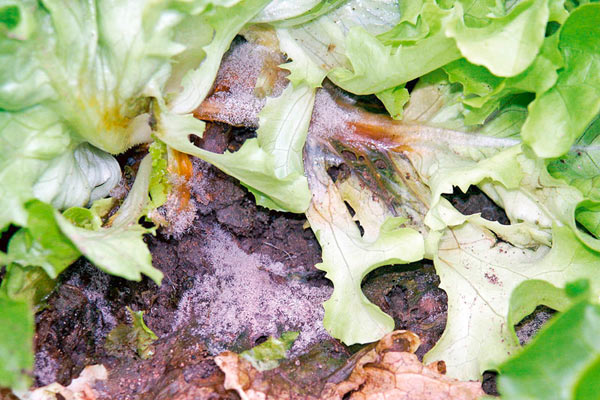
Gray mold (Botrytis cinerea Pers.)
Infection by the pathogen is rarely observed in seedling nurseries and more often after transplanting. It attacks plants at all stages of development – from the seedling stage to harvest. In young seedlings it causes damping-off by affecting the root collar. Infected plants fall over onto the soil surface, and the affected parts become covered with a gray sporulating fungal growth. In older plants it most often attacks the lowest, oldest leaves. Large watery spots form on them. They may also be located at the base of the leaf and at the tip. Later, the spots turn yellow and become covered with a grayish sporulating growth. Sometimes the pathogen encompasses the entire head and the plant dies. Later, large black sclerotia form on the dead tissues, with which the fungus persists in the soil for a long period. There is a key moment in the lettuce development cycle. As the plants develop, the leaf rosette expands and closes, and control of the fungus becomes increasingly difficult. Well-developed plants completely cover the soil surface. The old leaves remain covered by younger ones, receive less light, become chlorotic and pressed against the moist soil. The pathogen more easily colonizes such tissues. Damage may also be observed after harvest, during storage and transport.
The fungus survives in soil and plant residues as conidia, mycelium and sclerotia. The latter survive in the soil for several years. Conidia are spread by wind and air currents, less often by rain and water droplets. They penetrate through the cuticle or through wounds. It readily enters necrotic or dead tissues resulting from damage by low temperatures, water stress, or sunburn. The pathogen prefers a humid environment. Relative humidity around 95% and temperatures of 17–23 °C are very favorable conditions for its attacks. These occur in protected cultivation facilities but also in open fields, during rainy periods or after sprinkler irrigation. The agricultural textile used to protect plants from insects favors its development. Infection by B. cinerea is more significant under such covers due to higher humidity. In covered tunnels, the quality of the covering material matters for the development of some pathogens, especially Botrytis cinerea. The most severe infection occurs under polyethylene.
Control
Control of this pathogen is difficult because: plants are most often grown under polyethylene, where conditions are favorable for its development; treatments with chemical PPPs must stop early – before the plants reach market maturity – due to the risk of residual accumulation, while during this period they are most vulnerable; the fungus quickly adapts to PPPs and develops resistance; the number of PPPs registered against this disease is small.
Some preventive measures complement chemical control: the effectiveness of crop rotations is disappointing, which is certainly due to the polyphagy of Botrytis cinerea and the fact that the inoculum largely comes from the crop environment; regular ventilation of protected cultivation facilities to reduce air humidity; balanced fertilization; it is recommended that irrigation be done in the morning and at the beginning of the afternoon, never in the evening, so that the plants dry as quickly as possible; heating the facilities in the early morning hours is advisable to reduce humidity and remove dew formation on the leaves; removal of plant residues from diseased plants on which Botrytis sporulates abundantly and sometimes forms sclerotia.
Registered PPPs: Avalon (Erune/Laitane/Pyramid/Pretil) 200 ml/da; Botribel 0.4–1.5 l/da; Geox WG 50 g/da; Kiplant Metacare 0.4–1.5 l/da; Serenade ASO SC 400–800 ml/da; Serifel 50 g/da; Signum 60–75 g/da; Switch 62.5 WG 60 g/da; Fontelis SC 150 ml/da; Fungisei 300 ml/da.
Downy mildew (Bremia lactucae Regel)
Downy mildew is one of the oldest and most destructive known diseases affecting lettuce grown both in the field and under cover. It is particularly widespread in production areas characterized by prolonged periods of humidity and cool weather, especially in Europe. It can cause significant losses and destroy entire crops within a few days if climatic conditions are favorable. It often poses a constant threat and requires preventive fungicide treatments.
Bremia lactucae belongs to the oomycetes. It occurs on about 230 plant species in the family Asteraceae. The species has many specialized forms parasitizing a wide range of hosts. It attacks lettuce throughout its growth cycle. Seedlings are especially susceptible to downy mildew. The pathogen develops very quickly on the cotyledons, which turn yellow and become covered with a loose white growth. Plants show stunted growth and die. In older plants it first attacks the lower leaves. Large pale-green to yellow angular spots appear on them, delimited by the veins. Later the spots become necrotic and turn light brown. Their lower surface becomes covered with a loose growth of the pathogen’s sporulation. Subsequently, spots also appear on the inner leaves. Under severe infection, the spots merge, necrotize and the leaves die. Systemic infections are also possible. In such cases, browning of the internal tissues of the stem and the base of the leaves is observed. The damaged tissues provide a nutritional base for the development of secondary bacterial (Pseudomonas spp., Pectobacterium carotovorum subsp. carotovorum spp.) or fungal (Botrytis cinerea) invasions, which under humid conditions cause wet and soft rots in the field and sometimes even during storage.
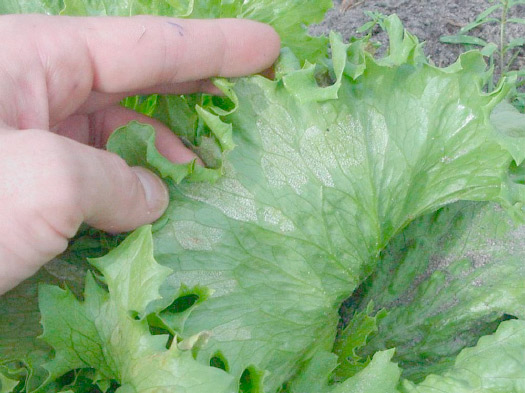
Downy mildew (Bremia lactucae Regel)
It occurs in protected cultivation facilities and in the open field. This obligate parasitic organism is strongly influenced by climatic conditions. It favors prolonged periods of cool, humid weather (with relative humidity close to 100%) and cloudiness. Long periods of leaf wetness in the morning are especially favorable for infection. Sprinkler irrigation stimulates downy mildew development more than other irrigation methods. The temperature range for sporangia germination is between 10 and 15 °C. Infections can develop within 2 to 3 hours at temperatures from 2 to 20 °C. Sporulation is intensive at night temperatures around 5–10 °C and day temperatures between 12 and 20 °C. Conversely, as soon as the weather warms again, temperatures rise above 20 °C and humidity decreases, sporulation drops sharply. The temperature interval for pathogen development is 1–150C. If climatic conditions are favorable, yellow spots appear 4 to 7 days after the first infections. Under high air humidity, when plants remain covered for a long time with dew droplets, the disease develops massively and causes large losses. Lettuce that has undergone stress during growth, such as very low temperatures, low light, or temporary water shortage, is more sensitive to this pathogen. Bremia lactucae completes a full cycle in less than 5 days if climatic conditions are highly favorable. It survives on plant residues in the soil as oospores and mycelium. Seeds sometimes carry the pathogen superficially, but it has not been proven that they are a source of primary infections.
Control
It should begin with preventive measures: regular ventilation of seedling nurseries and protected cultivation facilities; watering during the day so plants have time to dry by evening; when necessary and possible, turning on heating in the early hours of the day to limit dew formation on plants; upon the appearance of the first spots, diseased leaves are removed and destroyed outside the greenhouse; maximum removal of plant residues at the end of the growing season; deep plowing of remaining residues into the soil; treatment with PPPs – preventively and upon appearance.
Registered PPPs: Bordeaux mix 20WP 375–500 g/da; Vitene Triplo R 400–450 g/da; Golbex WG (Golbex WP/Kyifol WG/Kyifol WP/Kilate WG/Kilate WP) 250 g/da; Enervin Pro 320 ml/da; Enervin SC 120 ml/da; Eruan SC 250 ml/da; Infinito SC 140–160 ml/da; Yodus 200 ml/da; Kapar Key (Kapar Key Flow/Kapar Lainko/Kodimur 50 WP/Kodimur SC/Kupra) 150–240 g/da; Kodimur 38 Flo 200–320 ml/da; Corsate 60 WG 20–40 g/da; Limocide 200 ml/da; Melody Compact 49 WG 185 g/da; Mykonos Evo 45–250 ml/da; Oxitec 25% High Bio 300 g/da; Orondis Ultra 40 ml/da; Proplant 722 SL 150 ml/da; Revus 250 SC 60 ml/da; Ridomil Gold R WG 500 g/da; Ridomil Gold SL 20 ml/da; Taegro 18.5–37.0 g/da; Favia 50 ml/da; Fungisei 300 ml/da; Cyclo R Liquido 300–400 ml/da.
Anthracnose (Marssonina pannattoniana (Berlese) Magnus).
The fungus attacks young plants, which are particularly susceptible. Under high air humidity and severe infection, seedlings become chlorotic and growth is stunted. The pathogen is responsible for leaf spots located close to the soil. Initially they are small and watery. Subsequently they expand and become rounded. Their delimitation by the veins gives them an angular appearance. The damaged tissue changes color from orange to brown. Later it dries, tears off and falls out. The leaves look perforated. Spots along the veins are more elongated and often merge. They acquire a dark orange hue. Along the periphery of the spots, individual whitish to pink spore masses of acervuli form, providing asexual reproduction.
With late infection, lesions appear only during storage and transport, which worsens the quality of the salads ready for sale. It is most often observed with earlier planting dates in autumn, but it can occur throughout the entire growing season. Small watery spots appear on older leaves. On veins and petioles, the spots are sunken, pale yellow-brown. In humid weather they become covered with a pale pink growth of mycelium and sporulation of the fungus. The pathogen survives in the soil and is also transmitted by seeds. Spores are spread by water droplets. For these reasons, infection is more often observed in crops whose seedlings were grown outdoors.
Control
Introducing a 3–4-year crop rotation where possible; seed disinfection; maintaining an optimal air-water regime; preventing water droplets from forming on the leaves; removing diseased leaves during transplanting and upon the appearance of the first spots; when infection is established, treatment with PPPs is carried out. Only Bordeaux mix 20WP 375–500 g/da is registered for control of this disease.
Powdery mildew (Golovinomyces cichoracearum (syn. Erysiphe cichoracearum))
It attacks both wild and cultivated species of the family Asteraceae. The disease develops from spring to early autumn, and in some regions throughout the year, most often in protected cultivation facilities. Conidia tolerate a wide range of environmental conditions (9–30 °C), and infections can occur at temperatures between 10 and 27 °C. Conidia germinate and initiate infection even when relative humidity is between 50 and 75%. The optimum is 95–98%. After infection occurs, conidia production in powdery mildew colonies remains unaffected by relative humidity. Light intensity can reduce lettuce susceptibility to powdery mildew.
The oldest leaves are usually infected first. The fungus can affect seedlings and colonize both the leaf surface and the lettuce stems. Small, separate white spots appear on the leaf surface. Later the spots merge and white mycelium and spores cover the entire leaf. Severely affected plant tissues turn yellow, then brown, and the leaves die. They may deform, plants may lag in growth, and later may die.
Control
Powdery mildew is very difficult to control, especially when it appears at an advanced stage close to harvest. Some preventive measures can improve control: cleaning areas of plant residues, or rapid and deep plowing; destruction of weeds that host the pathogen; introducing crop rotation – it does not need to be long, because the cleistothecia of the pathogen do not persist long in the soil; proper selection of plots for the next growing season – well-ventilated and sunny areas; balanced fertilization during the growing season.
If favorable conditions for development are present or the first spots appear, treatment with PPPs is applied. Registered PPPs: Kumulus 500 g/da; Limocide 300 ml/da; Sonata SC 500–1000 ml/da; Thiovit Jet 80 WG 400 g/da; Flowsol/Pousis 750 ml/da.
Basal rot (Rhizoctonia sp.)
Limiting contact between lettuce leaves and the soil beneath them helps prevent infection by some diseases. Pests and soil-borne pathogens have easier access to crops when plants lie on the ground. Fungi of the genus Rhizoctonia are extremely common in garden soil and develop very well under the same conditions as lettuce.
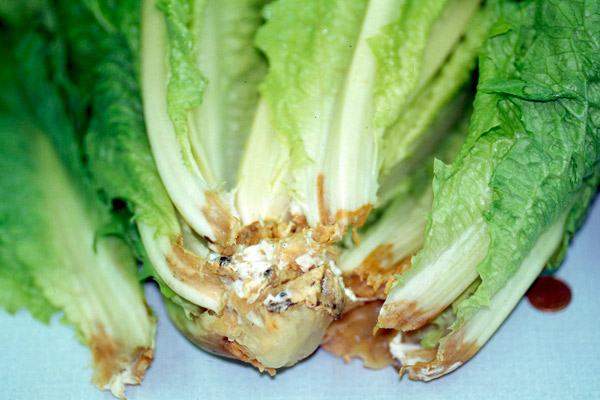
Basal rot (Rhizoctonia sp.)
When plants reach market maturity, the outer wrapper leaves come into contact with the soil, where the fungus is present, and infection may begin. There are strains that can infect other crop species – such as potatoes, onions and even weeds – therefore it is important to keep the areas well cleaned between plantings. The first signs on infected plants are the appearance of brown or rusty discoloration, which often develops as scales along the midribs. Later, sticky areas form, which can cover a larger part of the underside of the head or the stems. If not treated, the leaves wilt and turn yellow, the rusty color changes to black, and the slimy texture dries and crumbles until the plant dies. Another characteristic sign of crown rot is the distinctive musty smell that appears when fungal damage becomes evident.
Control
Removing infected leaves limits the spread of the pathogen, but reinfection can still occur; hilling soil around plants at planting prevents leaf contact with the soil; growing on raised beds will limit water retention that wets the lower leaves; introducing crop rotation; leveling and drying plots before planting; treating the soil in the planting zone with a PPP containing Trichoderma harzianum.
Bacterial diseases (Xanthomonas campestris pv. vitians (Brown) Dowson; Pseudomonas viridiflava (Burkholder) Dowson).
The disease is important during the post-harvest period in salads. It is caused by pectolytic and fluorescent bacteria. Losses can be high because some infected plants die, while the rest have reduced market quality and may also die during storage and transport. The first symptoms are brown to greenish-black rot of the midrib, first on one and later on several inner leaves. The disease can develop very quickly and affect a large number of plants. Most often, plants are infected immediately before harvest.
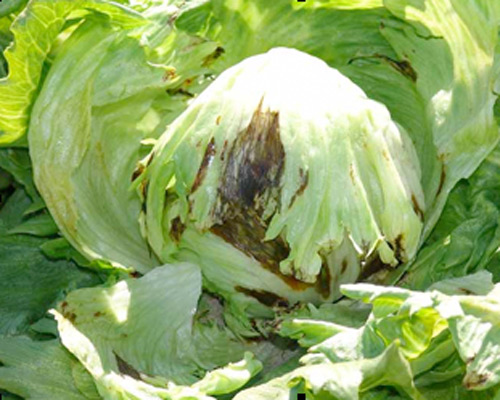
Bacterial diseases (Xanthomonas campestris pv. vitians (Brown) Dowson; Pseudomonas viridiflava (Burkholder) Dowson).
It spreads via water splashes caused by rainfall outdoors or by irrigation in protected cultivation facilities. Infection can be prevented by using drip or gravity irrigation instead of spraying or overhead sprinkler irrigation. Over-wetting of crops has an unfavorable effect. Another source of infection may be infected seeds. The pathogens persist for a long time in seeds – up to ten years. Therefore, once infection is established, such seed lots must be disinfected before sowing or discarded. If infection occurs, bacteria can develop very quickly under warm, humid conditions. Increasing airflow and slightly drying the plots can limit spread. Balanced mineral fertilization also limits infection.
Despite the efforts made, the disease may still occur. Under favorable conditions it is advisable to treat plants with a copper-containing PPP. All infected leaves must be removed and destroyed far from the crop.
Areas where infection has been established should not be replanted with salads, because the pathogen persists in the soil and in infected plant residues for up to one year. It is necessary to introduce crop rotation and regularly clean areas of weeds, as bacteria can persist in the roots even in plants that are not usually hosts.
Control
It is mainly aimed at good prevention. It is necessary to maintain optimal air temperature and humidity; regular ventilation of the facilities; balanced fertilization; the first diseased plants should be pulled out and destroyed outside the greenhouse; scorching the spots with a 2% solution of copper sulfate. Spraying plants with copper-containing PPPs is not recommended, but if necessary they can be treated with Bordeaux mix 20WP 375–500 g/da.
Lettuce mosaic (Lettuce mosaic virus (LMV))
LMV is one of the most serious viruses affecting lettuce. It is seed-borne and also infects chicory. There are many strains that differ in their biological and serological properties. For example, highly aggressive strains have been isolated from wild species, as well as from chicory and lettuce.
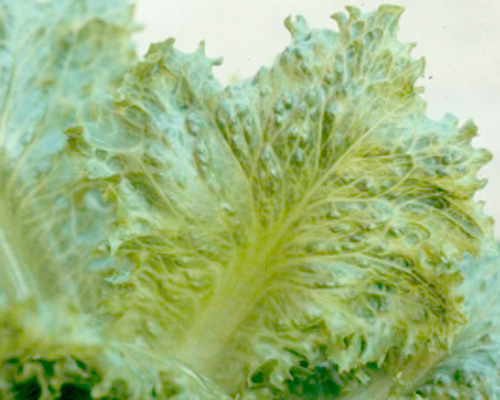
Lettuce mosaic (Lettuce mosaic virus (LMV))
On the leaves of young plants emerging from infected seed, vein thinning, mosaic mottling and deformation of the leaf blade are observed, sometimes also necrotic spots. As a result of early infection, plant growth and development are severely limited. Ultimately, the lettuces remain small and are not marketable. In plants infected later, mottling and deformation of the leaves are observed, including curling of the outer leaves. Lettuce development is restricted to a lesser or greater extent. In some cases of late infections, symptoms on the leaves are very limited. Symptoms are particularly noticeable in actively growing plants. There are differences in symptoms among varieties. They are less pronounced in Batavia and iceberg types. LMV symptoms vary greatly depending on the lettuce type, virus strain, plant growth stage, and environmental conditions.
The virus is transmitted through seed. The transmission rate varies depending on genotype, strain and environmental conditions from 3 to 15%. In lettuce, symptoms of infection include: chlorosis; dull, deformed leaves with blisters; ragged edges of the leaf blade. Spinach, peas and all lettuce types are susceptible to LMV.
Control
The only real control is prevention: removing weed vegetation from production areas; sowing healthy, disinfected seed; systematic control of the vectors – aphids.
Aphids
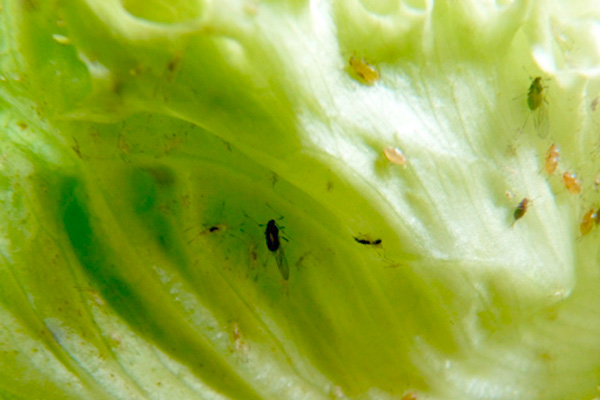
Aphids
The most common aphid on lettuce is the green peach aphid (Myzus persicae). Other species that may periodically be observed in crops are the potato aphid (Macrosiphum euphorbiae), the foxglove aphid (Aulacorthum solani) and the buckthorn potato aphid (Aphis nasturtii). Aphids are among the most common pests of lettuce. They are observed throughout the entire growing season, from seedling production to marketing of the produce.
Aphids are piercing-sucking pests that feed on plant sap. They tend to gather in large groups and often form dense colonies on the underside of leaves. They cause leaf deformation and stop plant growth and development, and at high density the plant may die. While feeding, aphids excrete a sticky secretion called honeydew, on which sooty saprophytic fungi develop. This contaminates the leaves and slows photosynthesis. Aphids are vectors of some viral diseases.
Control
Destroying weed vegetation. Maintaining optimal humidity. Crops should be inspected regularly and, if necessary, sprayed with: Abanto 60 ml/da; Azatin EC 100–150 ml/da; Delmur 50 ml/da; Decis 100 EC 6.5–12.5 ml/da; Krissant EC 60 ml/da; Nature Breaker 60 ml/da; Niimic Ten 260–390 ml/da; Oikos 100–150 ml/da; Pyregard 60 ml/da; Pyrekris 70–150 ml/da; Sivanto Prime 63 ml/da; Skato 25–50 ml/da.
Thrips (Thrips tabaci, Frankliniella occidentalis)
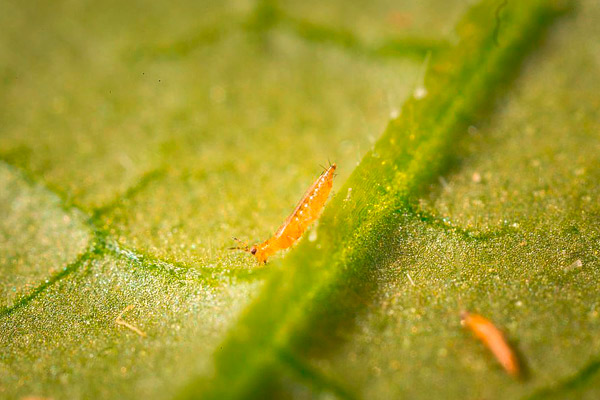
Thrips (Thrips tabaci, Frankliniella occidentalis)
Adults and larvae cause damage by sucking sap from the leaves. Small silvery-white spots with black dots appear at the feeding sites. At high densities, the spots enlarge and merge. Leaves dry out. Damage can often be easily detected on the lower leaves. Plants lag in development.
Control
Use healthy, pest-free seedlings. Destroy weed vegetation. Regularly inspect fields. Spray with: Azatin EC 100–150 ml/da; Biavrio 480 SC 15.8–20 ml/da; Benevia 75–112.5 ml/da; Volkete 15.8–20 ml/da; Dicarzol 10 SP 556 g/da; Deka EC/Desha EC/Dena EC/Poletsi/Decision/Deltin 30 ml/da; Milsah 15.8–20 ml/da; Flipper 1–2 l/da.
Cutworms: soil-dwelling (Agrotis ipsilon, Agrotis segetum) and aboveground (Helicoverpa armigera, Mamestra oleraceae, Autographa gamma)
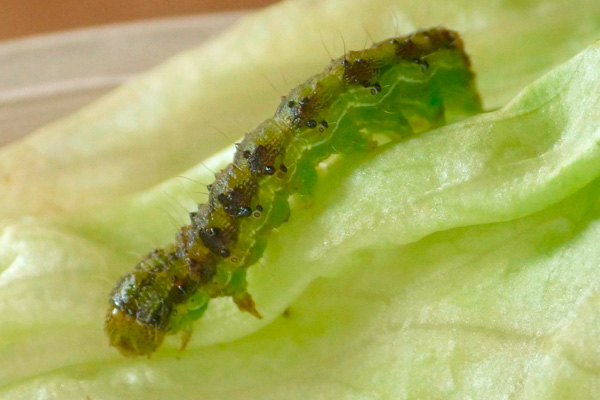
Polyphagous pests. The caterpillars (1st and 2nd instars) skeletonize the leaves and make holes, while those of the soil-dwelling cutworms in later instars cut the plants at soil level. As a result of the damage, plants break and die. During the day, soil cutworm caterpillars are found shallowly buried in the soil, most often around the damaged area, curled into a ring. Young plants are particularly sensitive to damage before their supporting tissues develop. With later attack, plants may survive, but their development is usually greatly reduced. Damage often spreads along the row, affecting several consecutively positioned plants.
Control
Regular soil cultivation, which significantly reduces the population density of this pest by mechanically destroying a large portion of the pupae. Regular removal of weed vegetation. Insecticide treatments are effective when targeted against young caterpillars. The following plant protection products can be used: Altacor 35 WG 8–12 g/da; Azatin EC 100–150 ml/da; Benevia 60–75 ml/da; Dipel DF 75–100 g/da; Delmur 50 ml/da; Deka EC/Desha EC/Dena EC/Poletsi/Decision/Deltin 30 ml/da; Niimic Ten 260–390 ml/da; Oikos 100–150 ml/da; Skato 25–50 ml/da.
Mole cricket (Gryllotalpa gryllotalpa)
It causes damage as early as February in greenhouses, especially where it is introduced with soil-manure mixes and farmyard manure. It prefers loose, moist, humus-rich soils. The mole cricket makes underground tunnels, undermines and lifts plants.
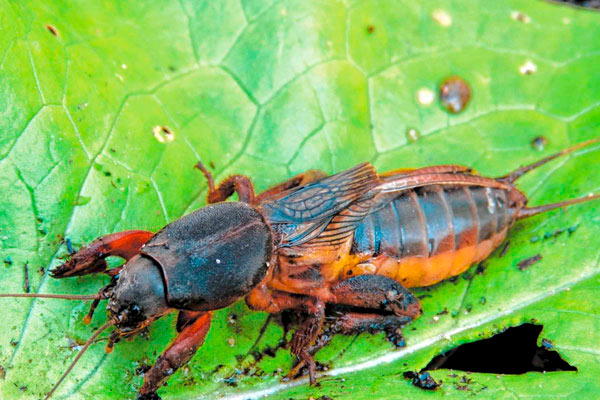
Mole cricket (Gryllotalpa gryllotalpa)
Both larvae and adults feed on the underground parts of plants, gnaw the root system, and eat young sprouts. Damaged plants dry out.
Control
There are no approved plant protection products against this pest in lettuce. If necessary, products registered for other crops may be used: Belem 0.8 MG (Colombo 0.8 MG) 1.2 kg/da.
Slugs (Limacidae)
Non-insect, polyphagous pests. They chew on lettuce leaves and make irregular holes. Under severe infestation, leaves may become ragged.
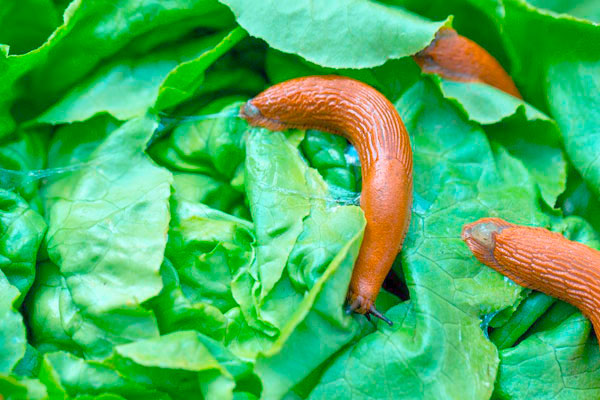
Slugs (Limacidae)
They are especially dangerous at high humidity. They are common in lettuce crops. Damage significantly worsens the market appearance and quality of lettuces. Soils that warm up more easily favor higher slug activity. Drought leads to a decrease in the population density of these pests. As they move on plants, they leave a white slimy trail, which indicates their presence.
Control
Regular soil cultivation. Optimal planting density. In small areas – mechanical removal (placing traps from plant residues, wet paper, attractant liquids, etc.). Application of the product Karakol 5 GB 0.7 kg/da.
In greenhouse-grown lettuces, albeit more rarely, damage may be observed from leaf-mining flies, greenhouse whitefly, and the common two-spotted spider mite.
Control of lettuce pests requires an integrated approach. Of primary importance are prevention and the production and transplanting of healthy plants. All known preventive and agronomic measures are applied, such as using mineral or peat-mineral substrates in seedling production, ensuring an optimal nutritional and temperature-humidity regime, weed control, applying optimal agronomic practices, etc.
Lettuce is a crop with a short growing period. The use of chemical plant protection products must be prudent and careful, strictly aligned with the pre-harvest intervals.
References
1. Bahariev D., Velev B., Stefanov S., Loginova E. (1992). Diseases, weeds and pests of vegetable crops, Zemizdat.
2. Aysan Y., Sahin S., Ulke G., Sahin F. (2003) Bacterial rot of lettuce caused by Pseudomonas cichorii in Turkey. Plant Pathol 52:6782.
3. Brandes EW (1918) Anthracnose of lettuce caused by Marssonina panattoniana. J Agric Res 13:261–280
4. Brown S., Koike S. T., Ochoa O. E., Laemmlen F., Michelmore R. W. (2004) Insensitivity to the fungicide fosetyl-aluminum in California isolates of the downy mildew pathogen Bremia lactucae. Plant Dis 88:502–508
5. Coley-Smith J. R., Verhoeff F., Jarvis W. R. (eds) (1980) The biology of botrytis. Academic Pres
6. Elmer W., M. McGrath, R. McGovern (2023). Handbook of Vegetable and Herb Diseases, Diseases of Lettuce, 1-60.