Nikolay Georgiev: A tomato salad should consist of as many colors as possible to be beneficial for health
Author(s): Нора Иванова, Редактор Растителна Защита /РЗ/
Date: 18.02.2026
2820
![MultipartFile resource [file_data]](/assets/img/articles/трихговска-николай.jpg)
Geosemselect is the first Bulgarian private company established in the field of breeding and production of hybrid tomato seeds. The company's legacy is built on the long-term experience of Prof. Hristo Georgiev, one of the most famous hybrid tomato breeders, and today the company is managed by Prof. Georgiev's grandson – Nikolai. Last year, Geosemselect marked 35 years of activity and joint participation with the Maritsa Vegetable Crops Research Institute in one of the most famous events in the field of breeding – the XXI Eucarpia Meeting of the Tomato Working Group.
In a conversation with Nikolai Georgiev, we recall the quality and taste of the Bulgarian tomato, created for our soil and climate, about tomato breeding, and about the traditions in the food habits in our country.
Mr. Nikolai Georgiev, what is the most difficult task in tomato breeding and what are the challenges facing modern tomato breeding?
N.G. Indeed, tomatoes are a very specific crop for breeding. Although the breeding process takes the same amount of time as with other crops like wheat, corn, and sunflower, tomatoes show their potential depending on different conditions. Therefore, the difficult task is to create a variety that delivers the same, or at least with minor deviations, performance indicators under different conditions, such as climatic zones, countries, soils, and cultivation technologies. This is one of the difficult tasks; otherwise, there are many challenges facing tomato breeding – more and more viruses, pests, climate changes, which make us think in the direction of resistance to high temperatures and droughts, and other abiotic and biotic stresses.
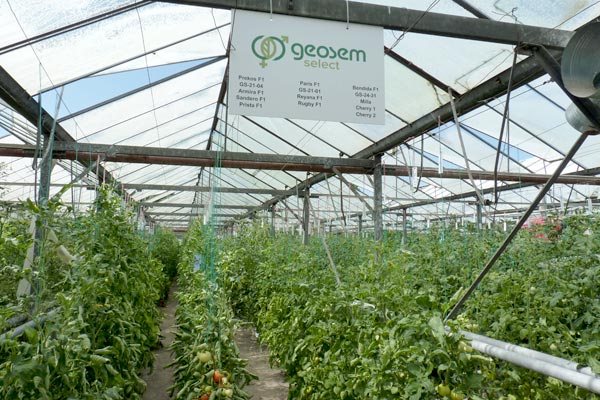
Experimental greenhouse at the Maritsa Vegetable Crops Research Institute
What is the difference between hybrids and open-pollinated varieties offered by Geosemselect Ltd.?
N.G. Hybrid varieties are first-generation hybrids; they are created by crossing two parental lines, i.e., essentially two varieties with a mother plant and a father plant. Pollen is taken from the father plant and crossed with the mother plant, and the seeds obtained are the first generation or F1 hybrid. They combine the qualities of both parents. The seeds we offer from hybrid varieties have the advantage of having combined the positive qualities of both parental lines; they are created and adapted for the Bulgarian climate.
With open-pollinated varieties, the natural principle is followed, namely the tomato self-pollinates and the next generation it creates is identical to the previous one. We also produce open-pollinated tomato varieties, created by Prof. Hristo Georgiev in co-authorship with Prof. Bistra Atanasova from the Institute of Genetics at the Bulgarian Academy of Sciences – Sofia.
Are Bulgarian tomato varieties competitive on the European market?
N.G. Yes, especially on the hobby market and the semi-professional market; here I am not including high-tech greenhouses and conventional production practiced in wealthier countries. But some of our varieties manage to break into foreign markets without problems and are actually quite sought after and liked by customers abroad, mainly due to their taste qualities. For the last 5-6 years, early tomato varieties have enjoyed enviable success in Romania.
The tomato is traditional for Bulgarians in terms of taste. But what does the Bulgarian like, because even though it's the same crop in different countries where the tomato is a staple part of the menu like Spain or Italy, the taste preferences are quite different.
N.G. What I have observed in recent years is that the Bulgarian consumer is rather conservative; they are not so inclined to try new things, unlike a consumer in France, for example. There I have noticed how they constantly try new flavors, colors, and combinations. In Bulgaria in recent years, large, pink tomatoes are sought after above all, which are probably associated with grandmother's tomatoes, but they do not correspond to our traditions from the past.
I believe that the red tomato from our childhood is much more typical for the Bulgarian table.
The difference between the red and pink tomato lies in one Y gene, which is responsible for the coloration of the skin, and in one flavonoid, which is yellow. The pink tomato specifically lacks this flavonoid – naringeninchalcone, which is yellow. Otherwise, the content of the substance lycopene is the same in both tomato varieties.
In fact, according to literature data, the healthiest tomatoes are the brown ones, because they contain a large combination of flavonoids.
When the color is different from red and pink, for example like the brown tomatoes from Spain, Bulgarians think that this tomato is genetically modified and accordingly does not deserve their attention. In fact, a tomato salad should consist of as many colors as possible to be beneficial for health.
You can also find Geosemselect at AGRA 2026 (February 17-21), hall 13, stand B5