IRGR-Sadovo will coordinate a project to study the phenotypic diversity and new technological solutions for bitter vetch (Vicia ervilia)
Author(s): доц. д-р София Петрова, Институт по растителни генетични ресурси "К. Малков" – Садово, ССА
Date: 29.01.2026
3046
![MultipartFile resource [file_data]](/assets/img/articles/burchak-1.jpg)
IRGR-Sadovo is the coordinator of a new project on the topic "Study of the phenotypic diversity and new technological solutions for bitter vetch (Vicia ervilia) – potential for use in the face of advancing global climate changes", funded by the "Scientific Research" Fund, Contract No. KP-06-N96/14/10.12.2025.
The project implementation period is 2025-2028. The project leader is Assoc. Prof. Dr. Sofia Petrova.
A number of plant species, underutilized and undervalued, are increasingly proving their significant potential to transform global agri-food systems. Despite their advantages and high adaptability, these species largely remain outside the scope of conventional agriculture, often overshadowed by major cereal crops. Integrating them into agricultural practices offers multiple benefits, including increased biodiversity, enhanced resilience to climate change, and improvement of the global nutritional profile.
Vicia ervilia, known as bitter vetch, is an ancient legume crop originating from the Mediterranean region. It has a long history of cultivation dating back to the Paleolithic and is widely represented in archaeological finds from the Neolithic and Bronze Age. In the past, bitter vetch was an important crop for grain and forage production in Mediterranean countries, but its popularity declined with the introduction of more productive crops. This legume deserves a fresh look due to a number of agronomic advantages – high yield potential, drought and cold tolerance, improvement of soil fertility, and ability to adapt to marginal soils and semi-arid regions.
For the successful management and integration of bitter vetch into agriculture, it is essential to have extensive knowledge about the available diversity in the National Collection, as well as its applications and significance. This will stimulate the interest of agricultural producers and contribute to the sustainable maintenance of ecosystems involving diverse agricultural crops. Although traditional knowledge provides valuable information regarding the cultivation and use of these species, it is necessary to conduct in-depth scientific research to fill existing gaps, resolve current disputes regarding agronomic practices, and better understand their effect on human health.
The main objective of the present study is to perform a comprehensive characterization, evaluation, and enrichment of Vicia ervilia accessions from the national collection using phenotyping, agronomic traits, resistance to biotic and abiotic stress, as well as biochemical and technological parameters. Biochemical analyses will be aimed at generating new knowledge regarding starch content, total carbohydrates, fatty acid composition in triacylglycerols, seed energy value, and water-soluble sugar content.
The promising accessions identified during the research will be tested under production conditions. The development of a cultivation technology for a local autumn form of bitter vetch under conventional farming conditions in the regions of the Eastern Rhodopes and Sadovo is envisaged.
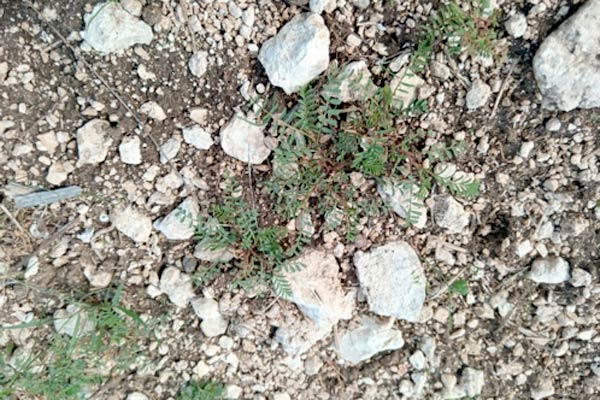
bitter vetch, grown under organic field conditions in the Eastern Rhodopes
The inclusion of bitter vetch in flour mixtures aligns with public health goals, providing access to more balanced and functional foods, which is a priority in national health and preventive policy. In this regard, a broad set of studies is planned to assess the technological properties of flour from selected promising bitter vetch accessions, chosen based on specific agronomic characteristics. A full technological evaluation of the flour will be performed using key quality indicators to determine its technological potential for incorporation into bread products intended for daily consumption.
The main objective of the present study is to perform a comprehensive characterization, evaluation, and enrichment of Vicia ervilia accessions from the national collection using phenotyping and agronomic indicators. The promising accessions identified during the study will be tested for abiotic stress resistance, characterized by biochemical and technological parameters, and tested under production conditions in the regions of the Eastern Rhodopes and Sadovo.
Tasks
- Phenotyping and evaluation of bitter vetch accessions using morphological, phenological, and economic traits;
- Phenotyping and evaluation of promising bitter vetch accessions under different ecological and geographical conditions;
- Evaluation of bitter vetch accession seeds based on biochemical parameters;
- Chemical-technological analyses of two-component wheat-bitter vetch flour mixtures aimed at improving the protein content and taste qualities of bread.
More on the topic:
First report of root rot (rhizoctoniosis) on bitter vetch (Vicia ervilia) in Bulgaria
Farmer's Day in Sadovo – crops suitable for alternative and organic farming