Round table united all involved with the bioeconomy in Bulgaria
Author(s): Растителна защита
Date: 23.11.2025
2464
![MultipartFile resource [file_data]](/assets/img/articles/кръгла-маса-биотехнологии-1.jpg)
A first-of-its-kind event, which gathered all stakeholders involved in the country's bioeconomy in one place, was held on November 20 at the TEZ Event Center, initiated by the Regional Bioeconomy Hub – Plovdiv and in partnership with Thracian Economic Zone. The round table brought together representatives of state authorities, academia, business, municipalities, the non-governmental sector, and experts in finance and sustainable development to discuss the strategic opportunities for the development of the bioeconomy in the region and the country.
The debate focused on the implementation of European policies and regulatory requirements, the development of science, education and innovation, as well as the transfer of technologies to bio-based industries.
Also discussed were startups, incubators and accelerators with a circular and ecological focus, sustainable business models, ESG standards, and funding opportunities from European, national, and private sources. Special attention was given to the transfer of knowledge from universities and research centers to businesses and the integration of sustainable practices into industrial and regional models.
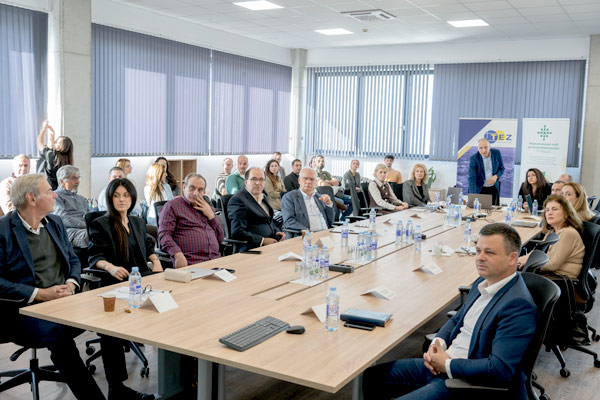
Prof. Vladislav Popov, chairman of the Regional Bioeconomy Hub - Plovdiv, provided an overview of the sector and outlined the key challenges in Bulgaria: fragmentation and lack of a national strategy, weak monitoring, insufficient connection between business and the academic community, lack of demonstration centers, and a low level of innovation and digitalization. At the same time, opportunities were identified for: integrating a framework for sector development, synchronization with European initiatives, creation of living labs, R&I ecosystems, knowledge transfer platforms, demonstration zones and accelerators, promotion of the sector, and support for circular solutions.
Institutions and Funding
Experts from the Ministry of Agriculture and Food noted that the structure possesses a wide range of financial instruments to support the bioeconomy. The Ministry of Innovation and Growth also provides funding opportunities. The Fund of Funds has directions for technology transfer, and the Rural Development Program also provides funding for vulnerable groups, including youth. Within the Common Agricultural Policy, interventions for investments in farms, environment, and biotechnologies are planned, which will open in December and January. Additionally, there are measures for risk management, drought, and regenerative agriculture. The Ministry has sufficient funds for financing, and the team is open for assistance and dialogue.
Science and Business
It was concluded that science and business cannot function independently. The work of research centers should stem from the real needs of business. Participants agreed that both sides need to communicate more and primarily develop joint projects. University representatives presented national centers of excellence, as well as successfully implemented local structures and initiatives developed under European projects. The potential of all these is significant, but a high level of applied science and accelerated technology transfer are generally required – currently, it is slow, and businesses seek quick results. Plovdiv University, Thracian University, and UFT already work with businesses through technology transfer and patents, but these partnerships need to increase. The Center for Plant Systems Biology and Biotechnology has inquiries from companies from Bulgaria and abroad, but their number should be greater. Business must be the active party and seek science, and solutions should be based on regional prerequisites. The potential and ideas are there, but substantial work and realistic goals are needed. A good example cited was the TIE initiative with the new wastewater treatment plant, demonstrating successful coordination between science and business. Experience from Switzerland was shared, where universities and scientific units operate only on business orders, and science is entirely applied. Clear business goals are set, and scientific development is measured through economic indicators – first, financial benefits and future job creations are calculated, and then the actual scientific work begins. Municipalities and local authorities also have a crucial role in the development of education and innovation. The regional potential is great, but the need for innovation is urgent. A striking example cited was China, where for years, waste from edible roses and other biologically active essential crops has been utilized, while in Bulgaria, a leading producer of Rosa Damascena, this practice has not yet been implemented.
Education and Startup Funding
There is a need for higher-level education development, stimulating students, shortening the distance between academic and practical work, and teamwork. Spin-off companies should be encouraged, and professions and business activities with a biological and ecological focus – agriculture, biotechnologies, circular practices, recycling, etc. – should be promoted. The creation of incubators is key. As for funding, there are accelerators focused on innovation and startups, working exclusively in the circular economy. For them, however, it is essential that activities are supported by scientific development and data.
Business and Sustainability
Regarding sustainability and ESG standards, it was noted that they are important for transparency, risk reduction, improving access to finance, and promoting sustainable and responsible business development. ESG reporting provides an opportunity for data-driven decision-making, while helping companies build trust among investors, partners, and consumers and successfully integrate into European and international market frameworks.
It is encouraging that numerous bioeconomy initiatives already exist in Bulgaria, and the fact that all stakeholders gathered at one table is a positive sign for future coordination. Event participants emphasized the need to consolidate the results of everyone's work and for the next step to be the unification of efforts through the creation of a single working group and the initiation of a national-level debate involving all sectors applicable to the bioeconomy. The inclusion of the Ministries of Agriculture and Food, Innovation and Growth, as well as Environment and Water, is crucial for achieving synergy among all involved units.
The bioeconomy is one of the fastest-growing sectors in Europe, encompassing activities from the sustainable use of biological resources – agriculture, forestry, and industries for producing energy, materials, and value-added products. The goal is to reduce waste and increase competitiveness. Bulgaria possesses significant potential – favorable natural conditions, established agricultural traditions, and a developing scientific infrastructure. The Plovdiv region emerges as a key territory for interaction between science, industry, and the entrepreneurial sector. In 2024, the "Regional Bioeconomy Hub – Plovdiv" Association was established to promote the bioeconomy ecosystem in the Plovdiv Province. The Hub brings together academic and scientific institutions, business organizations, professional associations, local authorities, and NGOs.