Plant protection activities in the orchard in August
Author(s): ас. Кирил Кръстев, Институт по декоративни и лечебни растения – София
Date: 10.08.2025
2956
![MultipartFile resource [file_data]](/assets/img/articles/заглавна-защита-август.jpg)
With the exception of powdery mildew on apple and peach, the risk of fungal diseases has almost passed. Damage caused by harmful insects and mites is also greatly reduced, as the old leaves are not suitable for their development. In addition, some of them move to their alternate hosts.
Plant protection activities in August are aimed mainly at protecting the fruit crop from worm damage and the leaves from leaf-mining moths, bugs and other pests that develop several generations. Monitor for damage caused by mites, due to their population increase.
Treatments must comply with the pre-harvest intervals of the pesticides and the harvest time. They should be carried out during the cooler hours of the day.
In fruit orchards
All orchards are monitored for the presence of the fall webworm. When the economic threshold is exceeded, crops are treated with Dipel 2 X (100 g/da).
The fall webworm (Hyphantria cunea Drury.) is widespread throughout the country. It has a multiannual type of population dynamics (it multiplies massively every 5–6 years). It is a typical polyphagous species, attacking more than 240 plant species belonging to 47 botanical families. It prefers mulberry, apple, plum, cherry, quince, walnut, Norway maple and ash among the broadleaf species.
In Bulgaria the fall webworm usually develops two generations per year, and sometimes a partial third one. It overwinters as a pupa under cracked bark on tree trunks, under roofs or shallow in the soil. Newly hatched larvae from a single egg cluster web together several leaves with silk threads and prepare a common larval nest, which they inhabit. The nest gradually expands as they feed and grow, encompassing the entire terminal part of the branch and sometimes neighbouring twigs. Up to the fifth instar (they usually have seven, but sometimes more) they live in the nest, which protects them from predators. After this stage the larvae lead an independent way of life. Their dense hairiness protects them from predatory insects and birds.
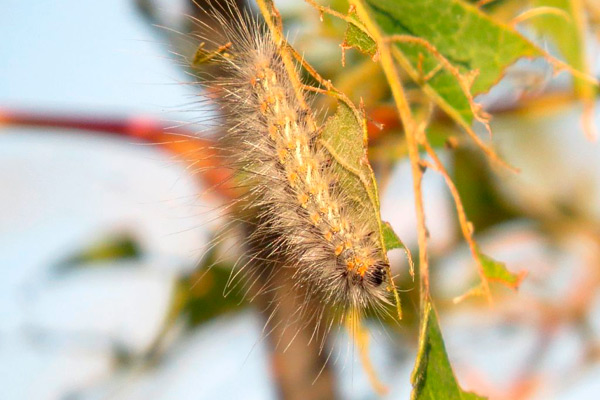
Young larvae (in the nests) partially skeletonise the leaves, feeding on one epidermis and the parenchyma. Older larvae roughly skeletonise the leaves without affecting the veins, and the oldest larvae consume the entire leaf blade. In the absence of food, the larvae may also superficially gnaw the fruits. At higher population densities the pest can completely defoliate large trees over significant areas.
Moths of the second generation fly from the beginning of July to the end of August. Their fecundity is even higher (2,500 eggs). Damage caused by the hatched larvae is often even greater than that of the first generation, with a maximum in August and early September.
After feeding, the larvae of this generation pupate and remain to overwinter. Some of the earlier pupating individuals may emerge as a partial third generation, but this occurs only in certain years and at very low population density.
Fruit orchards infested by the fruit tree tortrix are sprayed with one of the following products – Delegate 250 WG (30 g/da), Rapax 100–200 (ml/da), Dipel DF 50–150 (g/da), Avant 150 EC (33.3 ml/da), Decis 100 EC (8.75–12.25 ml/da), Coragen 20 SC (16–30 ml/da). For mating disruption you can also use combined pheromone dispensers – Isomate – SLR (100 pcs/da).
The trunks and thick branches of fruit trees infested by bark beetles are treated with one of the following products – Decis 100 EC (12.25 ml/da), Coragen 20 SC (30 ml/da), Sumi Alpha 5 EC (0.03%), Karate Zeon 5 SC (15 ml/da).
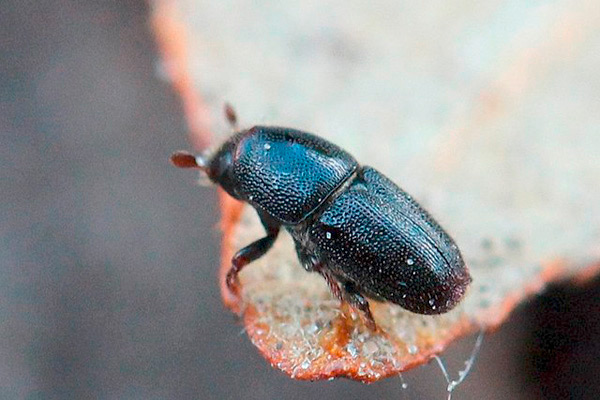
The small (rugose) fruit bark beetle (Scolytus (Ecoptogaster) rugulosus Ratz.) is widespread. It prefers stone fruit species – peach, apricot, cherry, plum, but also attacks pome fruits – pear, apple, etc. It has varietal preferences – for example, the apple cultivar Gloster and rootstock M9. It attacks both old and abandoned orchards and young plantations with healthy plants, which makes it a more dangerous pest than the large fruit bark beetle.
The species develops two generations per year. It overwinters as a larva of various ages in galleries in the trunks and branches of fruit trees. Beetles of the second generation appear in July–August and can be found until September–October. They gnaw round exit holes with a diameter of about 1 mm. They feed on the buds and bark of branches and shoots. They fly well and spread to new trees. After copulation, the females gnaw an entrance hole at the base of the buds and skeletal branches and penetrate into the branches. There they make short longitudinal maternal galleries (1.5–3 cm). On both sides of the maternal gallery they excavate small niches, in each of which they lay one egg. From 10 to 40 eggs are laid in a single maternal gallery. Female fecundity ranges from 12 to 120 eggs. After oviposition the females die and plug the entrance holes with their bodies. The larvae hatch after one to two weeks and gnaw lateral larval galleries, which are long, curved and may intersect. Often the galleries are completely filled with compacted excrement. The hatched larvae remain to overwinter in the galleries, and in milder weather feeding may continue during the winter months.
Peach orchards are sprayed with one of the following products – Sulphur WG (600 g/da), Solfo 80 WG (750 g/da), Systhane 20 EW (0.03%), Luna Experience (50–75 ml/da), Flint Max 75 WG (0.02%) against powdery mildew; with a deltamethrin-based product – Decis 100 EC (12.5 ml/da), Meteor (90 ml/da), Deka EC (50 ml/da) against the oriental fruit moth, peach twig borer (third generation), mulberry scale, San José scale; and with Apollo 50 SC (40 g/da), Valmec (60–96 ml/da) or another abamectin-based product, Voliam Targo 063 SC (75 ml/da), Naturalis (100–150 ml/da) against mites.
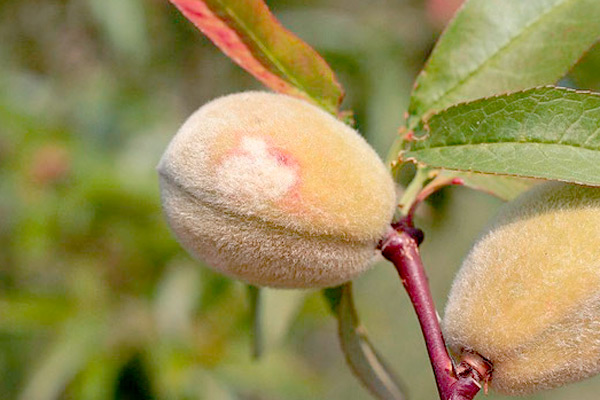
The ascomycete fungus Sphaerotheca pannosa (Wallroth) Levelle var. persicae Woronichin, with conidial stage Oidium leuconium Desmazieres, the causal agent of powdery mildew on peach, overwinters between the scales of infected buds.
The local infection first appears on young, enlarging fruits in the form of expanding powdery spots. Under them the fruit flesh darkens, becomes corky and very often cracks. Young fruits are susceptible to the disease until they reach a size of about 4 cm, after which they usually do not become infected. Often, slightly infected fruits grow to harvest maturity, but corky spots remain on them. In the second half of summer, numerous, mostly angular, chlorotic spots are formed on the leaves and shoot tips, covered on the underside with a powdery coating. The affected leaves become severely deformed and, at high disease pressure, necrotise and fall off.
Nectarine cultivars are particularly highly susceptible to powdery mildew.
The disease develops over a wide temperature range, but at higher air humidity, although individual infections are possible under dry conditions. Frequent and intense rainfall is unfavourable for the development of powdery mildew, as it inhibits fungal growth and leads to washing off of spores or their death. Spore germination is stimulated by light and diseased fruits are usually located in the higher, southern or south-western parts of the tree canopy.
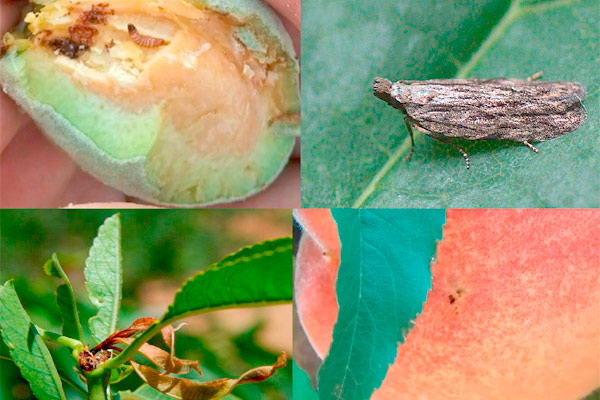
The peach twig borer (Anarsia lineatella Zell.) is widespread throughout the country. It prefers stone fruit species. It most severely attacks peach, apricot and plum. It has also been found on cherry, almond, sour cherry, etc.
The insect develops three generations per year, and in a warm autumn a fourth one. It overwinters as a second-instar larva, and more rarely as a first-instar, in buds, mummified fruits, branch crotches, fruit stalks and on the trunk. For overwintering the larva gnaws a small chamber with smooth walls, lined with silk threads. Most often the chamber is located on the sun-exposed middle storeys of the canopy. Usually small piles of brown excrement accumulate around the overwintering site.
Moths of the third generation fly during August–September until October. They damage mainly the shoots, but sometimes also attack the fruits. One larva damages 1–2 shoots and/or one fruit. At this time, the length of the gallery in the shoots is from 2–3 to 8–10 cm. Infested shoots wilt, and later their terminal part dries up together with the leaves and their growth stops. In small fruits, larvae can destroy the entire interior, and in larger fruits they gnaw a short gallery in the fleshy part. The damage resembles that caused by fruit worms.
The mulberry scale (Pseudaulacaspis pentagona Targ.) attacks mulberry, peach, plum, cherry, almond, walnut, fig, horse chestnut, blackthorn, spindle tree, cherry laurel, lilac, sophora and others. Today it can be found throughout the country.
In our conditions the mulberry scale develops 2–3 generations per year. It overwinters as an adult, sexually immature female and as a nymph of the male individuals.
The second generation appears in August, the third – in September and October. The damage is identical to that of other flat scale insects – the colonies formed on the wood cause necrosis of the cambial tissue under the bark and drying of the branches. Red spots are observed on the fruits.
Fallen wormy hazelnut fruits are collected and destroyed.
Apple orchards are treated with a pyrethroid insecticide – Decis 100 EC (7.5–12.5 ml/da), Sumicidin 5 EC (0.02%), Afikar 100 EC (15 ml/da), Efzimetrin 10 EC (15 ml/da) and one of the following products – Apollo 50 SC (40 g/da), Valmec (60–96 ml/da) or another abamectin-based product, Voliam Targo 063 SC (75 ml/da), Naturalis (100–150 ml/da) respectively against the serpentine leaf miner moth and mites.
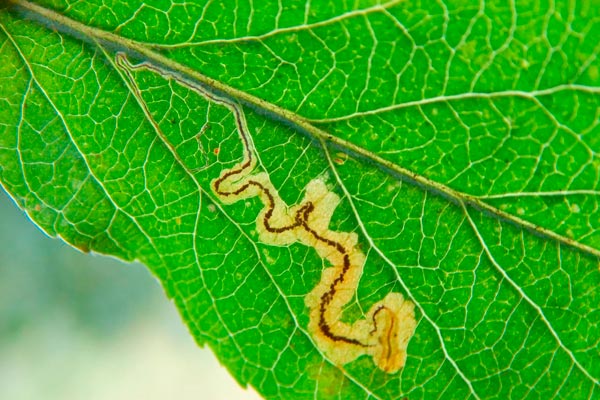
The serpentine leaf-mining moth (Stigmella malella Stt.) occurs in all fruit-growing regions of the country and sometimes reaches significant population density. It attacks only apple.
The serpentine leaf-mining moth develops three to four generations per year. It overwinters as a pupa in the soil.
Eggs are laid on the underside of leaves, near the veins. A female lays on average 50 eggs. Embryonic development lasts from 6 to 11–12 days. The hatched larvae pierce the chorion at the point of attachment to the substrate and enter the leaf without moving on the surface. The entrance hole is covered by the eggshell. The larvae mine the leaves, feeding just under the upper epidermis and forming serpentine, winding galleries that gradually widen. The length of the mines in which the larvae have completed their development is from 2.7 to 5 cm. Excrement is located in the middle of the mine, forming one broad or two longitudinal lines. Larval feeding lasts from 12 to 26 days. After completing its development, the larva gnaws a heart-shaped exit hole in the widened part of the mine, descends on a silk thread and pupates in the soil at a depth of 5 to 7 cm in a light brown cocoon. The pupal stage lasts from 6 to 13 days.
Due to the relatively large number of generations, the pest can multiply significantly. In the second half of the vegetation period, old and new mines from different generations accumulate on the leaves. Under heavy infestation, more than 20–30 mines can be observed on a single leaf. Leaves of heavily infested trees turn yellow and fall as early as August, and the fruits remain small and of poor quality. Trees lag in growth, become weakened and form fewer fruit buds.
Pear orchards heavily infested with pear psylla and pear lace bug are sprayed with a deltamethrin-based insecticide – Decis 100 EC (12.5 ml/da), Meteor (90 ml/da), Deka EC (50 ml/da). This treatment is also effective against the codling moth in pear.
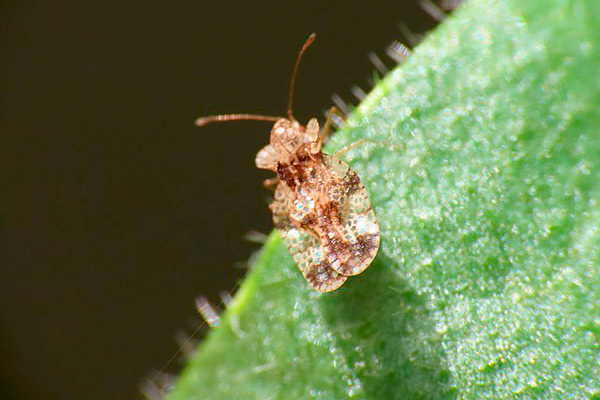
The pear lace bug (Stephanitis pyri) F. is a widely distributed pest throughout the country. It attacks pear, apple, cherry, sour cherry, plum, chokeberry, rose and other fruit as well as some ornamental tree and shrub species (cotoneaster, ligustrum, etc.). The pest develops two generations per year, and in a warm autumn a partial third. It overwinters as an adult insect under fallen leaves and in cracked bark.
At the beginning of August, adults of the second generation appear. When the maximum daily temperature rises above 20 0C they disperse over the leaves and begin to suck sap from the underside. During feeding, they gradually cover it with watery excretions that harden into brown drops. The upper side of the leaves acquires a mosaic (mottled) appearance due to the extraction of chlorophyll grains together with the cell sap. Initially, the spots are few, but gradually increase and, under heavy infestation, acquire a chlorotic appearance – they partially or completely turn yellow and may fall prematurely. If exposed to the sun, this process accelerates considerably and the damaged areas acquire a bronze tint. After copulation, females lay their eggs on the underside of leaves, inserting them obliquely into the parenchyma tissue and covering them with a sticky secretion that hardens in the air. Average fecundity is 170 eggs. The larvae hatch after 20–25 days and feed in the same way on the underside of leaves.
Under heavy infestation by this pest, leaves do not photosynthesise normally, turn completely yellow and fall prematurely, fruits remain small, and trees become exhausted and form fewer fruit buds for the following year. Young trees and seedlings in nurseries and newly established orchards are particularly sensitive, especially where regular plant protection is not carried out.
Chestnut trees are sprayed against the chestnut weevil with Coragen 20 SC (18–30 ml/da).
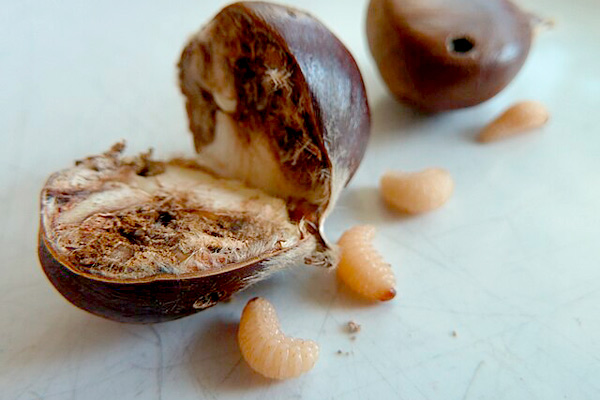
The chestnut weevil (Curculio (Balaninus) elephas Gyll.) is widespread. It damages sweet chestnut and oak. It is most common in regions with chestnut stands.
This weevil species develops one generation per year. It overwinters as a larva in the soil and pupates in June. Beetles emerge on the surface in July. They feed by puncturing the fruits, but this damage has no economic significance. Oviposition starts only in August–September. With the help of their long rostrum, females lay from 1 to 20 eggs in a single fruit. Embryonic development lasts 2–3 weeks. The larvae feed on the interior of the fruits, which become wormy and are filled with excrement, frass and shed larval skins.
After completing their development they gnaw a round hole, leave the fruit and go into the soil. There they prepare an earthen chamber at a depth of 7 to 40 cm, most often around 15–25 cm, and remain in it until June–July of the following year.
In strawberry plantations
Strawberry plantations infested with strawberry mite are treated with one of the following products – Voliam Targo 063 SC (80 ml/da), Laota, Bermektin, Valmec (15–100 ml/da), Sulphur WG (500–700 g/da), Heliosulfur C (150–750 ml/da).
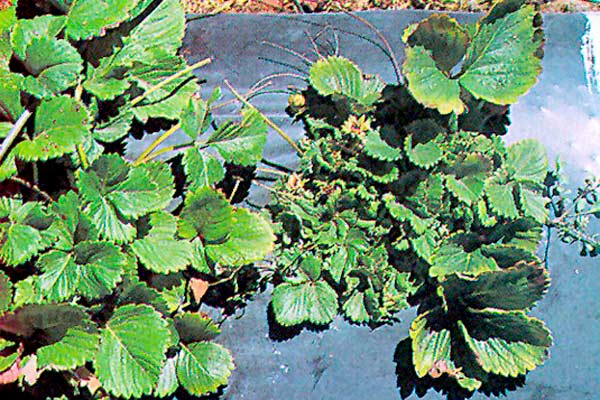
The strawberry mite (Tarsonemus pallidus Banks. (T. fragariae Zimmerman)) is widespread in many regions where strawberries are grown. Besides strawberry, it also damages many ornamental plants – cyclamen, chrysanthemum, begonia, petunia, gerbera, geranium, etc. It prefers more humid regions.
The pest overwinters as a fertilised female in the upper soil layer, under plant residues, in the leaf axils and buds of strawberry plants.
Depending on temperature conditions, one generation develops in 15 to 65 days. In one year the pest develops about seven overlapping generations and at harvest time, when maximum population density is reached, all stages – eggs, larvae and adults – can be observed on infested plants. The pest multiplies massively at relatively lower temperatures (16–22 oC) and high humidity (85–90%). The presence of young leaves with tender tissues is also of great importance. At higher temperatures and lower humidity it falls into depression.
Females settle on the underside of leaves, most often near the veins, where they suck sap and begin laying eggs. The minimum temperature for the onset of oviposition is 13°C, and the optimum is 16–18°C. Optimal humidity is above 80%, and at humidity below 50% mites die within 36 hours. Embryonic development lasts 10–15 days.
Newly hatched larvae also suck sap and at this stage are the most harmful. The damaged leaves remain small and deformed, turn yellow and dry out in dry weather or rot in humid conditions. The pest prefers young leaves with tender tissues. Sometimes it remains hidden in the plant rosette and feeds only there. The grown leaves are damaged, but no mites can be detected on them, which makes timely identification of the causal agent difficult. Symptoms resemble damage caused by stem nematodes and some viral diseases. Depending on the degree of infestation, yields can be reduced by 20 to 70–80%. The harvested fruits are of reduced quality – small and with low sugar content, and under very heavy infestation they may shrivel. Leaf dwarfing leads to a reduction in the nutrients in the rhizome and to poor bud formation for the following year.
Strawberry planting material intended for planting in August is inspected. If strawberry mite and other pests are detected, it is disinfected.
In blackcurrant plantations
Plantations infested with the magpie moth are sprayed with contact insecticides from all groups. You can use one of the following products – Decis 100 EC (12.25 ml/da), Coragen 20 SC (30 ml/da), Sumi Alpha 5 EC (0.03%), Karate Zeon 5 SC (15 ml/da).
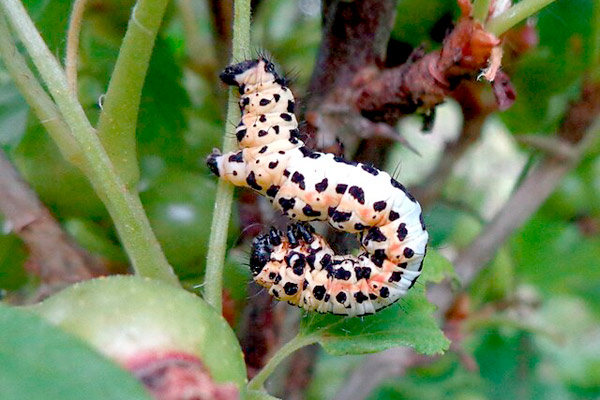
The magpie moth (Abraxas grossulariata L.) is widespread throughout the country. It attacks mainly plants of the genus Ribes. The larva has also been found on stone fruit crops, mahaleb cherry and dwarf almond. The pest develops one generation per year. It overwinters as an underdeveloped fifth (last) instar larva under plant residues, soil clods, stones, etc.
Moths appear in mid-May and fly until July, but in some higher mountainous regions the flight may start in June and continue until August. The flight coincides with fruit formation and ripening. Moths are active at night and at sunrise. Females lay their eggs in small groups (10–15) on the underside of leaves. Average fecundity is 200–300 eggs. Embryonic development lasts from 12 to 20 days.
Young larvae feed on leaves, making barely visible holes. When shaken, they descend on a silk thread and hide under plant residues. Before leaf fall, the larvae wrap themselves with silk threads and fall to the ground together with the falling leaves, where they overwinter.