Biological Asparagus – Specifics of Seedling Production and Cultivation Technology
Author(s): доц. д-р Цветанка Динчева, ИЗК "Марица" в Пловдив; доц. д-р Емил Димитров, ИПАЗР "Никола Пушкаров", София
Date: 05.11.2025
4196
![MultipartFile resource [file_data]](/assets/img/articles/аспержи-заглавна.jpg)
Summary
In recent years, interest in asparagus from farmers and consumers has been increasing. Its cultivation under organic field conditions and the obtaining of healthy and high-quality produce early in spring enhances its value as an important crop on the market, while also contributing to an increase in vegetable diversity. The crop is perennial, resistant to prolonged low temperatures in winter and extended droughts in summer. Unlike the traditionally grown vegetable crops in the country, asparagus is characterised by a specific cultivation technology. In spring, from the beginning of April to the end of May, at the start of vegetation, the marketable part – the young spears – is harvested at a height of about 20–22 cm, and from the beginning of June the plants are left to grow freely. Vegetation ends with the first autumn frosts at the end of October–beginning of November.
Asparagus stands are established by means of seedlings or by crowns. When they are grown using crowns as planting material, the harvesting period of the plantation is delayed by one year and the first yields are recorded in the second year after planting.
Cultivation of asparagus for crowns
Asparagus can be grown through the production of nursery plants, with a nursery period of about 3 months, thereby accelerating the entry of the plantation into harvesting by one year. This method of crop cultivation provides an advantage in the earlier supply of produce to the market, as a small yield is realised in the first year after planting. However, nursery plants are characterised by a weak habitus and poorly developed root system, as a result of which in the following year they form more fragile and weaker spears that do not meet market requirements. This can be partially compensated by suitable organic fertilisers.
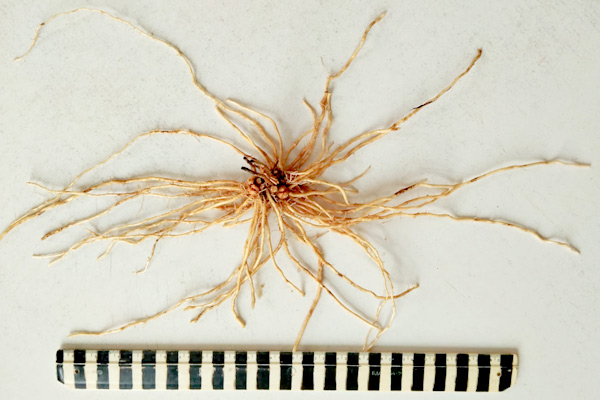
Asparagus crown
According to an established traditional technology, asparagus has been grown from crowns. The crowns are obtained from plants grown as nursery plants for one year. The long vegetation period allows the formation of well-developed plants with strong crowns, which in the following year produce spears that meet market requirements. The use of suitable organic fertilisers and fertilisation schemes contributes to the cultivation of more vigorous plants. This technology, with a duration of 7–8 months, increases the cost of the planting material but guarantees higher-quality produce and a stable yield from the plantation.
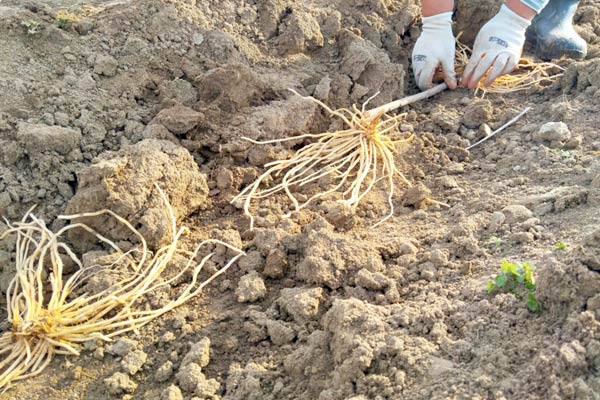
Planting of crowns
The cultivation of plants for crowns, as planting material for establishing a plantation in an organic manner, must be carried out on a certified organic field. When selecting the site, attention must be paid to the soil profile and the soil’s supply of the main nutrients. Asparagus prefers alluvial-meadow soils that are slightly sandy-loamy in the upper 0–30 cm and rich in nutrients. The areas must be free of weeds, therefore the type of preceding crop is of decisive importance. This must be observed absolutely strictly, given the ban on the use of herbicides in organic production and the risk of failure in asparagus cultivation.
It is preferable to use fields after cereal crops or vegetables that complete their vegetation by the end of October and allow for soil preparation. Before sowing, the soil must be in good tilth, with a friable structure. Sowing of the seeds is carried out at the end of April. It is preferable to shape the soil surface into a raised bed with 3 rows and to provide irrigation by means of a drip system. Good results are obtained by using drip lines with a spacing between emitters of 10 cm. The seeds are sown at a distance of 8–10 cm to provide sufficient space for the formation of well-developed crowns. Thinning of the plants is recommended in case of higher plant density. After emergence of the asparagus plants and the appearance of the first weeds, hand weeding must be carried out, followed later by soil loosening and hoeing of the plants. It has been established that fertilisation of the plants during nursery production with Lumbrical at a rate of 1 L/1.6 m2, applied once in the period June–July, has a good effect, when hoeing of the plants is still possible, they are not too large and are in the 3rd–4th branching growth stage.
For optimal plant development, soil moisture should be maintained at about 70–80% of field capacity. Irrigation two or three times per week is required, depending on climatic conditions and the extreme increase in air temperatures during July and August, when irrigation may need to be carried out more frequently, because the plants have a shallow root system and may die from lack of moisture.
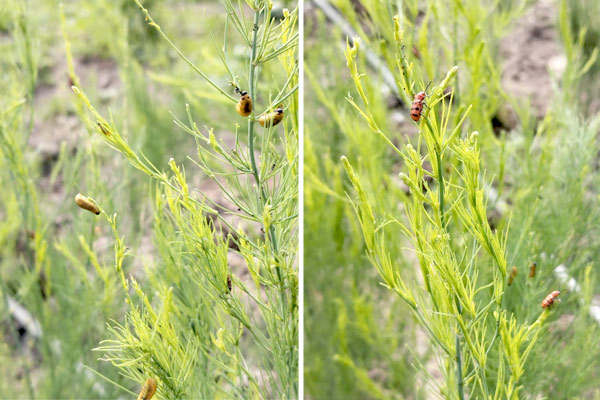
Larvae and adult of the twelve-spotted asparagus beetle (Crioceris duodecimpunctata)
The main problem in organic cultivation of asparagus for crowns is pest control. This crop is attacked by the twelve-spotted asparagus beetle (Crioceris duodecimpunctata), with damage caused by both adults and larvae. The larvae are particularly dangerous, as they very quickly consume the cladodes and the plants die if treatment with plant protection products is not carried out promptly.
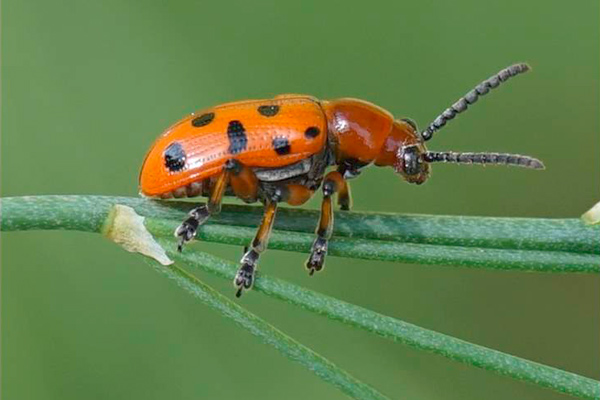
Adult individual of the twelve-spotted asparagus beetle (Crioceris duodecimpunctata)
The choice of organic plant protection products is limited, and broad-spectrum insecticides authorised for use in organic production are applied. The plants must be inspected for larvae, which are very small, and treatment must be carried out at the first appearance. With regard to diseases, young plants are very rarely attacked by the causal agent of rust.
With the first autumn frosts, the plants turn golden-yellow, which indicates the end of vegetation. The above-ground biomass is cut and removed from the field, and the plants are hoed and earthed up. In the following year, under suitable conditions in the period February–March, the crowns are lifted from the soil, sorted and the well-developed and healthy ones are selected, after which they are planted in a permanent location. Lifting of the crowns must not be delayed, because at the end of March–beginning of April the weather warms up and spear growth is induced. Lifting of the crowns is carried out with a knife-hoe at a soil depth of about 12–15 cm so as not to injure the crowns, and the soil is removed from them with the help of a fork. The soil must not be waterlogged or too dry, in order to avoid breaking the crowns during lifting. High-quality asparagus planting material has an average diameter of about 40 mm and a fresh mass of 60–65 g. The crowns can be stored for about 2–3 weeks before planting.
Establishment of an asparagus plantation
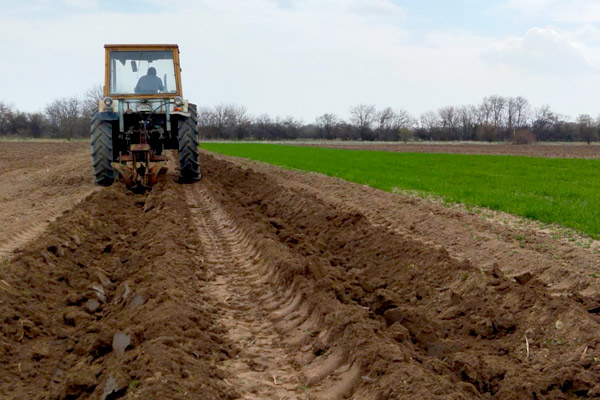
Furrowing of the field immediately before planting
The lifted crowns are planted on fields after deep ploughing, several diskings and furrow shaping. The distance between the furrows is 80 cm, but in the presence of small-scale machinery it is advisable for this distance to be consistent with the working width of the machine. The distance between plants in the row is 45–50 cm. The crowns are placed at the bottom of the furrow with the growing points upwards and are covered with soil. When the crop is grown according to the technology for green asparagus, the depth of the furrows is about 20 cm, but for white (etiolated) spears it is 30 cm.
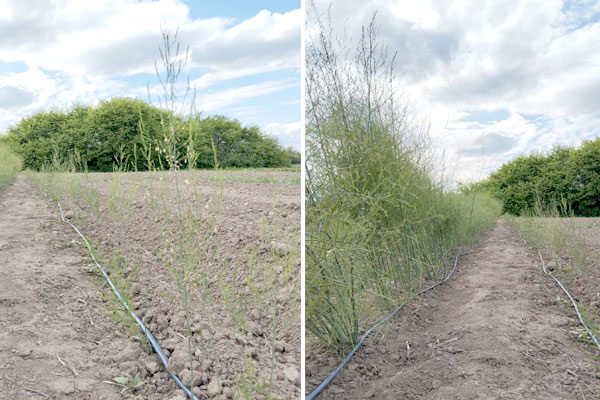
Asparagus in the first and second year after planting, respectively
In the first year after planting, the plants are left to grow without harvesting. Harvesting of the produce begins in the second year after planting, when the young spears are harvested for about 2–3 weeks, but not longer, so as not to deplete the plants. In the third year, the harvest period is extended and lasts about 4–5 weeks. Asparagus plantations are normally harvested for about 2 months, from the beginning of April to the end of May.
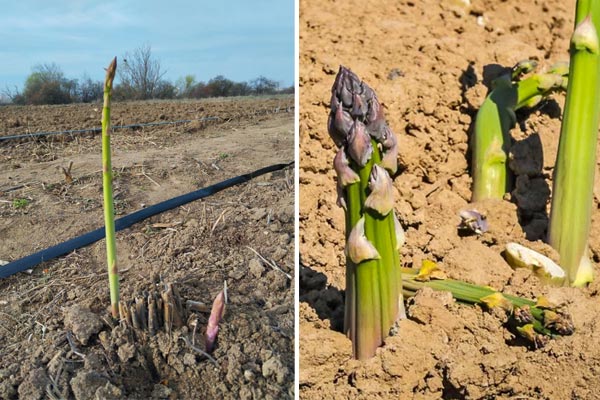
First spears
Over the last 2–3 years, due to climate change, spear growth has been induced by warmer weather, vegetation begins at the end of March, but in the first ten days of April the weather changes abruptly, conditions for frosts are created, and the young spears are sensitive to freezing and the crop is compromised. Revenues from early produce decrease drastically, which has a negative effect on production. With the subsequent warming of the weather, the plants form new spears, but the adaptation period shortens the harvesting period, which is a serious problem for producers.
Asparagus is a drought-tolerant crop, but to ensure high and stable yields it must be grown under irrigated conditions, maintaining optimal soil moisture at 70–80% of field capacity. Drip irrigation with a spacing between emitters of 10 cm is suitable. The frequency of irrigation is determined by climatic conditions.
Weed control, especially of rhizomatous species under organic cultivation of the crop, is difficult and as many hand hoeings and mechanical operations as possible must be carried out during vegetation.
As with the organic cultivation of crowns for planting material, disease and pest control is difficult. It is advisable to grow several asparagus cultivars in one plantation, where pests select the more susceptible ones.
At the end of October–beginning of November, when conditions for frosts are created and temperatures decrease, the plants change colour from green to golden-yellow. The above-ground part is cut at a height of about 1 cm above the soil surface and removed from the plantation. The soil around the plants is hoed and organic fertilisers are applied. Lumbrical, applied pre-winter or in early spring, has a good effect. The fertiliser rate of organic fertilisers increases with the ageing of the plantation in order to maintain a stable and high yield. An asparagus plantation reaches its maximum productivity in the 10th–11th year, and cultivation of the crop is economically viable for up to 15 years.
References
- Lorlowhakarn1, S. Piyatiratitivorakul and W. Cherdshewasart1, 2008, Organic Asparagus Production as a Case Study for Implementation of the National Strategies for Organic Agriculture in Thailand, Thai Journal of Agricultural Science, 41(1-2): 63-74).
- Bulluck III, L.R., Brosius, M., Evanylo, G.K., Ristaino, J.B. 2002. Orgainc and synthetic fertility amendments influence soil microbial, physical and chemical properties on organic and conventional farms. Appl. Soil Ecol. 19:147-160.
- Drost DT (1999) Soil water deficits reduce growth and yield of asparagus. Acta Hort 479: 390-393.
- Omran AS (1998) Effect of some fertilizer treatments on growth, yield and quality of asparagus (Asparagus officinalis L.). Ph.D. Thesis Ain Shams Uni, Egypt 99 pp.
- Gonzalez, M. I.; Pozo, A. del, 2002, Influence of planting depth and plant population on yield and quality of green asparagus, Acta Horticulturae(589), 123-127