Significance of Aegilops cylindrica Host. - Jointed Goatgrass in Breeding Programmes
Author(s): гл. ас. д-р Божидар Кьосев, Институт по растителни генетчини ресурси "Константин Малков" – Садово; доц. д-р Гергана Дешева, ИРГР – Садово; гл. ас. д-р Евгения Вълчинова, ИРГР – Садово; гл. ас. д-р Албена Пенчева, ИРГР – Садово; доц. д-р Манол Дешев, ИРГР – Садово
Date: 17.03.2025
3285
![MultipartFile resource [file_data]](/assets/img/articles/заглавна-цилиндрично-жито.jpg)
Abstract
Bulgaria is one of the countries on the Balkan Peninsula with a diversity of Aegilops species. They are a source of genes for resistance to biotic and abiotic environmental stress factors which, when introduced into the genome of durum and common wheat, can improve their resistance. The interest in these species is also justified by the possibility of using them in breeding to broaden the genetic base of durum and common wheat, and even of barley. The wild relative of wheats, Aegilops cylindrica Host., is an annual herbaceous plant known as jointed goatgrass. It is a tetraploid species (2n = 4x = 28; CCDD), originating from its ancestors Aegilops markgrafii (Greuter) Hammer (2n = 2x = 14; CC) and Aegilops tauschii Coss (2n = 2x = 14; DD). This species is widespread in Bulgaria, which provides grounds for a broader study of the genetic potential of the Aegilops cylindrica Host. genotypes distributed in the country and of their traits, for the purposes of wheat and barley breeding.
Distribution countries: Afghanistan, Bulgaria, Czech Republic, Slovakia, Greece, Hungary, Iran, Iraq, Japan, Kazakhstan, Kyrgyzstan, Crimea, Lebanon-Syria, Northern Caucasus, North-western and Southern European Russia, Pakistan, Palestine, Romania, Tajikistan, Turkey, Turkmenistan, Ukraine, Uzbekistan, and the countries of the former Yugoslavia (Slovenia, North Macedonia, Croatia, Serbia, Montenegro, Kosovo and Bosnia).
The species has been introduced into: USA (states – Alabama, Arizona, Arkansas, California, Colorado, Idaho, Illinois, Indiana, Iowa, Kansas, Kentucky, Louisiana, Michigan, Missouri, Montana, Nebraska, Nevada, New Mexico, New York, North Dakota, Ohio, Oklahoma, Oregon, South Dakota, Tennessee, Texas, Utah, Virginia, Washington), Central European Russia, Cyprus, France, Austria, Germany, Great Britain, Italy, Korea, Mexico, Pennsylvania, Poland, and Tunisia, where it is considered an invasive weed. (https://www.cabidigitallibrary.org/doi/10.1079/cabicompendium.108330), (van Slageren, 1994; Danin and Scholz, 1994).
Botanical description and morphology
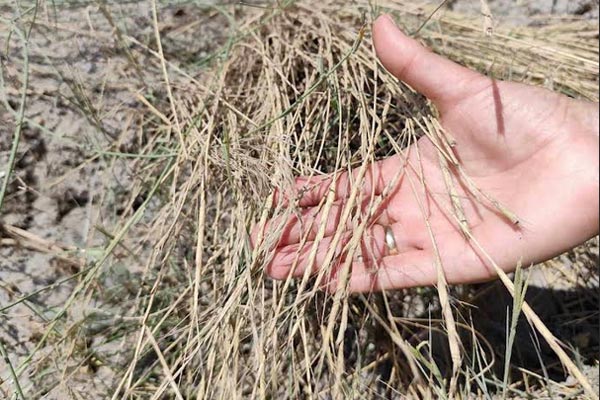
Winter annual tufted herbaceous plant, forming from several to many productive tillers. Isolated plants can form more than 100 tillers. At the base, the culms are semi-prostrate, and later become ascending to erect.
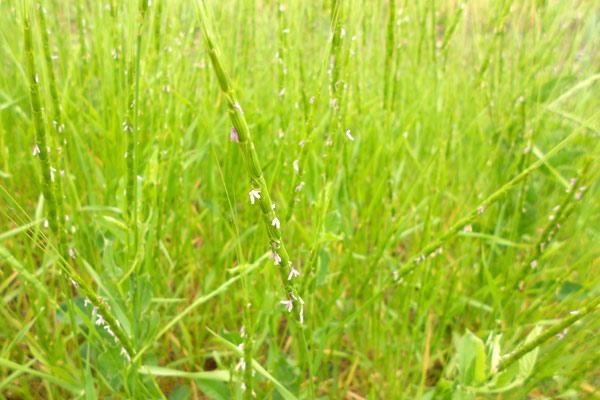
Culm length is usually 20–40 cm, but can reach up to 80 cm in height (excluding the awns). The leaves are linear-lanceolate, glabrous or pubescent, 2–5 mm wide and 3–15 cm long. The lowest and the uppermost leaves are shorter than the rest on the culm. Between the leaf sheath and the blade there is a short membranous ligule and pubescent auricles. The inflorescence is a narrow cylindrical spike, slightly tapering towards the tip, 6–12 cm long (excluding the awns) and 3–5 mm thick, consisting of 4–12 (usually 6–8) fertile spikelets arranged compactly and alternately along the main axis of the spike. The spikelets are sessile, 9–10 mm long and about 3 mm wide. The terminal spikelet is conical, shorter and thinner, about 7 mm long and about 2 mm wide. In one spikelet there are 3–5 florets, of which the lower 1–2 are usually fertile, but there may be up to five fertile florets, giving 5 grains per spikelet. The glumes of the lateral spikelets are ovate-elongated, 7–10 mm long, green to purple-green at heading and flowering, with a striated surface and unevenly wide veins (9–13), sunken into the surface, more or less parallel, two-toothed, one of the teeth being short and blunt, and the other forming an awn up to 18 mm long. The lemmas of the fertile florets are 9–10 mm long, narrowly elliptic, boat-shaped and folded lengthwise in the upper part. The lemmas of the terminal (apical) spikelets have a prominent central awn 4–8 cm long, with 2 sharp teeth at the base, and when mature are less branched than the awns of the glumes. The awns of the lemmas of the sterile terminal florets are strongly reduced. The palea is narrowly ovate-elliptic, with 2 sharp, striated keels ending in a sharp tip. The caryopsis is 6–7 mm long, between closely appressed lemmas and paleas. Usually the uppermost spikelet of the spike has 3–4 awns, shorter than the spike. At fruiting, the spike disarticulates into its constituent spikelets, with the exception of 1–2 tough spikelets at the base.
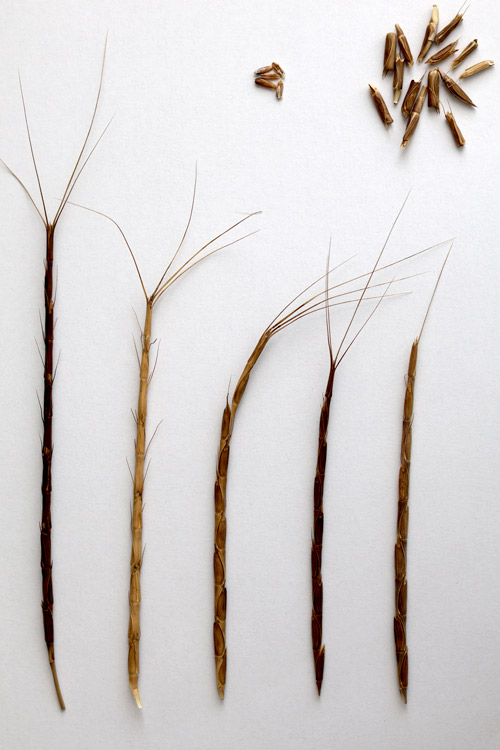
The fruit is a dorsiventrally flattened grain with a groove along the entire ventral length. The grain colour is red. It reproduces by seed.
Phenology: Flowering (April–August), fruiting (May–August)
Habitats: Uncultivated and heavily disturbed sites, e.g. fallow lands, roadsides, dry, sandy, grassy slopes, pastures. Distributed throughout Bulgaria at altitudes: 0–1750 m.
Ecology: Least affected or threatened species.
Taxonomy of the species:
Royal Botanic Gardens (https://powo.science.kew.org/taxon/urn:lsid:ipni.org:names:384583-1)
The species Aegilops cylindrica Host. belongs to division Magnoliophyta Cronquist, Takht. & W. Zimm. ex Reveal (Angiosperms), class Liliopsida Batsch (Monocotyledons), order Poales Small, family Poaceae Barnhart (Grasses), genus Aegilops L. (Wild wheat).
Synonyms: Aegilops caudata subsp. cylindrica (Host) Hegi; Aegilops caudata var. cylindrica Fiori; Aegilops caudata var. hirsuta Hegi; Aegilops cylindrica f. brunnea (Popova) K. Hammer; Aegilops cylindrica f. brunusica van Slageren & Eldarov; Aegilops cylindrica f. ferruginea (Popova) K. Hammer; Aegilops cylindrica f. fuliginosa (Popova) K. Hammer; Aegilops cylindrica f. gahvayii Aminov & Eldarov; Aegilops cylindrica f. garamtil Aminov & Eldarov; Aegilops cylindrica f. prokhanovii (Tzvelev) K. Hammer; Aegilops cylindrica f. pullusica van Slageren & Eldarov; Aegilops cylindrica f. rubiginosa (Popova) K. Hammer; Aegilops cylindrica subsp. aristulata Zhuk.; Aegilops cylindrica subsp. pauciaristata (Eig) Chennav.; Aegilops cylindrica unr. pubescens Kloos; Aegilops cylindrica var. albescens Popova; Aegilops cylindrica var. aristulata (Zhuk.) Tzvelev; Aegilops cylindrica var. brunnea Popova; Aegilops cylindrica var. ferruginea Popova; Aegilops cylindrica var. flavescens Popova; Aegilops cylindrica var. fuliginosa Popova; Aegilops cylindrica var. gobustanica van Slageren & Eldarov; Aegilops cylindrica var. hirsuta (Hegi) Hegi; Aegilops cylindrica var. kastorianum Karat.; Aegilops cylindrica var. khizii Aminov & Eldarov; Aegilops nova Winterl ex Borbás; Aegilops cylindrica var. longiaristata Lange; Aegilops cylindrica var. multiaristata Jansen & Wacht.; Aegilops cylindrica var. pauciaristata Eig; Aegilops cylindrica var. prokhanovii Tzvelev; Aegilops cylindrica var. pubescens Jansen; Aegilops cylindrica var. rubiginosa Popova; Aegilops cylindrica var. rumelica Velen.; Aegilops cylindrica var. typica Eig.; Aegilops squarrosa var. cylindrica (Host) Mutel; Cylindropyrum cylindricum (Host) Á.Löve; Cylindropyrum cylindricum subsp. pauciaristatum (Eig) Á.Löve; Triticum caudatum subsp. cylindricum (Host) Asch. & Graebn.; Triticum cylindricum (Host) Ces., Pass. & Gibelli; Triticum cylindricum var. rumelicum (Velen.) Stoj. & Stef.; Cylindropyrum cylindricum subsp. cylindricum; Triticum cylindricum Cesati, Pass. & Gib.
Significance of the species Aegilops cylindrica Host.
Aegilops cylindrica Host. is a valuable source of genes associated with salt tolerance. It has been established that the D genome in Ae. cylindrica Host. possesses genes such as AecHKT1;5, AecSOS1, AecNHX1 and AecVP1, responsible for preventing the transport of Na ions into the tissues of the roots and coleoptiles of the plant (Kiani et al., 2015). Two genotypes have been identified – USL26, which is tolerant to salinity, and genotype K44, which is sensitive (Arabbeigi et al., 2014). This species is the subject of various studies by scientists and breeders, and although it is not the most sought after in breeding materials involving interspecific wheat hybridizations, breeding programmes are looking for new sources for improving not only resistance. Studies show that the species has the ability to absorb from the soil essential minerals such as Mn, Fe, Ca, Mg, K, Na, Cr, Ni, Co, and to store them in the grain (Mohammad et al., 2015). Prins et al. (2016), in a study of the diversity of enzymes in the Calvin cycle among genera and species of the tribe Triticeae, indicate Aegilops cylindrica Host. as an enzyme system with higher assimilation parameters, which makes it a potential donor of genes related to the improvement of photosynthesis. Genes associated with the presence of subunits of high molecular weight storage proteins have also been isolated in Ae. cylindrica, which could replace the well-characterized similar genes from bread wheat, leading to the use of a wider range of high molecular weight subunits exhibiting greater diversity (Wan et al., 2002; Kan et al., 2006; Sun et al., 2006; Farkhari et al., 2007; Zhang et al. 2008).
In other studies on proteins and the respective responsible genes, new genetic resources for gluten have been identified. Different types of low molecular weight subunits have been found in examined accessions of Ae. cylindrica in the glutenins, which represent 60% of the storage proteins in the endosperm of wheats and play an important role in dough quality (Wan et al., 2002; Liu et al., 2003; Khabiri et al., 2012; Xin et al., 2015).
In a study of variation in susceptibility to wheat dwarf virus in wild and cultivated wheats (Triticum sp. and Aegilops sp.) it was found that plants of Ae. cylindrica Host. inoculated with wheat dwarf virus are initially severely affected, but subsequently show increased tillering and leafiness, and therefore could be useful genetic resources for improving resistance to wheat dwarf virus (Nygren et al., 2015).
Breeding lines between wheat and Ae. cylindrica Host. are of interest to breeders worldwide, also in relation to reducing plant height as well as earliness (Yuhai et al., 2017). One of these donors is line TA001, which is the result of a hybridization between the common bread wheat cultivar “Yannong 15” and the amphiploid SDAU18, which in turn is the result of a cross between the species Aegilops ventricosa × Aegilops cylindrica. In the study of this line, at least 30 genes responsible for plant dwarfing were identified, including the genes Rht1, Rht3, Rht1s, RhtKrasnodari1, RhtT.aeth, RhtHighburg, Rht2, Rht10, RhtAibian1, Rht4, Rht5, Rht6, Rht7, Rht8, Rht9, Rht11, Rht12, Rht13, Rht14, Rht15, Rht16, Rht17, Rht18, Rht19, Rht20, Rht21, Rht22, Rht_R107, Rht-dp, Rht23, and Rht-NM9. Only a few genes, such as Rht1, Rht2, Rht8, and Rht9 have been used more widely in breeding for wheat dwarfing.
Aegilops cylindrica Host. also participates in breeding not only in wheat, but also in barley. One such example is barley breeding lines based on a 7H deletion, which have originated with the involvement of chromosome 2C of Aegilops cylindrica Host. (Shi et al., 2000; Nasuda et al. 2005; Molnár et al., 2016). It has been established that the same chromosome 2C from Ae. cylindrica Host., also has the ability to induce chromosome breakage in common wheat (Triticum aestivum L.). This trait is used by breeders in the development of hybridization lines in breeding for resistance to Fusarium head blight. An example of this is line T3AS-Lr7S, created through chromosome translocation and complex involvement of other species (McCain et al., 1990; Farr and Rossman, 2015). Natural interspecific hybridizations and backcrosses between Aegilops cylindrica Host. and Triticum aestivum L. can lead to gene introgression (Kozub et al., 2004). It has been established that such hybrids may possess herbicide resistance (Hegde and Waines 2004), as well as resistance to fungal diseases and increased tolerance to insect pests (Schoenenberger et al., 2006).
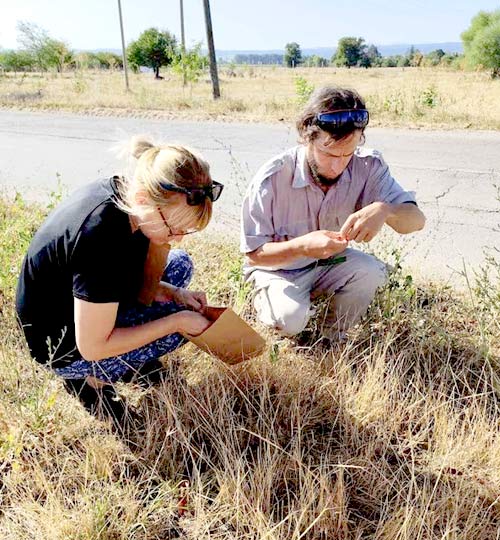
Assoc. Prof. Gergana Desheva, PhD and Chief Assistant Prof. Bozhidar Kyosev, PhD during an expedition for collecting Aegilops accessions in 2024 in Bulgaria.
The increased interest in the species Aegilops cylindrica Host. as a potential donor of genes for improving wheat and barley is a prerequisite for many gene banks to set as a main priority in their activities the “in situ” and “ex situ” conservation of crop wild relatives, including the above-mentioned species. In Bulgaria, a collection of Aegilops species is maintained under long-term “ex situ” storage conditions in the National Gene Bank at the Institute of Plant Genetic Resources in Sadovo. The diversity in the Aegilops collection is represented by 14 plant species. The total number of Aegilops accessions amounts to 438, originating from 19 countries, of which 365 accessions are of Bulgarian origin. The species Aegilops cylindrica Host. includes 63 accessions, 59 of which represent populations collected from different regions of our country.
In 2023, project BG-175467353-2023-13-0018, KP-06 H76/3 “Study of the genetic diversity of Aegilops species in the flora of Bulgaria” was approved for funding by the Bulgarian National Science Fund, one of the specific objectives of which is the collection and conservation (ex situ) of Aegilops species from the flora of Bulgaria. Enrichment with new genetic plasma of Aegilops species, and their in-depth study and provision of free access to them through their inclusion in the exchange collection, will lead to a higher scientific and societal impact, in line with the function of the gene bank to serve a large number of users at regional, national and international level – scientists, breeders, NGOs, environmental organizations, students and pupils in the field of agricultural and biological sciences.
Acknowledgements:
The study is financially supported by the Bulgarian National Science Fund, Ministry of Education and Science, under project KP-06-H76/3 “Study of the genetic diversity of Aegilops species in the flora of Bulgaria”.
Photos © Institute of Plant Genetic Resources “K. Malkov” – Sadovo
References
1. Arabbeigi M, Arzani A, Majidi MM, Kiani R, Sayed Tabatabaei BE, Habibi F (2014) Salinity tolerance of Aegilops cylindrica genotypes collected from hyper-saline shores of Uremia Salt Lake using physiological traits and SSR markers. Acta Physiol Plant 36:2243–2251.
2. Danin A, Scholz H, 1994. Note: Bromus commutatus Schrader, Aegilops cylindrica host, and Vulpia persica (Boiss. et Buhse) V. Krecz. et Bobrov, new grasses in Israel. Israel Journal of Botany, 42:257-259.
3. Farkhari, M., Naghavi, M.R., Pyghambari, S.A., 2007. Genetic variation of jointed goatgrass (Aegilops cylindrical Host.) from Iran using RAPD-PCR and SDS-PAGE of seed proteins. Pak. J. Biol. Sci. 10, 2868–2873.
4. Farr DF, Rossman AY, 2015. Fungal Databases, Systematic Mycology and Microbiology Laboratory. ARS, USDA,. http://nt.ars-grin.- gov/fungaldatabases/ (accessed 25.01.16).
5. Hegde SG, Waines JG (2004) Hybridization and introgression between bread wheat and wild weedy relatives in North America. Crop Sci. 44: 1145 – 1155.
6. Kan, Y., Wan, Y., Beaudoin, F., Leader, D., Edwards, K., Poole, R., Wang, D., Mitchell, R.A.C., Shewry, P.R., 2006. Transcriptome analysis reveals differentially expressed storage protein transcripts in seeds of Aegilops and wheat. J. Cereal Sci. 44, 75–84.
7. Khabiri Toraj, Rasool Asghari Zakaria, Nasser Zare, Omid Sofalian. 2012. Analysis of genetic diversity based on HMW and LMW glutenin subunits in Aegilops cylindrica from Northwest of Iran. International Journal of Agriculture and Crop Sciences, Vol., 4 (9), 529-533, 2012.
8. Kiani A, Arzani A, Habibi F (2015) Physiology of salinity tolerance in Aegilops cylindrica. Acta Physiol Plant 37:135. https://doi.org/10.1007/s11738-015-1881-0.
9. Kozub, N.A., Sozinov, I.A., Sozinov, A.A., 2004. Effect of an introgression from Aegilops cylindrica host on manifestation of productivity traits in winter common wheat F2 plants. Russ. J. Genet. 40, 12–15.
10. Liu, Z., Yan, Z., Wan, Y. et al. Analysis of HMW glutenin subunits and their coding sequences in two diploid Aegilops species. Theor Appl Genet 106, 1368–1378 (2003). https://doi.org/10.1007/s00122-002-1175-y.
11. McCain JW, Hennen JF, Ono Y, 1990. New host species and state distribution records for North American rust fungi (Uredinales). Mycotaxon 39: 281e300.
12. Mohammad Ali Rajabzadeh, Ehsan Ghasemkhani, Ahmadreza Khosravi. 2015. Biogeochemical study of chromite bearing zones in Forumad area, Sabzevar ophiolite, Northeastern Iran. Journal of Geochemical Exploration, Volume 151, Pages 41-49, https://doi.org/10.1016/j.gexplo.2015.01.002.
13. Molnár I, Vrána J, Burešová V, Cápal P, Farkas A, Darkó É, Cseh A, Kubaláková M, Molnár-Láng M, Doležel J. 2016. Dissecting the U, M, S and C genomes of wild relatives of bread wheat (Aegilops spp.) into chromosomes and exploring their synteny with wheat. Plant J. 2016 Nov;88(3):452-467. doi: 10.1111/tpj.13266.
14. Nasuda S., Y. Kikkawa, T. Ashida, A.K.M.R. Islam, K. Sato, T.R. Endo, 2005. Chromosomal assignment and deletion mapping of barley EST markers, Genes Genet. Syst. 80 (2005) 357–366.
15. Nygren, J., Nadeem Shad, A. K., & Westerbergh, A. (2015). Variation in susceptibility to wheat dwarf virus among wild and domesticated wheat. PLoS One, 10(4). Available from https://doi.org/10.1371/journal.pone.0121580, e0121580_e0121580.
16. Porceddu E. and Damania A.B. 1994. Sampling strategies for conserving variability of genetic resources in seed crops. Technical Manual No. 17. ICARDA, Aleppo, Syria–University of Tuscia, Viterbo, Italy.
17. Prins А., D.J. Orr, P.J. Andralojc, M.P. Reynolds, E. Carmo-Silva, M.A.J. Parry, (2016) Rubisco catalytic properties of wild and domesticated relatives provide scope for improving wheat photosynthesis, J. Exp. Bot. 67 (6) (2016) 1827–1838.
18. Schoenenberger N, Guadagnuolo R, Savova-Bianchi D, Küpfer P, Felber F. Molecular analysis, cytogenetics and fertility of introgression lines from transgenic wheat to Aegilops cylindrica host. Genetics. 2006 Dec;174(4):2061-70. doi: 10.1534/genetics.106.058529.
19. Shi F., T.R. Endo, (2000) Genetic induction of chromosomal rearrangements in barley chromosome 7H added to common wheat, Chromosoma 109 (2000) 358–363.
20. Slageren M. van, 1993. Taxonomy and distribution of Aegilops. In: Biodiversity and wheat improvement [ed. by Damania, A. B.]. Chichester, UK: John Wiley & Sons, 67-79.
21. Sun, X., Hu, S., Liu, X., Quian, W., Hao, S., Zhang, A., Wang, D., 2006. Characterization of the HMW glutenin subunits from Aegilops searsii and identification of a novel variant HMW glutenin subunit. Theor. Appl. Genet. 113, 631–641.
22. Wan, Y., Wang, D., Shewry, P.R., Halford, N.G., 2002. Isolation and characterization of five novel high molecular weight subunit of glutenin genes from Triticum timopheevi and Aegilops cylindrica. Theor. Appl. Genet. 104, 828–839.
23. Xin Li, Dong-cheng Liu, Jia-zhu Sun, Wen-long Yang, Xiao-li Guo, Dao-wen Wang, Ai-min Zhang. 2015. Characterization of novel high-molecular-weight glutenin subunits and their coding sequences in Aegilops markgrafii, Journal of Cereal Science,Volume 65, Pages 9-18, https://doi.org/10.1016/j.jcs.2015.05.014.
24. Yuhai Wang, Qingdian Han, Fang He, Yinguang Bao, Dongfeng Ming, Honggang Wang. 2017. Characterization of a Triticum aestivum-Aegilops germplasm line presenting reduced plant height and early maturation. The Crop Journal, Volume 5, Issue 3, 185-194, https://doi.org/10.1016/j.cj.2016.10.004.
25. Zhang, Y., Li, X., Wang, A., An, X., Zhang, Q., Pei, Y., Gao, L., Ma, W., Appels, R., Yan, Y., 2008. Novel x-type high-molecular-weight glutenin genes from Aegilops tauschii and their implications on the wheat origin and evolution mechanism of Glu-D1-1 proteins. Genetics 178, 23–33.