White rot on pepper in unheated cultivation facilities
Author(s): ас. Наталия Караджова, ИЗК "Марица", Пловдив; доц. д-р Олга Георгиева, ИЗК "Марица", Пловдив; проф. д-р Петър Чавдаров, Институт по растителни генетични ресурси „К. Малков” – Садово
Date: 08.06.2024
4595
![MultipartFile resource [file_data]](/assets/img/articles/заглавна-бяло-гниене-1.jpg)
Summary
White dry stem rot of pepper is caused by the fungus Sclerotinia sclerotiorum (Lib.) de Bary and is a relatively new disease for this crop. The trend of growing peppers in unheated facilities creates favorable conditions for the development of the pathogen Sclerotinia sclerotiorum, placing white mold disease on the list of economically important diseases for this crop. Controlling the infection is difficult because the fungus renews itself from sclerotia stored on plant residues and in the soil for a long time. For this reason, effective control over white mold disease requires an integrated approach. Along with the development of chemical and agrotechnical control measures, understanding the biology and life cycle of the phytopathogen, its relationship with the host plant, and the search for reliable protection methods using antagonists or hyperparasites are of great importance.
Pepper is one of the most popular vegetable crops produced in Bulgaria. The energy crisis of the 1990s led to a complete change in pepper production in greenhouses. Year-round production of peppers in glass greenhouses was replaced by early production in unheated polyethylene greenhouses. Key requirements for pepper production in unheated cultivation facilities are achieving early and high yields, quality produce, and a long vegetation period for the crop.
Growing peppers in polyethylene greenhouses has its specifics. In addition to regular watering, fertilizing, and weeding, preventive and curative treatments are carried out against pests and diseases that multiply in unheated greenhouses. In the conditions of Southern Bulgaria, transplanting plants into greenhouses occurs at the end of March, and cultivation continues until early November. During April and May, daytime and nighttime temperatures and humidity in the greenhouses are below optimal values for pepper cultivation, making the plants susceptible to attack by soil pathogens causing yield loss: Verticillium (Verticillium dahlia) and Fusarium (Fusarium solani) wilting, root rot (Phytophthora capsici, Pythium spp., Rhizoctonia solani Kuchn), gray (Botrytis cinerea) and white (Sclerotinia sclerotiorum) stem and fruit rot.
White sclerotial rot, caused by the fungus Sclerotinia sclerotiorum, is a common disease in industrial and vegetable crops. In greenhouse conditions, it primarily affects lettuce, cucumbers, and melons. The trend of growing peppers in unheated facilities creates favorable conditions for the accumulation and spread of infection by the pathogen S. sclerotiorum, placing white mold disease on the list of economically important diseases.
Symptoms of White Mold on Pepper
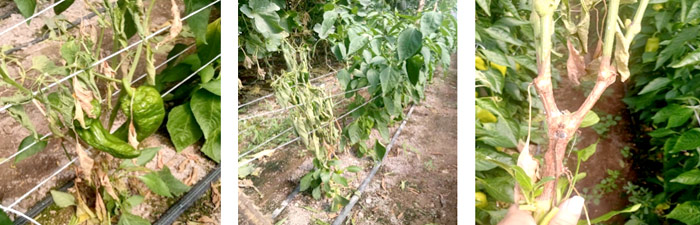
The first symptoms of the disease are observed in mid-May. Necrotic rings of various sizes form on the stem or first and second-order branches. The necroses enlarge and envelop part of the plants, causing wilting and drying of individual parts or the entire plant. On the fruits, during September and October, as they transition from technical to biological maturity, wet rot appears with a dense white growth of the pathogen, on which sclerotia of various shapes and sizes form.
Pathogen, life cycle
White dry stem rot of pepper is caused by the fungus Sclerotinia sclerotiorum (Lib.) De Bary and is a relatively new disease for this crop. Understanding the biology and life cycle of the phytopathogen allows for the establishment of an effective control system against this dangerous disease.
The life cycle of S. sclerotiorum consists of a vegetative (mycelium, sclerotia) and a sexual stage (apothecia with ascospores). The fungus overwinters in the soil as sclerotia, which can be preserved for more than seven years. The viability of sclerotia depends on many factors: soil type, depth of burial, temperature, moisture, and biological activity of the soil, ambient temperature, and sclerotia moisture. High soil moisture and relatively low positive daytime and nighttime temperatures (+2-8°C) during December-March create favorable conditions for the initiation of the pathogen's sexual stage. At air temperatures of +11-15°C and relative humidity of 70-90% (April, May), fruiting bodies - apothecia - form on sclerotia located in the upper soil layer. The optimal depth for apothecia formation is 2 cm. Apothecia form near the soil surface as small light brown to gray mushroom-like structures that produce ascospores, which are easily dispersed by air currents. The high viability of sclerotia is maintained at a depth of 10 cm and decreases at 30 cm. For this reason, agrotechnical soil treatment directly influences the infectious potential of the fungus S. sclerotiorum. Mycelium preserved on plant residues does not play a significant role in pathogenesis. When plowing the soil to a depth of 7 cm, the pathogen's mycelium completely perishes. During soil cultivation - deep plowing, chiseling, rotary tilling, bed formation - the pathogen's sclerotia are redistributed in the soil profile, with some of them ending up in the upper 2 cm and proceeding to form apothecia, while the rest are buried deep, where they can be stored for seven or more years.
The fungus S. sclerotiorum is a necrotrophic polyphage that primarily develops monocyclically in the open field. In unheated greenhouses with a long vegetation period, polycyclicity is observed during September, October, and November. Sclerotia germinate via mycelium and develop infectious hyphae in dead or aging tissues, which infect relatively young pepper shoots and leaves, fruits at biological maturity, as well as weed vegetation.
White Mold Control System
Effective control over white mold disease requires an integrated approach. The integrated control system includes adequate organizational measures aimed at regulating the pathogen density below the economic damage threshold. It consists of optimal management of technological parameters for pepper cultivation in growing facilities and the application of primary plant protection methods that determine disease prevention.
Organizational measures begin with the destruction of the previous crop. Plant residues are removed from the greenhouse and burned.
Crop rotation is not of significant importance for this disease. Pepper should not be grown after lettuce, an autumn-winter crop that is highly susceptible to white mold.
The wide host range of the pathogen S. sclerotiorum limits the effectiveness of various agrotechnical approaches capable of reducing the infection level in the soil (crop rotation, soil cultivation).
Currently, commercial pepper varieties do not have resistance to white mold infection. One of the most effective ways to prevent and control white mold in vegetable crops remains the use of fungicides. For pepper crops, registered fungicides for white mold control are few. As an alternative, the use of biofungicides containing antagonistic fungi and hyperparasites from the genera Trichoderma, Gliocladium, and Coniothyrium can be considered. Before the last rotary tilling, biofungicides Trianum G – 1.5 kg/dka and Contans WG – 0.4 kg/dka are incorporated. During the pepper's vegetation period, 35 days after transplanting, with optimal temperature and humidity, one or two treatments of the plants and soil surface are carried out with the fungicide Switch 62.5 WG - 100 g/dka at an interval of 10–12 days. The mentioned fungicides are licensed for use on peppers.
References:
- Georgiev, G. (1991). Possibilities for biological control of white mold on cucumbers in greenhouses. Symposium with international participation "Present and Future of Agriculture in Bulgaria". Plovdiv.
- Conrad, A.M., and Telenko, D. E. P. (2023). Efficacy of Biocontrol Agents Coniothyrium minitans and Bacillus amyloliquefaciens for Managing Sclerotinia sclerotiorum in Indiana Soybean. PhytoFrontiers, 3:3, 518–524.
- Purdy, L.H. (1979). Sclerotinia sclerotiorum. History, disease and symptomatology, host range, geographie distribution, and impact. Phytopathology, 8:875-880.
- Zeng, W. T., Wang, D. C., Kirk, W. & Hao, J. J. (2012b). Use of Coniothyrium minitans and other microorganisms for reducing Sclerotinia sclerotiorum. Biological Control, 60(2): 225–232.
- Sumida, C.H.; Daniel, J.F.S.; Araujod, A.P.C.S.; Peitl, D.C.; Abreu, L.M.; Dekker, R.F.H.; Canteri, M.G. (2018). Trichoderma asperelloides antagonism to nine Sclerotinia sclerotiorum strains and biological control of white mold disease in soybean plants. Biocontrol Sci. Technol., 28: 142–156.