Weed control in maize and sunflower crops
Author(s): гл. ас. д-р Зорница Петрова, Добруджански земеделски институт – Генерал Тошево, ССА
Date: 12.04.2024
4937
![MultipartFile resource [file_data]](/assets/img/articles/контрол-плевели-заглавна.jpg)
Summary
Long-term studies in our country show that maize and sunflower yields under moderate weed infestation decrease by 15-25%, and under heavy infestation by more than 40-50%. Severe weed infestation leads to a sharp reduction in yield and difficulties in the operation of the harvesting machinery. Grain losses increase, more energy is invested for harvesting per unit area, and the weed seed bank increases. A large number of weeds find very favourable conditions for growth and development in the crops. The Clearfield technology and the Express SUN technology are widely used in a number of sunflower hybrids.
Protecting maize and sunflower crops from weeds in the early stages of their development is of great importance, as it frees them from weed competition and reduces yield losses that occur when crops are infested with weeds.
Maize
Weeds in maize crops are controlled by soil-applied and post-emergence herbicides. For this purpose, there is a sufficiently large range of products with different mechanisms of action and application timings. It is necessary to know the species composition of the weeds in a given field in order to select the most appropriate herbicide and to comply with the recommended rate.
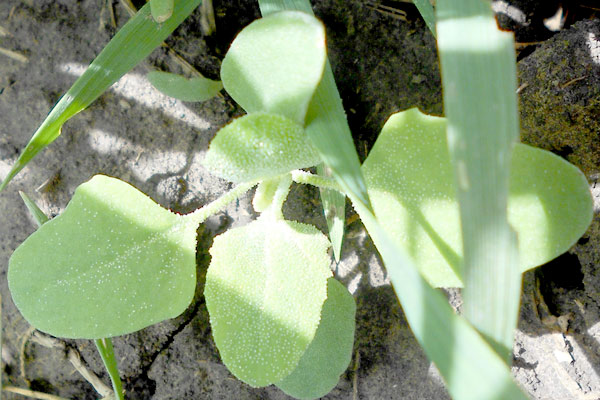
Common lambsquarters
Maize crops are most often infested by early weeds – wild mustard species, field bindweed (Fallopia convolvulus) and others, and among the late spring weeds competitors are green foxtail, common lambsquarters, barnyard grass, pigweed species, jimsonweed, black nightshade, field pansy, knotgrass, smartweed with dock-like leaves, sowthistle and others; among the grasses – blackgrass, wild oat and others.
Rhizomatous and root-suckering weeds such as johnsongrass, field bindweed, creeping thistle, spurge and others are massively increasing and spreading, which is usually due to shortcomings in agronomic practices – the use of rotary tillers and disc implements in the presence of rhizomatous weeds, improper crop rotation and, not least, incorrect and untimely use of herbicides, inaccurate doses and others.
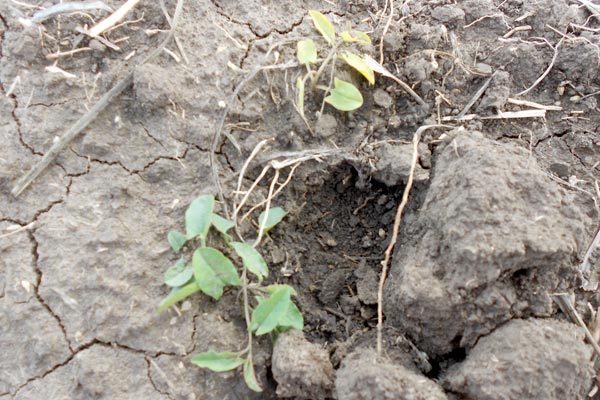
Field bindweed
Monoculture maize cultivation has its disadvantages – perennial weed species such as johnsongrass, field bindweed, etc. increase in number.
Weed control is more effective when agronomic and chemical measures are combined. Among the agronomic measures, crop rotation is of major importance. If heavy infestation with perennial weeds is found in the field, wheat and barley are included in the rotation, as they free the land earlier and provide opportunities for suitable soil tillage. In addition, mineral fertilisation should be balanced, sowing should be carried out within the optimal time window and as soon as possible after the last pre-sowing tillage. After sowing, rolling is recommended to ensure uniform emergence of maize plants, which crushes clods, levels the soil surface and thus ensures uniform distribution and effectiveness of soil-applied herbicides.
In the period after sowing and before maize emergence, herbicides with predominantly graminicidal action are applied to the soil.
Against annual grass and broadleaf weeds, including johnsongrass from seed, after sowing and before emergence of the crop, one of the following soil-applied herbicides may be used: Merlin Flex 480 SC – 42 ml/ha (the product is dependent on soil moisture in the period from sowing to emergence; if early drought occurs, the herbicide may be used at the beginning of emergence of the crop and weeds); Adengo 465 SC – 44 ml/ha, the product may also be applied early post-emergence at a rate of 35 ml/ha (Adengo is less dependent on soil moisture deficit); Lumax 375 SC – 300-400 ml/ha; Dual Gold 960 EC/Tender EC – 150 ml/ha; Stomp New 330 EC – 400 ml/ha; Stomp Aqua – 350-400 ml/ha; Kamix 560 SE – 200 and 250 ml/ha (effective even under insufficient soil moisture); Spectrum – 80-140 ml/ha; Pendigan 330 EC – 400 ml/ha; Gardoprim Plus Gold 500 SC/Silba SC – 400-450 ml/ha; Callisto 480 SC – 20 ml/ha; Pledge 50 WP – 8 g/ha.
Soil-applied herbicides destroy the majority of emerging weeds, and by removing them in the early stages of crop development, a well-established stand is ensured. However, their duration of action is about 40-50 days, after which secondary weed infestation begins and post-emergence application of herbicides becomes necessary.
Unlike soil-applied herbicides, post-emergence herbicides have low dependence on soil moisture.
Against annual and perennial grass weeds and annual broadleaf weeds, including johnsongrass from seeds and rhizomes, the crop may be treated with one of the following herbicides: Adengo 465 SC – 35 ml/ha (from sowing of maize until the 1st–2nd–3rd leaf stage of the crop and for grass weeds up to the 1st–2nd leaf stage before tillering, and for broadleaf weeds up to the first pair of true leaves); Lumax 375 SC – 300 ml/ha in the early weed growth stage (2–3 leaves); Laudis OD – 200 ml/ha at the 2nd–8th leaf stage of the crop, up to the 6th leaf of the weeds and at a johnsongrass height of 15–25 cm; Logos 4 SC – 125 ml/ha up to the 8th leaf stage of the crop and the 2nd–4th leaf of johnsongrass; Equip OD – 200–250 ml/ha at the 3rd–6th leaf stage of susceptible weeds – barnyard grass, common lambsquarters, redroot pigweed, prostrate pigweed, shepherd’s purse, knotgrass, common smartweed, black nightshade, jimsonweed; Callisto 480 SC – 20 ml/ha – post-emergence for maize and early weed stages; Merlin Flex 480 SC – 42 ml/ha at the 1st–3rd leaf stage of the crop; Principal – 9 g/ha + Trend – 0.1% (adjuvant) at the 2nd–8th leaf stage of the crop; Ventum WG – 10–15 g/ha + Mero – 200 ml/ha (adjuvant) at the 2nd–6th leaf stage of the crop; Mistral Extra 6 OD – 65–75 ml/ha at the 1st–8th leaf stage of maize, the 2nd–4th leaf of weeds and a johnsongrass height of 15–25 cm with 20–40 l spray solution per hectare (single application); Stomp Aqua – 350 ml/ha at the beginning of maize vegetation and up to the 2nd leaf of weeds; Monsun Active OD – 150 ml/ha at the 2nd–8th leaf stage of maize; Pendigan 330 EC – 400–600 ml/ha with 20–40 l water/ha.
The herbicides Adengo and Merlin Flex have UV protection, therefore they do not volatilise and are not degraded by direct sunlight.
Against broadleaf weeds the crops may be sprayed with one of the following herbicides: Magneto TOP 464 SL – 80–100 ml/ha at the 3rd–5th leaf stage of maize, including weeds slightly sensitive to hormone-like herbicides; Maton 600 EC – 110 ml/ha at the 3rd–5th leaf stage of maize; Kalimba – 60–75 ml/ha at the 3rd–5th leaf stage of the crop; Mustang 306.25 SC – 40–60 ml/ha at the 3rd–5th leaf stage of maize (the higher rate is applied in the presence of creeping thistle); Terminator 4 SC – 125 ml/ha up to the 8th leaf stage of maize, 2–4 leaf stage of johnsongrass (from seed and rhizomes).
Against annual and perennial broadleaf weeds Casper 55 WG – 30 g/ha may be used at the 3rd–8th leaf stage of maize, at the 2nd–4th leaf stage of annual weeds, 4–6 leaves (rosette) in perennials and 15 cm height of field bindweed (up to flowering).
Sunflower
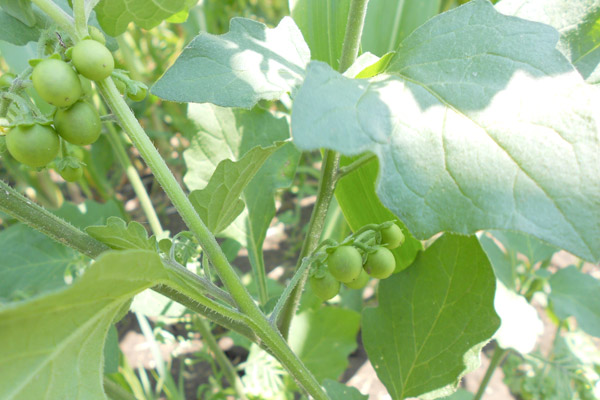
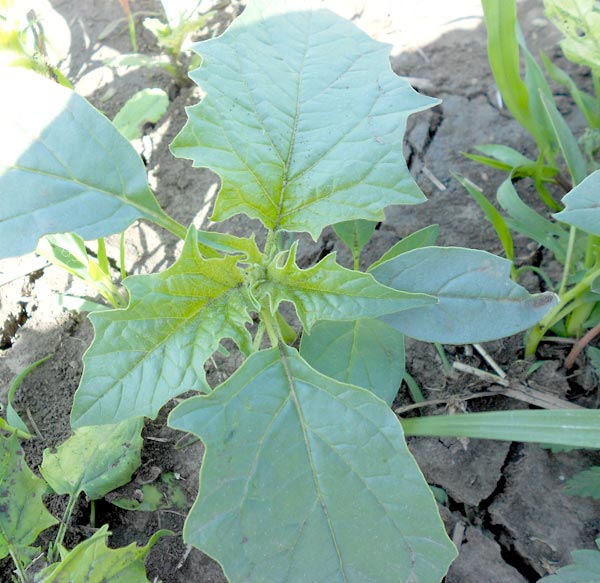
Black nightshade
Sunflower crops are infested with more than 130 species of weeds. The most widespread annual weeds are redroot and prostrate pigweed, wild mustard, common lambsquarters, black nightshade, green foxtail species, barnyard and panic grass, purslane, knotgrass, shepherd’s purse, sowthistle, and among the perennials – johnsongrass, field bindweed, creeping thistle.
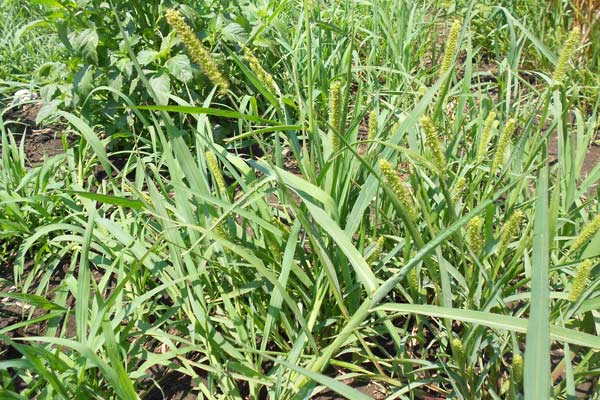
Green foxtail
Some new races of broomrape (Orobanche cumana) also create problems.
Sunflower is highly sensitive to weed infestation in the early phenological stages of its development. The presence of weeds causes a decrease in dry matter, thinning of the stands and yield reduction.
In sunflower, successful weed control depends to a large extent on early deep ploughing after harvesting the preceding crop and on additional summer–autumn tillage, and among the spring pre-sowing operations – the first cultivation.
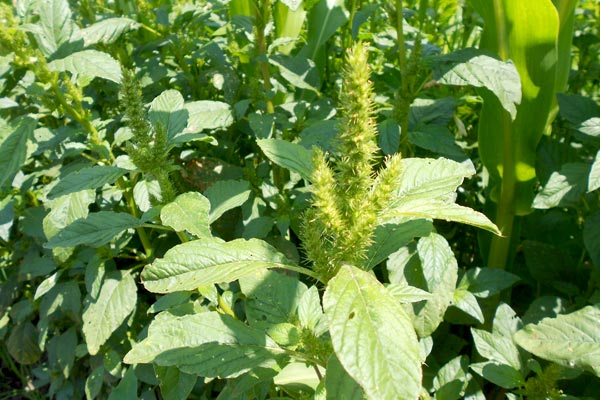
Redroot pigweed
Chemical weed control is carried out with a large range of herbicides with different mechanisms of action and different application timings.
Against annual grass and broadleaf weeds, soil-applied herbicides may be applied after sowing and before emergence of the crop, choosing one of the following: Gardoprim Plus Gold 500 SC/Silba SC – 350 ml/ha; Stomp New 330 EC – 400 ml/ha; Stomp Aqua – 350–400 ml/ha; Pendigan 330 EC – 400–600 ml/ha with 20–40 l water/ha; Frontier Super/Spectrum – 80–140 ml/ha; Pledge 50 WP – 8 g/ha; Dual Gold 960 EC/Tender EC – 150 ml/ha, including against johnsongrass from seed.
For soil application of herbicides, the requirement for very good soil preparation must be observed – without clods, plant residues and with normal soil moisture, in order to achieve the necessary effect.
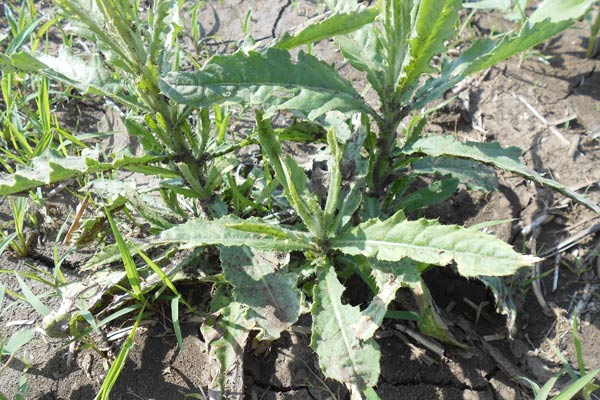
Creeping thistle
Post-emergence, against grass weeds, including perennials, the crop may be treated with one of the following herbicides: Agil 100 EC/Shogun 100 EC – 80 ml/ha at the 3rd–5th leaf stage of the weeds; Select Super 120 EC – 80–160 ml/ha; Select 240 EC – 40 ml/ha + Amigo – 80 ml/ha (adjuvant); Pantera 40 EC/Rango 40 EC/Panarex – 150–175 ml/ha; Leopard 5 EC/Navigator 5 EC – 150–200 ml/ha; Focus Ultra/Stratos Ultra – 200 ml/ha; Targa Super 5 EC – 150–200 ml/ha; Fusilade Forte – 80–130 ml/ha.
Against annual grass and broadleaf weeds, according to the Clearfield technology with sunflower hybrids, the crop may be treated post-emergence with Pulsar 40/Listengo 40/Pasat 40 – 120 ml/ha at the 2nd–6th leaf stage of the crop; Pulsar 40/Listengo 40/Pasat 40 – 120 ml/ha + DES – 50 ml/ha (adjuvant) for imidazolinone-tolerant hybrids (including against johnsongrass from rhizomes and creeping thistle) at the 2nd–6th leaf stage of sunflower; Pulsar 40/Listengo 40/Pasat 40 – 120 ml/ha + Stomp New 330 EC – 230 ml/ha at the 2nd–3rd pair of leaves of the imidazolinone-tolerant hybrid Rimi (also effective against broomrape), Pulsar Plus – 120–200 ml/ha in sunflower hybrids tolerant to imidazolinones/imazamox, including Clearfield and Clearfield Plus hybrids.
Under the Express SUN technology the herbicide Express 50 SG – 4 g/ha controls weeds such as creeping thistle, jimsonweed, black nightshade, sowthistle and others. The best effect is obtained on actively growing weeds in their early stages (for creeping thistle at a height of 15 cm, and for sowthistle at the 2nd–4th leaf stage), with an even stand, when the smallest sunflower plants are at the 2nd true leaf stage. The adjuvant Trend 90 – 0.1% must be added, which improves the herbicidal effect by helping the spray solution to distribute evenly on plant surfaces. Treatment of sunflower crops must be completed by the 8th leaf stage.
High yields and quality of maize and sunflower are obtained by observing the above-mentioned measures and plant protection products.
References:
- Limagrain offers a phenomenal solution for protecting sunflower from weeds!, 2004, Stopanin, No. 31, pp. 2–8.
- Sunflower without weeds!, 2000, No. 12, pp. 11–12.
- Roundup – Biosila offers a new technology for weed control in maize, 1999, No. 17, p. 6.
- The herbicide Merlin – the most significant achievement in weed control in maize from Bayer CropScience, 2003, Agronom, No. 3, p. 22.
- The Roundup Ready technology is a revolution in weed control in maize, 2000, Plant Protection, No. 3, p. 14.
- Possibilities for weed control in maize, 1998, No. 2, pp. 21–22.