Pests Affecting the Underground Parts of Fruit Crops and Strawberry
Author(s): проф. д.с.н. Ангел Харизанов
Date: 06.01.2024
10454
![MultipartFile resource [file_data]](/assets/img/articles/заглавна-овощни-1.jpg)
The increase in the areas planted with stone fruit species, in nurseries for the production of planting material, and the insufficient care for old orchards create conditions for an increase in the population density of harmful insects and other pests damaging the underground parts of the plants. Observations in recent years in the regions of Plovdiv, Pazardzhik and Stara Zagora have shown that the larvae of the black and copper flatheaded borers are the most common pests, followed by those of leaf-feeding beetles and, to a lesser extent, by “wireworms” and some other pests.
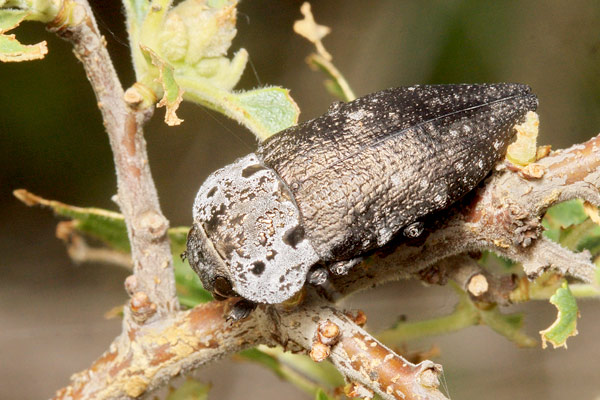
The black flatheaded borer is widespread throughout Bulgaria, but occurs in higher numbers in Southern Bulgaria compared to Northern Bulgaria and the other parts of the country. Its density is highest near rose plantations, dog rose, hawthorn, blackthorn and on light and sandy soils. The larvae feed on the roots of blackthorn, myrobalan plum, plum, peach, sweet cherry, apricot, sour cherry, almond, mirabelle, nectarine, dog rose, hawthorn, oil-bearing rose and to a limited extent on the roots of pome fruit species. In fruit tree nurseries the roots of plum, apricot and peach are most severely damaged, while in bearing orchards – those of sweet cherry, peach and apricot.
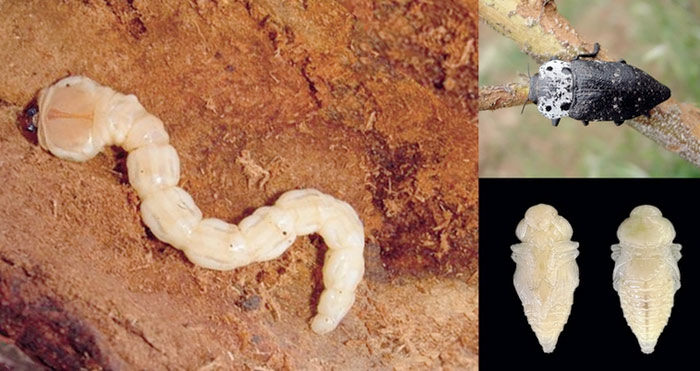
In nurseries the larvae bore into the fine roots of the seedlings and excavate galleries, feeding on the wood without affecting the bark. In plum seedlings the entry hole is easily visible because of the thin bark, but in peach and apricot it is more difficult to detect due to the thicker bark. When the bark is torn, larvae and frass can be seen in the gallery. The damaged seedlings most often dry out. In two- and three-year-old trees the larvae bore into the taproot below the root collar, gnawing the wood in the form of a longitudinal gallery together with the cambial layer. The damage is visible through the wilting leaves and the drying of entire trees.
On the roots of bearing sweet cherry, peach, plum and other species of trees, a large number of larvae cause damage – several dozens, and in some cases even more. In such heavy infestations, the leaves in the upper part of the canopy fall off, the plants weaken and dry out after a few years.
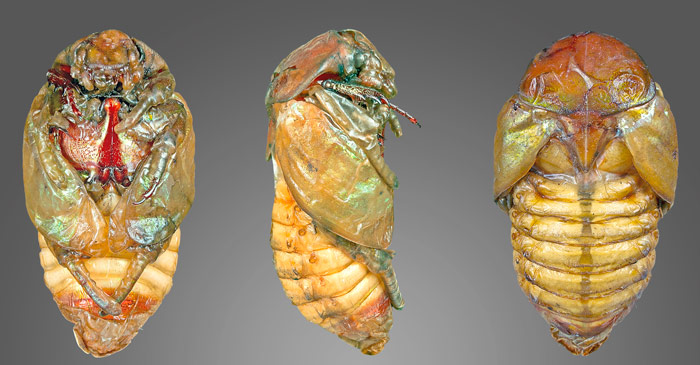
The black flatheaded borer develops one generation in about two years and overwinters as larvae of different ages and as adults. Overwintered beetles appear on blackthorn, hawthorn and dog rose as early as the second half of April in warm and sunny weather. They fly with a buzzing sound and land on the trees noisily, crawl actively, fly away when touched, and when branches are shaken they fall onto the soil surface and remain motionless. Early in the morning they climb up the trunk of the trees, gnaw and sever the petioles of the leaves, causing massive defoliation; they gnaw the buds at the base of the petiole and feed on the bark of young branches and shoots. The feeding period until the beginning of egg laying lasts for more than two months – until mid- and late June. The pest lays eggs when the air temperature is permanently above 22–23 ˚C, and mass oviposition occurs in July and August. The eggs are laid around the root collar of young trees and mature trees, in bark cracks at a height of 10–15 cm above the soil surface and are glued with a secretion from the accessory sex glands, as well as on the soil surface at a distance of 10–20 cm from the base of the trunk. The egg is large – 1.5 mm long, white and easily visible on the bark, but difficult to see on the soil because of the soil particles adhering to it. Egg production varies from 60 to 776 (some authors report from 200 to 2,500 eggs laid). The egg stage lasts 10–25 days, and the larval stage – 12–13 months. High humidity has an adverse effect on the eggs and young larvae. The larvae bore just below the root collar, gnaw the bark on the trees and penetrate into the taproot, which they tunnel. The larvae hatched from eggs laid on the soil surface feed on the lateral roots. Overwintered larvae pupate in July and the first half of August, and the beetles emerge in the third ten-day period of July and in August. Adults appear in two periods – in April–early May and at the end of July and in August.
The copper flatheaded borer in Southern Bulgaria shows a trend of increasing population density and harmful activity compared to the black flatheaded borer. The larvae mainly damage apricot, peach and plum. A characteristic feature of this pest is that the larvae do not bore into the taproot below the soil surface, but gnaw the bark and wood of the above-ground part around the root collar. The species develops one generation per year and overwinters as larvae on the roots of the damaged plants.
The common flatheaded borer is a dangerous pest of fruit trees, but at the same time the saprophytic larvae of the borer are the equivalent of the earthworm, transforming the decaying mixture of organic matter and plant residues on which they feed into excellent compost.
The beetles appear at the end of April – in the first ten days of May and most often establish themselves on dog rose, pear and hawthorn. They cause damage similar to that of the beetles of the black flatheaded borer, lay their eggs in June and July, placing them in clusters of several dozen up to 100 per cluster at the base of the trunk – around the root collar. The larvae develop within 9–10 months.
Related species of the black flatheaded borer are: Capnodis tenebucosa Ol and C. cariosa Pall. The first species is smaller, and the second – larger than the black flatheaded borer, but they have the same biology and cause damage in the same way. Control is difficult due to the concealed way of life of the larvae of the black flatheaded borer and the lack of registered products against the adults of both species. In the past, fumigation with carbon disulfide according to a special method was applied against the larvae, and products that have long since been withdrawn from the market were used against the adults.
Regular observations must be carried out on the phenology of the beetles, egg laying and larval hatching. Shrubs of blackthorn, dog rose and hawthorn in the vicinity of nurseries and areas intended for new stone fruit orchards must be destroyed. High standards of crop husbandry should be maintained in the cultivation of stone fruit species in orchards and in nurseries for the production of fruit planting material. The production of planting material must be strictly controlled – only trees fully complying with the Bulgarian State Standard (height of the above-ground part of the stem, thickness at 15 cm from the grafting point, number and length of roots and freedom from pests) should be planted. Trees should be shaken (where possible), and the beetles collected and destroyed.

The underground parts of fruit trees are mainly damaged by the larvae of the common cockchafer and the marbled chafer. They cause the most severe damage to the roots of sweet cherry, pear and apple, to young trees in nurseries and those planted in permanent sites, by gnawing and consuming the wood. In bearing trees, the gnawing may extend to 20 cm and more. First-instar larvae initially feed on humus substances and later gnaw young rootlets, while second- and third-instar larvae feed exclusively on the roots.
On the roots of bearing trees several dozen larvae cause damage, which initially leads to heavy leaf fall (defoliation of the upper storey of the crown), and later – to the drying of trees in fruit and forest nurseries. When the taproot is damaged, the trees dry out.
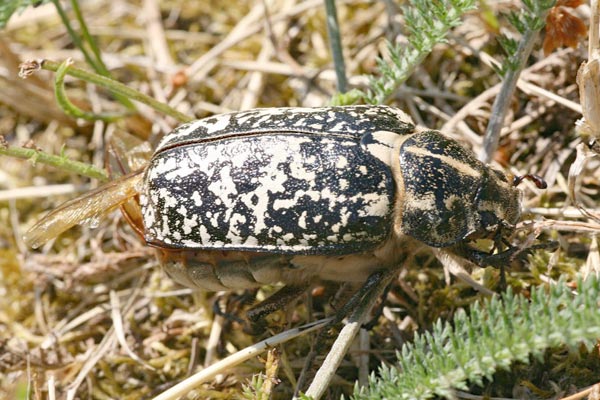
marbled chafer
Both beetle species prefer light and sandy soils with decaying vegetation and soils heavily manured with farmyard manure. They are polyphagous and the damage they cause to the roots of fruit trees is significantly less than that of the black and copper flatheaded borers. They are evolutionarily ancient, lay a small number of eggs and develop one generation in about 3 years. Their control is similar to that of the flatheaded borers: monitoring of beetle flight, egg laying and larval hatching, destruction of weed vegetation, cleaning of areas from decaying materials (straw, plant residues, etc.), high standards of crop husbandry and frequent irrigation of nurseries during the period of mass egg laying and larval hatching. Against the common cockchafer Deka EC is applied, and against it and other leaf-feeding beetles – Meteor.
The underground parts of trees in nurseries and of young trees planted in permanent sites are also slightly damaged by wireworms. Against them, in addition to agrotechnical measures, Ercole GR or Trika Expert GR may be applied at planting; these products are also toxic to the larvae of leaf-feeding beetles.
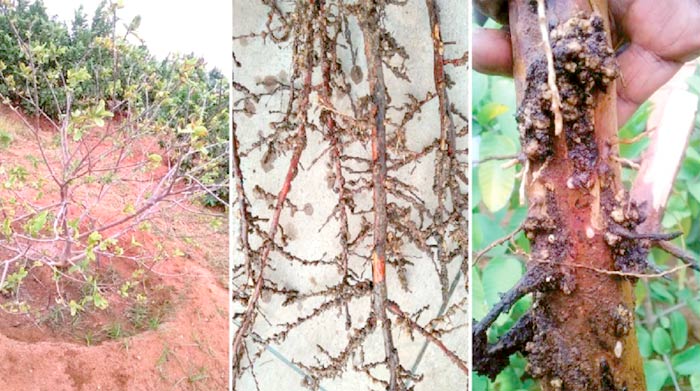
The underground parts of trees in nurseries and of bearing trees are also infected and damaged by nematodes Meloidogyne spp., Xiphinema spp, Pratylenchus spp and others, which necessitates soil testing for nurseries and new orchards to determine the nematode status.
The underground parts of the strawberry plant – rhizome (modified stem and strongly branched roots) are attacked by larvae of cockchafers, the wheat June beetle; larvae of various species of wireworms; pollen beetles; weevils and others, but the most severe damage is caused by the larvae of the common cockchafer and the strawberry root weevil – Otiorrhynchus rugosostriatus Goeze. The larvae of the cockchafer gnaw and sever the roots of the plants and excavate galleries in the rhizome. The damage occurs in patches; the affected plants grow poorly, produce small and low-quality fruits or completely dry out. The larvae of the strawberry root weevil cause similar damage; in light infestations the plants flower and bear fruit, but the fruits are small, discoloured and most often dry out during the ripening period. The species develops one generation per year and overwinters as an adult female beetle.
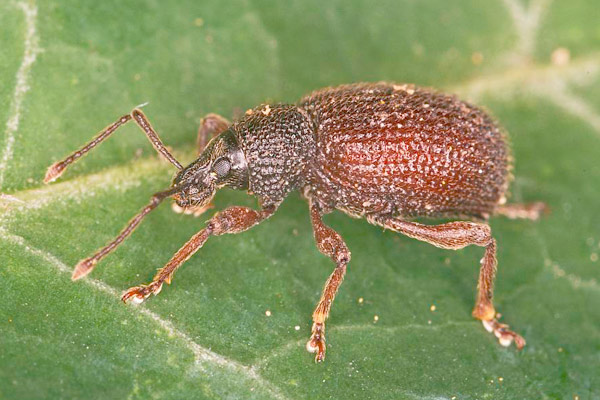
Control of leaf-feeding beetles and the strawberry root weevil is based solely on agrotechnical measures – selection of a site for the production of planting material and fruits, planting of healthy and high-quality seedlings fully complying with the Bulgarian State Standard; cleaning of areas from decaying plant parts, etc. and from straw; application of high standards of crop husbandry, systematic monitoring of the health status of the plantations; timely destruction of infested plants and the larvae on them, and other measures.